

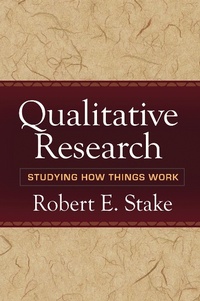
Qualitative Research
Description

Graduate students in education, psychology, sociology, social work, management, and nursing; qualitative researchers and evaluators. Will serve as a core book in doctoral-level courses such as Qualitative Methods and Qualitative Dissertation/Proposal Writing, and as a supplemental text in graduate-level Research Design courses.
More details
Other editions
Additional editions
Person
Robert E. Stake is Director of the Center for Instructional Research and Curriculum Evaluation at the University of Illinois at Urbana-Champaign. He is one of several educational researchers who created theory and practice for educational program evaluation in the 1960s. His responsive evaluation approach emphasizes the study of classroom experience, personal interaction, and institutional processes and contexts, often in the form of case studies. Among the evaluative studies he has directed are studies in science and arts education; model programs; and conventional teaching, including higher education, special education and, with Bernadine Evans Stake, gender equity. He is a recipient of the Special Career Award in Qualitative Inquiry from the International Congress for Qualitative Inquiry, the Lazarsfeld Award from the American Evaluation Association, and the Presidential Citation from the American Educational Research Association, and holds honorary doctorates from the University of Uppsala, Sweden, and the University of Valladolid, Spain. For many years, Dr. Stake has been a prominent voice in a transatlantic "invisible college" of like-minded evaluators questioning contexts and conventions for educational evaluation and infusing evaluation with fairness and a valuing of experience.
Content
Introduction: Make Yourself Comfortable
1. Qualitative Research: How Things Work
2. Interpretation: The Person as Instrument
3. Experiential Understanding: Most Qualitative Study Is Experiential
4. Stating the Problem: Questioning How This Thing Works
5. Methods: Gathering Data
6. Review of Literature: Zooming to See the Problem
7. Evidence: Bolstering Judgment and Reconnoitering
8. Analysis and Synthesis: How Things Work
9. Action Research and Self-Evaluation: Finding on Your Own How Your Place Works
10: Storytelling: Illustrating How Things Work
11. Writing the Final Report: An Iterative Convergence
12. Advocacy and Ethics: Making Things Work Better
