

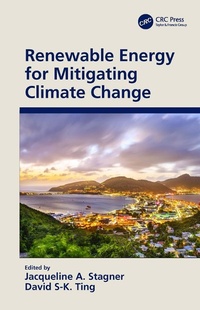
Renewable Energy for Mitigating Climate Change
1st Edition
Published on 24. November 2021
234 pages
978-1-000-48384-0 (ISBN)
Description

Based on state-of-the-art science and technologies, this book disseminates the latest advancements concerning the relationship between renewable energy and climate change and presents the best practices to further utilize renewable energy for mitigation. It examines issues of climate change from different renewable energy fronts by the respective experts from around the world. While high-level and in-depth technological advancements are judiciously presented, it also discusses different types of renewable energy and the associated technologies in consideration of the various perspectives of economy, availability, and societal implications in different regions.
Features:
Discusses the concept of leapfrogging renewable energy technologies in developing countries for the purpose of minimizing human-induced climate change impacts as rapidly as possible
Includes various options from high technology to sustainable agriculture
Presents and compares the latest novel and emerging potential technologies
Outlines how to advance renewable energy by improving energy storage and optimizing financial incentives and management
Renewable Energy for Mitigating Climate Change enlightens readers from a renewable energy perspective on how to best tackle the challenges of climate change. This is a must-read for senior undergraduate and graduate students in environmental studies, decision- and policymakers, educators, and every environmental steward. The interests of all stakeholders, especially future generations, form the thread connecting all the chapters together into a powerful tool to mitigate global climate change.
Features:
Discusses the concept of leapfrogging renewable energy technologies in developing countries for the purpose of minimizing human-induced climate change impacts as rapidly as possible
Includes various options from high technology to sustainable agriculture
Presents and compares the latest novel and emerging potential technologies
Outlines how to advance renewable energy by improving energy storage and optimizing financial incentives and management
Renewable Energy for Mitigating Climate Change enlightens readers from a renewable energy perspective on how to best tackle the challenges of climate change. This is a must-read for senior undergraduate and graduate students in environmental studies, decision- and policymakers, educators, and every environmental steward. The interests of all stakeholders, especially future generations, form the thread connecting all the chapters together into a powerful tool to mitigate global climate change.
More details
Edition
1. Auflage
Language
English
Place of publication
London
United Kingdom
Publishing group
Taylor & Francis Ltd
Target group
Professional and scholarly
Illustrations
28 Tables, black and white; 41 Line drawings, black and white; 21 Halftones, black and white; 62 Illustrations, black and white
ISBN-13
978-1-000-48384-0 (9781000483840)
Copyright in bibliographic data and cover images is held by Nielsen Book Services Limited or by the publishers or by their respective licensors: all rights reserved.
Schweitzer Classification
Other editions
Additional editions
Jacqueline A. Stagner | David S-K. Ting
Renewable Energy for Mitigating Climate Change
Book
08/2024
1st Edition
CRC Press
€71.70
Shipment within 10-20 days
Jacqueline A. Stagner | David S-K. Ting
Renewable Energy for Mitigating Climate Change
Book
11/2021
1st Edition
CRC Press
€131.90
Shipment within 15-20 days
Persons
Dr. Jacqueline A. Stagner is the Undergraduate Programs Coordinator of Engineering at the University of Windsor. She has a PhD in Materials Science and Engineering, a Master of Business Administration, and a bachelor's degree in Mechanical Engineering. As an adjunct graduate faculty member in the Department of Mechanical, Automotive and Materials Engineering, she co-advises students in the sustainability and renewable energy areas, in the Turbulence & Energy Laboratory. To date, she has edited four volumes.
Dr. David S-K. Ting is the founder of the Turbulence & Energy Laboratory, University of Windsor. As a professor in the Department of Mechanical, Automotive and Materials Engineering, he supervises students on a wide range of research projects in the thermofluids, flow turbulence, energy conversion and conservation, and renewable energy areas. Professor Ting has supervised over eighty-five graduate students and co-authored more than one hundred and fifty journal papers.
Dr. David S-K. Ting is the founder of the Turbulence & Energy Laboratory, University of Windsor. As a professor in the Department of Mechanical, Automotive and Materials Engineering, he supervises students on a wide range of research projects in the thermofluids, flow turbulence, energy conversion and conservation, and renewable energy areas. Professor Ting has supervised over eighty-five graduate students and co-authored more than one hundred and fifty journal papers.
Content
Chapter 1. Furthering Renewable Energy for Climate Change Mitigation : Case Study on the Implementation in Eco-Industrial Estates in Thailand. Chapter 2. Estimation of Global Solar Energy to Mitigate World Energy and Environmental Vulnerability. Chapter 3. Energy Storage: A Practical Solution to Increase Wind Energy Integration in the United States Electricity Sector. Chapter 4. Investigating the Electricity Portfolio Optimization for Renewable Energy Sources. Chapter 5. The Impact on Energy Efficiency of Traditional Natural Stones for Sustainable Architecture: The Case of Authentic Restaurant in Harput Region. Chapter 6. Limits of Waste Materials on Concrete Mixture Base Using Digital Design and Fabrication Techniques. Chapter 7. Remote 3D Printing Efficiency in Clay-based Materials Integration in Sustainable Architectural Design to Production. Chapter 8. Employing Columba livia Swarmal behavioral patterns in the design of self-sufficient Photo Bioreactor of Chlorella Spp mass cultivation in Placa de Catalunya. Chapter 9. Addressing agricultural pressures on water resources: A DEA environmental assessment in the case of European transboundary basins. Chapter 10. The Viability of Nuclear Power as an Alternative to Renewables for Clean Energy for Climate Change Mitigation.
