

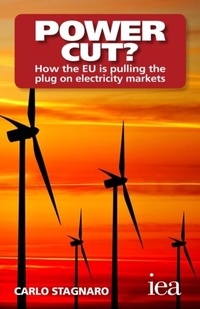
Power Cut?
How the EU Is Pulling the Plug on Electricity Markets
1st Edition
Published on 17. December 2015
174 pages
978-0-255-36717-2 (ISBN)
Description

By any measure, the privatisation and liberalisation of the UK energy industry was an enromous success. And yet the public are not convinced. As energy expert Carlo Stagnaro shows in this important book, the re-regulation of the market in the UK, together with policy developed at the EU level, has undermined all the important developments of the 1990s and early 2000s. The result has not only been poorer outcomes in the energy market but a very inefficient approach to reduce carbon dioxide emissions. The EU has also only been partially successful in promoting liberalisation and competition in electricity markets and the time is ripe for change. The author shows how the EU must learn the lessons from the UK's successful recent past - and the UK must re-learn them. Therein lies the route to a competitive energy market that serves the ends of consumers rather than the ends of politicians and other interest groups.
More details
Other editions
Additional editions
Book
12/2015
Institute of Economic Affairs
€14.50
Shipment within 10-20 days
Person
Carlo Stagnaro is Senior Fellow of Istituto Bruno Leoni, of which he was Research and Studies Director until April 2014. He currently heads the technical secretariat of Italy's Minister of Economic Development, Ms Federica Guidi. After graduating in Environmental Engineering at the University of Genoa, he achieved a PhD in Economics, Markets and Institutions from IMT Alti Studi - Lucca. His research interests are in the fields of energy economics, public service economics, and liberalisation and privatisation processes. His Twitter account is @CarloStagnaro. The ideas and opinions expressed in this monograph belong to the author alone, and do not necessarily reflect those of the institutions with which he may work or cooperate.
Content
- Intro
- Box?1 Carbon taxes versus cap-and-trade schemes
- Box?2 Institutions matter
- Box?3 The natural monopoly problem
- Figure?1 EU28's gross inland consumption of energy by source (2013, left panel) and gross electricity generation by source (2013, right panel)
- Figure?2 Transmission and distribution grids within the power industry
- Figure?3 Supply and demand curves in the Italian Power Exchange (IPEX) on 10 December 2014 at 12 a.m.
- Figure?4 EU legislative framework for energy
- Figure?5 Regulatory conditions in the electricity sector (1975-2013) in Europe
- Figure?6 Renewable energy as a share of electricity generation compared with 2010 plans ('target')
- Figure?7 Main renewable energy support instruments in the EU27
- Figure?8 Average support to renewable energy production in the EU [?/MWh] by country
- Figure?9 Average support to renewable energy production in the EU(?/MWh) by technology
- Figure?10 Average CO2 abatement cost in some EU member states
- Figure?11 Share of renewable and non-renewable electricity production in EU28
- Figure?12 Hourly prices of power in the day-ahead market in Italy for the Sicily market zone on Wednesday, 12 May 2010 (left) and 14 May 2014 (right)
- Figure?13 Installed generating capacity by source (bars, left axis) versus final electricity consumption (line, right axis) in the EU28
- Figure?14 Energy-related CO2 emissions per capita and CO2 intensity in selected regions
- Table?1 Achievements of EU electricity directives
- Table?2 Overview of RES electricity support instruments by country and technology
- The author
- Foreword
- Acknowledgment
- Summary
- Tables, figures and boxes
- 1 Introduction
- Complex supply chains and state monopolies
- Tackling environmental concerns
- Summary
- PART 1
- The Theoretical Framework
- 2 The climate-energy nexus
- Carbon emissions and energy
- Are climate change policies inconsistent with broadly free markets?
- 3 Electricity - from power station to household
- Power systems
- 4 The natural monopoly problem in electricity
- Has technological progress killed the 'natural monopoly' argument?
- 5 Market clearing and the problem of renewables
- How the electricity market clears
- PART 2
- Liberalisation in Advance and Retreat
- 6 The EU before the 'liberalisation' of electricity
- The rise of the European regulatory state
- The European Commission's role in 'promoting' a 'free market' in energy
- 7 Liberalising electricity markets the British way
- The core of the British model
- The British retreat from the British model
- Price controls and interference in industrial structure
- Electricity market reform - back to central planning
- PART 3
- The EU, Electricity Deregulation and climate-driven Regulation
- 8 Liberalising electricity markets the EU way
- The first liberalisation package
- The second liberalisation package
- The third liberalisation package
- 9 Environmental regulation: the empire strikes back
- Renewable energy: environmental policy or industrial policy?
- The first renewable energy sources directive
- The second renewable energy sources directive
- 10 Environmental regulation - achieving carbon reduction at a high cost
- The cost of renewable support schemes
- Directives pulling in opposite directions
- PART 4
- Electricity Liberalisation Versus Climate Interventionism
- 11 Distortions from subsidies for renewables
- Price distortions
- Quantity distortions
- Quality distortions
- 12 The new world of overcapacity
- 13 Capacity support schemes: the wrong answer
- Do markets under-supply reliability?
- Second-best interventions
- Defects of capacity remuneration mechanisms
- Capacity schemes in practice
- Providing capacity in the market
- PART 5
- From Planning to Market
- 14 The EU 2030 climate and energy policy framework: one step forward, one step back
- Good news and bad news from the 2030 package
- Why did the emissions trading system 'fail'?
- Challenges for emissions trading system reform
- 15 The way forward: laissez-faire
- Cutting carbon emissions the expensive way
- Cutting greenhouse gases efficiently
- Summary
- 16 Conclusion
- From state control to liberalisation in the UK
- Attempts at liberalisation in the EU
- Misconceived climate policies
- Fundamental misunderstandings
- References
- About the IEA
