

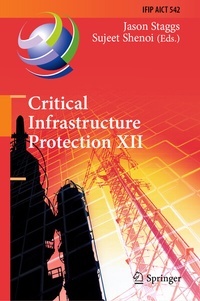
Critical Infrastructure Protection XII
Description

The information infrastructure - comprising computers, embedded devices, networks and software systems - is vital to operations in every sector: chemicals, commercial facilities, communications, critical manufacturing, dams, defense industrial base, emergency services, energy, financial services, food and agriculture, government facilities, healthcare and public health, information technology, nuclear reactors, materials and waste, transportation systems, and water and wastewater systems. Global business and industry, governments, indeed society itself, cannot function if major components of the critical information infrastructure are degraded, disabled or destroyed.
Critical Infrastructure Protection XII describes original research results and innovative applications in the interdisciplinary field of critical infrastructure protection. Also, it highlights the importance of weaving science, technology and policy in crafting sophisticated,yet practical, solutions that will help secure information, computer and network assets in the various critical infrastructure sectors. Areas of coverage include: Themes and Issues; Infrastructure Protection; Infrastructure Modeling and Simulation; Industrial Control Systems Security.
This book is the twelfth volume in the annual series produced by the International Federation for Information Processing (IFIP) Working Group 11.10 on Critical Infrastructure Protection, an international community of scientists, engineers, practitioners and policy makers dedicated to advancing research, development and implementation efforts focused on infrastructure protection. The book contains a selection of fifteen edited papers from the Twelfth Annual IFIP WG 11.10 International Conference on Critical Infrastructure Protection, held at SRI International, Arlington, Virginia, USA in the spring of 2018.
Critical Infrastructure Protection XII is an important resource for researchers, faculty members and graduate students, as well as for policy makers, practitioners and other individuals with interests in homeland security.
More details
Other editions
Additional editions
Content
- Intro
- Contents
- Contributing Authors
- Preface
- THEMES AND ISSUES
- 1 A THEORY OF HOMELAND SECURITY
- 2. Previous Work
- 3. Correlating Factor
- 4. Unique Mission
- 5. Proposed Theory
- 6. Descriptive Theory
- 7. Prescriptive Theory
- 8. Predictive Theory
- 9. Implications
- 10. Conclusions
- References
- 2 AN EVIDENCE QUALITY ASSESSMENTMODEL FOR CYBER SECURITYPOLICYMAKING
- Abstract
- Keywords
- 1. Introduction
- 2. Evidence and Policy Challenges
- 3. Assessing Evidence Quality
- 3.1 Subject Interviews
- 3.2 Evidence Source
- Data Sources
- Human Sources
- 3.3 Evidence Credibility
- Methodology
- Provider
- 3.4 Evidence Quality Assessment Model
- 4. Model Analysis
- 4.1 Sample Selection
- 4.2 Scoring Analysis
- NCSC Weekly Threat Report (E-1)
- CVE-2014-0160 (E-2)
- BBC 2017 (E-3)
- 5. Conclusions
- Acknowledgement
- References
- 3 LIABILITY EXPOSURE WHEN3D-PRINTED PARTSFALL FROM THE SKY
- Abstract
- Keywords
- 1. Introduction
- 2. Related Work
- 2.1 Additive Manufacturing Security
- 2.2 Liability Exposure
- 3. Attack Scenario
- 3.1 Additive Manufacturing Workflow
- 3.2 Sabotage Attack
- 4. Liability Analysis Framework
- 5. Liability Analysis
- 5.1 End User (Adversary Attack Layer 1)
- 5.2 Bystander (Adversary Attack Layer 1)
- 5.3 End User (Adversary Attack Layer 2)
- 5.4 Bystander (Adversary Attack Layer 2)
- 6. Discussion
- 6.1 Liability between Process Chain Elements
- 6.2 Corporate Criminal Liability
- 6.3 Nation-State Actors
- 7. Conclusions
- References
- INFRASTRUCTURE PROTECTION
- 4 ERROR PROPAGATION AFTERREORDERING ATTACKS ONHIERARCHICAL STATE ESTIMATION
- Abstract
- Keywords
- 1. Introduction
- 2. Related Work
- 3. Power System State Estimation
- 4. Hierarchical State Estimation
- 5. Three-Level Simplification
- 6. Attack Model
- 7. Reordering Attack Cost and Impact
- 8. Experimental Results
- 9. Conclusions
- References
- 5 SECURING DATA IN POWER-LIMITEDSENSOR NETWORKS USINGTWO-CHANNEL COMMUNICATIONS
- Abstract
- Keywords
- 1. Introduction
- 2. Background
- 2.1 Data Threats
- 2.2 Encryption Overhead
- 2.3 Two-Channel Communications
- 3. Proposed Methodology
- 3.1 Threat Scenario Development
- 3.2 Eavesdropping Scenario
- 3.3 Data Modification Scenario
- 3.4 Packet Structure Development
- 4. Conclusions
- References
- 6 REVERSING A LATTICE ECP3 FPGAFOR BITSTREAM PROTECTION
- Abstract
- Keywords
- 1. Introduction
- 2. Background
- 2.1 Field Programmable Gate Arrays
- 2.2 Bitstream Synthesis
- 2.3 Critical Infrastructure Applications
- 2.4 FPGA Threats
- 3. Reverse Engineering Methodology
- 3.1 Target System
- 3.2 Input/Output Block Reversal
- 3.3 Configurable Logic Block Reversal
- 3.4 Bitstream Modification Attack
- 4. Experimental Results
- 5. Conclusions
- References
- 7 PROTECTING INFRASTRUCTURE DATAVIA ENHANCED ACCESS CONTROL,BLOCKCHAIN AND DIFFERENTIALPRIVACY
- Abstract
- Keywords
- 1. Introduction
- 2. Motivating Scenarios
- 2.1 Scenario 1: Emergency Services Sector
- 2.2 Scenario 2: Healthcare Sector
- 3. Background
- 3.1 Access Control
- 3.2 Blockchain
- 3.3 Differential Privacy
- 4. Design and Implementation
- 4.1 System Architecture
- 4.2 Queries by Different Types of Analysts
- 4.3 Implementation Details
- 5. Preliminary Analysis
- 6. Conclusions
- Acknowledgements
- References
- 8 A NEW SCAP INFORMATION MODELAND DATA MODEL FOR CONTENTAUTHORS
- Abstract
- Keywords
- 1. Introduction
- 2. Information Model
- 3. Authoring Data Model and Application
- 4. Related Efforts and Next Steps
- 5. Conclusions
- Acknowledgement
- References
- INFRASTRUCTURE MODELINGAND SIMULATION
- 9 MODELING A MIDSTREAM OILTERMINAL FOR CYBER SECURITYRISK EVALUATION
- Abstract
- Keywords
- 1. Introduction
- 2. Related Work
- 3. Testbed Architecture
- 3.1 Virtual Testbed Modular Framework
- 3.2 Midstream Oil Terminal Testbed
- 4. Standards and Components
- 4.1 Midstream Oil Terminal Standards
- 4.2 Midstream Oil Terminal Components
- 5. Simulation Results
- 5.1 Inter-Tank Transfer Using Gravity
- 5.2 Inter-Tank Transfer Using Pumps
- 5.3 Cyber Attack Scenarios
- 6. Conclusions
- References
- 10 A CYBER-PHYSICAL TESTBED FORMEASURING THE IMPACTS OF CYBERATTACKS ONURBAN ROADNETWORKS
- Abstract
- Keywords
- 1. Introduction
- 2. Traffic Control Systems
- 3. Related Work
- 3.1 Traffic Control System Vulnerabilities
- 3.2 Experimental Scenarios for Risk Assessment
- 3.3 Traffic Control System Threat Assessment
- 4. Testbed Functional Requirements
- 5. Testbed Architecture
- 5.1 Monitoring and Control
- 5.2 Road Traffic Simulation
- 5.3 Communications Server
- 6. Validation and Experimental Setup
- 6.1 Initial Validation
- 6.2 Experimental Setup
- 7. Experimental Results
- 8. Conclusions
- References
- 11 PERSISTENT HUMAN CONTROL IN ARESERVATION-BASED AUTONOMOUSINTERSECTION PROTOCOL
- Abstract
- Keywords
- 1. Introduction
- 2. Background and Motivation
- 2.1 Autonomous Vehicle Taxonomy
- 2.2 Reservation Concept
- 2.3 Other Intersection Protocols
- 2.4 Persistent Human Control
- 2.5 Synthetic Environment
- 3. Proposed Design
- 3.1 Assumptions
- 3.2 Reservations
- 3.3 Synthetic Environment
- 3.4 Messaging
- 3.5 Human Controls and Feedback Displays
- 4. Experimental Observations
- 5. Conclusions
- References
- INDUSTRIAL CONTROLSYSTEMS SECURITY
- 12 A HISTORY OF CYBER INCIDENTSAND THREATS INVOLVINGINDUSTRIAL CONTROL SYSTEMS
- Abstract
- Keywords
- 1. Introduction
- 2. Cyber Incidents
- 2.1 Marconi Wireless Hack
- 2.2 Maroochy Water Services Breach
- 2.3 Turkish Pipeline Explosion
- 2.4 Stuxnet Malware
- 2.5 Night Dragon Malware
- 2.6 Duqu/Flame/Gauss Malware
- 2.7 Gas Pipeline Cyber Intrusion Campaign
- 2.8 Shamoon Malware
- 2.9 Target Stores Attack
- 2.10 New York Dam Attack
- 2.11 Havex Malware
- 2.12 German Steel Mill Attack
- 2.13 BlackEnergy Malware
- 2.14 Dragonfly/Energetic Bear Campaign No. 1
- 2.15 Ukraine Power Grid Attack No. 1
- 2.16 Kemuri Water Company Attack
- 2.17 Return of Shamoon Malware
- 2.18 Ukraine Power Grid Attack No. 2
- 2.19 CRASHOVERRIDE Malware
- 2.20 APT33 Group
- 2.21 NotPetya Malware
- 2.22 Dragonfly/Energetic Bear Campaign No. 2
- 2.23 TRITON/Trisis/HatMan Malware
- 3. Lessons Learned
- 4. Conclusions
- References
- 13 AN INTEGRATED CONTROL ANDINTRUSION DETECTION SYSTEMFOR SMART GRID SECURITY
- Abstract
- Keywords
- 1. Introduction
- 1.1 State Estimation
- 1.2 Control Function
- 1.3 Communications
- 1.4 False Data Injection Attacks
- 1.5 Research Objective
- 2. Related Work
- 3. Proposed Model
- 3.1 SOCOM Overview
- 3.2 SOCOM-IDS Model
- 4. Implementation and Results
- 4.1 FPGA Implementation
- 4.2 Attack Scenarios
- 4.3 Results
- 5. Conclusions
- References
- 14 GENERATINGABNORMALINDUSTRIALCONTROL NETWORK TRAFFIC FORINTRUSION DETECTION SYSTEMTESTING
- Abstract
- Keywords
- 1. Introduction
- 2. Related Work
- 3. Abnormal Traffic Generation
- 3.1 Time and Periodicity of Actions
- 3.2 Target Packets of an Action
- 3.3 Traffic Modification by an Action
- 4. Implementation
- 4.1 Preprocessing
- 4.2 User Configuration File
- 5. Conclusions
- References
- 15 VARIABLE SPEED SIMULATION FORACCELERATED INDUSTRIAL CONTROLSYSTEM CYBER TRAINING
- Abstract
- Keywords
- 1. Introduction
- 2. Background
- 2.1 Industrial Control Systems
- 2.2 Cyber Training Environments
- 2.3 Hardware-in-the-Loop Simulation
- 2.4 Related Work
- 3. Methodology
- 3.1 Test Systems
- 3.2 Experimental Design
- 4. Experimental Results
- 4.1 Metric 1 (Required Behavior)
- 4.2 Metric 2 (Average Difference)
- 4.3 Consistency
- 4.4 Simulation Speedup
- 5. Conclusions
- Acknowledgement
- References
