

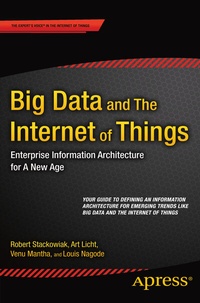
Big Data and The Internet of Things
Description

Enterprise Information Architecture for a New Age: Big Data and The Internet of Things, provides guidance in designing an information architecture to accommodate increasingly large amounts of data, massively large amounts of data, not only from traditional sources, but also from novel sources such everyday objects that are fast becoming wired into global Internet. No business can afford to be caught out by missing the value to be mined from the increasingly large amounts of available data generated by everyday devices.
The text provides background as to how analytical solutions and enterprise architecture methodologies and concepts have evolved (including the roles of data warehouses, business intelligence tools, predictive analytics, data discovery, Big Data, and the impact of the Internet of Things). Then you're taken through a series of steps by which to define a future state architecture and create a plan for how to reach that future state.
Enterprise Information Architecture for a New Age: Big Data and The Internet of Things helps you gain an understanding of the following:
- Implications of Big Data from a variety of new data sources (including data from sensors that are part of the Internet of Things) upon an information architecture
- How establishing a vision for data usage by defining a roadmap that aligns IT with line-of-business needs is a key early step
- The importance and details of taking a step-by-step approach when dealing with shifting business challenges and changing technology capabilities
- How to mitigate risk when evaluating existing infrastructure and designing and deploying new infrastructure
Enterprise Information Architecture for a New Age: Big Data and The Internet of Things combines practical advice with technical considerations. Author Robert Stackowiak and his team are recognized worldwide for their expertise in large data solutions, including analytics. Don't miss your chance to read this book and gain the benefit of their advice as you look forward in thinking through your own choices and designing your own architecture to accommodate the burgeoning explosion in data that can be analyzed and converted into valuable information to drive your business forward toward success.
More details
Other editions
Additional editions
Persons
Content
- Intro
- Contents at a Glance
- Contents
- About the Authors
- Acknowledgments
- Introduction
- Chapter 1: Big Data Solutions and the Internet of Things
- From Punched Cards to Decision Support
- The Data Warehouse
- Independent vs. Dependent Data Marts
- An Incremental Approach
- Faster Implementation Strategies
- Matching Business Intelligence Tools to Analysts
- Evolving Data Management Strategies
- NoSQL Databases
- Hadoop's Evolution
- Hadoop Features and Tools
- The Internet of Things
- The Methodology in This Book
- TOGAF and Architectural Principles
- Our Methodology for Success
- Chapter 2: Evaluating the Art of the Possible
- Understanding the Current State
- Information Architecture Maturity Self-Assessment
- Current Business State of the Industry
- Is a New Vision Needed?
- Developing the Vision
- The Current State and Future State Data Warehouse
- Determining Where Hadoop and NoSQL Databases Fit
- Linking Hadoop and the Data Warehouse Infrastructure
- Real-Time Recommendations and Actions
- Validating the Vision
- Chapter 3: Understanding the Business
- Understand Business Initiatives
- Big Data and IoT Impact on Business
- Data Gathering Methods
- Plan Discovery
- Conduct Preliminary Research
- Conduct Interviews
- Identify Critical Success Factors
- Business Drivers
- IT Drivers and Linkage to Business Initiatives
- Prioritize Initiatives to an Early Roadmap
- Determine Business Impact and Prioritize Initiatives
- Other Prioritization Considerations
- Develop Initial Business Case
- Total Cost of Ownership ( TCO)
- IT Value
- Business Value
- Other Trade-offs to Consider
- We Have Only Just Begun
- Chapter 4: Business Information Mapping for Big Data and Internet of Things
- Mapping the Current State
- Data Flow Diagram Basics
- Understanding the Current Situation
- Building a Current State Business Information Map
- Defining the Future State
- Preparing for a Future State Meeting
- The Future State Business Information Map
- Transitioning to the Technology Design
- Chapter 5: Understanding Organizational Skills
- Skills Assessment and Metrics
- Business Architecture Skills
- Data Architecture Skills
- Application Architecture and Integration Skills
- Technology Architecture Skills
- Addressing Skills Gaps
- Delivering the News of Skills Gaps
- Addressing Critical Skills Gaps
- Chapter 6: Designing the Future State Information Architecture
- The Current State Information Architecture
- Data Sources
- Data Management Systems for Analysis
- Data Analysis Tools and Interfaces
- Validating Current State BIMs
- Underlying Servers and Storage
- Other Current State Practices
- Designing the Future State
- The Future State BIM and Information Architecture
- Broad Future State Considerations
- Hadoop Considerations
- Internet of Things Considerations
- Early Operational Planning
- The Right Time to Define a Roadmap
- Chapter 7: Defining an Initial Plan and Roadmap
- Revisiting Earlier Findings
- Refining Our Skills Assessment
- Another Look at Project Priorities
- A Defensible Business Case
- Obtaining a Real Estimate of Costs
- Revising the Business Case
- Defining the Roadmap
- An Initial Plan for IT
- Building a Roadmap
- Gaining Approval and the Transition
- The Executive Meeting
- Transitioning to Implementation
- Chapter 8: Implementing the Plan
- Implementation Steps
- Project Plans and the Critical Path Method
- Best Practices for Driving Timely Progress
- Causes of Change to a Project Timeline
- Operationalizing the Solution
- Service Levels and Documentation
- Organizational Change Management
- Ending the Project
- Claiming Success
- Postmortem Analysis
- Starting Again
- Appendix A: References
- Published Sources
- Web Site Sources
- Appendix B: Internet of Things Standards
- Standards Bodies
- Open Source Projects
- Consortia
- Index
