

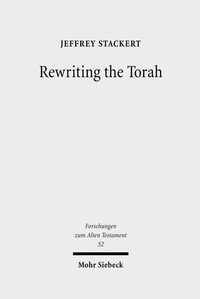
Rewriting the Torah
Literary Revision in Deuteronomy and the Holiness Legislation
1st Edition
Published on 1. August 2007
273 pages
978-3-16-151093-9 (ISBN)
Description

Jeffrey Stackert untersucht literarische Parallelen innerhalb der Gesetzestexte des Pentateuch und vor allem die Beziehungen zwischen ähnlichen Gesetzen im Deuteronomium und dem Heiligkeitsgesetz (Lev 17-26). Seine Analyse bestimmter Gesetze im Pentateuch führt ihn zu der These, daß das Heiligkeitsgesetz sowohl vom Bundesbuch als auch vom Deuteronomium abhängt. Er erläutert die Arbeitsweise der Verfasser des Heiligkeitsgesetzes und zeigt, daß sie eine Art literarischer Revision anwenden und ihre Quellen so ihren eigenen ideologischen Vorstellungen anpassen. Das Heiligkeitsgesetz zeigt sich also als ein 'Supergesetz', das die ihm vorausgehenden priesterlichen und nicht-priesterlichen Gesetze sammelt und neu aufbereitet.
More details
Other editions
Additional editions
Book
08/2007
1st Edition
Mohr Siebeck
€109.00
Article exhausted; check different version
Person
Content
- Cover
- Acknowledgments
- Abstract
- Table of Contents
- Chapter One: The Biblical Legal Corpora and their Correspondences: Accounting for Similarities and Differences
- Introduction
- The History of Pentateuchal Legal Scholarship and the Current State of the Question
- Previous Studies of Pentateuchal Legislation
- The Limitations of Previous Studies of Deuteronomy and the Holiness Legislation
- The Existence, Scope, and Dating of the Holiness Writings
- Leviticus 17-26 and the Question of an Expanded Holiness Corpus
- Dating the Holiness Legislation
- Methodological Approach
- Historical and Literary Issues
- The Comparative Method and Literary Dependence
- Inner-biblical Exegesis
- Chapter Two: The Urbanization of Asylum: Reconceptualizations of Refuge in Deuteronomy and the Holiness Legislation
- Asylum in Exodus 21:12-14 and Deuteronomy 19:1-13
- Exodus 21:12-14 and the Question of Altar Asylum
- Exodus 21:12-14, Deuteronomy 19:1-13, and the Origin of City Asylum
- The Reconceptualization of ???? in Deuteronomy 19:1-13
- Asylum in Numbers 35:9-34 and its Relation to Other Pentateuchal Asylum Laws
- Previous Scholarship on the Relationship between the Deuteronomic and Priestly Asylum Laws
- Analysis of Numbers 35:9-34 and its Relation to Exodus 21:12-14 and Deuteronomy 19:1-13
- Redactional Analysis of Numbers 35:9-34
- The Literary Relationship between Deuteronomy 19:1-13 and Numbers 35:9-34
- Asylum in Joshua 20 and its Relation to Pentateuchal Asylum Legislation
- Conclusions
- Chapter Three: Revision in the Pentateuchal Seventh-Year and Slavery Laws: Semittâ, Sabbatôn, and Yôbel
- Revision in the Holiness Collection's Seventh-Year Law
- Literary Parallels and Direction of Dependence in Leviticus 25:2-7
- Can H Serve as a Source for D and/or CC?
- Conclusions Concerning Revision in the Holiness Collection's Seventh-Year Laws
- Excursus 1: Is Exodus 23:10-11 a Fallow Law?
- Lexical and Grammatical Ambiguity in Exodus 23:10-11
- Exodus 23:10-11 in the Septuagint
- Exodus 23:10-11 and its Reformulation in Leviticus 25:2-7
- Exodus 23:10-11 and its Reformulation in Deuteronomy
- Revision in the Holiness Collection's Slavery Laws
- The Deuteronomic and Holiness Slavery and Manumission Laws
- Literary Parallels and Direction of Dependence in Leviticus 25:39-43
- Can Leviticus 25:39-43 Serve as a Source for Deuteronomy 15:12-15, 18?
- Legal Revision in Leviticus 25:44-46: Modifying and Integrating Sources
- Narrative Influence in the Composition of Biblical Law: Evidence from D and H
- Revision of Narrative Address in the Holiness Slavery Laws
- Can H Serve as a Source for D?
- Conclusions Concerning Revision in the Holiness Collection's Slavery Laws
- Chapter Four: "A Tithe from the Tithe": Revision of the Deuteronomic Tithe in the Holiness Legislation
- Tithes, Levites, and the Question of Historical Custom
- The Revision of Deuteronomy 14:22-29 in Numbers 18:20-32
- Correspondences Between Deuteronomy 14:22-29 and Numbers 18:20-32
- The Analogies for the Tithe in Numbers 18:27 and 30
- Excursus 2: Source Ascription in Leviticus 27:30-33 and Numbers 16-18
- Excursus 3: The Levites in the Torah and Ezekiel
- Conclusions
- General Conclusions Concerning the Deuteronomic and Holiness Tithes
- Centralization and Levitical Holiness Status
- Chapter Five: Literary Dependence and Compositional Logic: Understanding the Motivation for Biblical Legal Revision
- Biblical Legal Revision: Replacement or Supplementation?
- Competing and Complementary Modes of Textual Authority: Canon and Revelation
- Pre-Canonical Legal Revision and a New Empirical Model
- Conclusions
- Bibliography
- Hebrew Index
- Source Index
- Subject and Authors Index
