

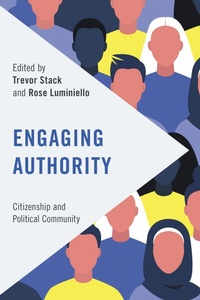
Engaging Authority
Citizenship and Political Community
1st Edition
Published on 31. January 2022
1 pages
979-8-8818-5602-1 (ISBN)
Description

Engaging Authority: Citizenship and Political Community aims to explore how authority is entailed in different versions of citizenship and political community. Who or what claims authority in the name of "a people," and to what effect? What kind and scope of authority is claimed? And who is held to be part of such a people"? Engaging Authority brings together scholars from anthropology, constitutional studies, cultural studies, politics, political theory, sociology, and philosophy in a collaborative project to develop a multifaceted understanding of citizenship in political community.
The volume begins with the premise that to describe or identify oneself as a citizen entails a particular relationship to authority. Citizens are understood to be members of a community which we consider "political" in that members are invoked, and may also be involved, in the business of governing. How does this relationship function? How is community invoked by those exercising authority, and in what senses do citizens partake in its exercise? In this volume, the authors explore different forms of the citizen's relationship to authority in political community, across and beyond the variations that usually concern scholars, such as the self-governing people, nation-states, popular sovereignty, and democratic citizenship.
The volume begins with the premise that to describe or identify oneself as a citizen entails a particular relationship to authority. Citizens are understood to be members of a community which we consider "political" in that members are invoked, and may also be involved, in the business of governing. How does this relationship function? How is community invoked by those exercising authority, and in what senses do citizens partake in its exercise? In this volume, the authors explore different forms of the citizen's relationship to authority in political community, across and beyond the variations that usually concern scholars, such as the self-governing people, nation-states, popular sovereignty, and democratic citizenship.
More details
Other editions
Additional editions
Book
01/2022
Rowman & Littlefield Publishers
€115.30
Shipment within 3-4 weeks
Persons
Trevor Stack is Director of the Centre for Citizenship, Civil Society and Rule of Law and Professor of Spanish and Latin American Studies at the University of Aberdeen.
Rose Luminiello is a Research Fellow at the Research Institute of Irish and Scottish Studies (RIISS) at the University of Aberdeen and the Cushwa Center for the Study of American Catholicism at the University of Notre Dam.
Rose Luminiello is a Research Fellow at the Research Institute of Irish and Scottish Studies (RIISS) at the University of Aberdeen and the Cushwa Center for the Study of American Catholicism at the University of Notre Dam.
Content
Preface
1. Introduction: Citizenship and Political Community in Four Questions, Trevor Stack
2. Political Community in a Plural Society: Reflections from India, Gurpreet Mahajan
3. Recasting Political Community: The New National Identity of Hungary, Balázs Majtényi
4. Political Community under Communism: Regime, Dissidents and Church in Post-World War II Poland, Anna Grudzinska
5. Schooling in Citizenship and Political Community, Nadia Kiwan, Rachel Shanks, and Trevor Stack
6. Sovereignty, Autonomy and Citizenship in the Kurdish Model of Political Community, Hanifi Baris
7. Overcoming the Myth of the Sovereign, Self-Governing People, David Thunder
8. Civic Friendship, Economic Justice, and Political Authority, Nathaniel Jezzi
9. Studying Political Community from the Citizen Up, Trevor Stack
10. Competing Models of Islamic Political Community: ISIS and the Amman Message and Shariah Index, Ionut Untea
11. Community as Referent and Effect of Authority Claims, Trevor Stack
1. Introduction: Citizenship and Political Community in Four Questions, Trevor Stack
2. Political Community in a Plural Society: Reflections from India, Gurpreet Mahajan
3. Recasting Political Community: The New National Identity of Hungary, Balázs Majtényi
4. Political Community under Communism: Regime, Dissidents and Church in Post-World War II Poland, Anna Grudzinska
5. Schooling in Citizenship and Political Community, Nadia Kiwan, Rachel Shanks, and Trevor Stack
6. Sovereignty, Autonomy and Citizenship in the Kurdish Model of Political Community, Hanifi Baris
7. Overcoming the Myth of the Sovereign, Self-Governing People, David Thunder
8. Civic Friendship, Economic Justice, and Political Authority, Nathaniel Jezzi
9. Studying Political Community from the Citizen Up, Trevor Stack
10. Competing Models of Islamic Political Community: ISIS and the Amman Message and Shariah Index, Ionut Untea
11. Community as Referent and Effect of Authority Claims, Trevor Stack
