

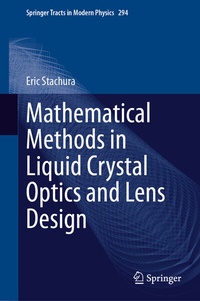
Mathematical Methods in Liquid Crystal Optics and Lens Design
Description

Freeform lens design has numerous applications in imaging, aerospace, and biomedicine. Due to recent advancements in precision cutting and grinding, the manufacturing of freeform optical lenses with very high precision is now possible. However, there is still a significant lack of mathematical literature on the subject, and essentially none related to liquid crystals. Liquid crystals are appealing for use in imaging due to their flexibility and unique electro-optical properties.
This book fills a gap in mathematical literature and attracts focus to liquid crystals for freeform lens design. It provides a rigorous mathematical perspective on liquid crystal optics, focusing on ray tracing in the geometric optics regime. A mathematical foundation is set to study lens design and ray tracing problems in liquid crystals.
Additionally, it addresses absolute instruments, which are devices that image without any optical aberrations. These instruments cannot be designed through transformation optics, and until recently, only a handful of examples were known. Mathematically, this is a largely untapped area of research, yet the applications are profound.
Finally, the book describes several open directions, revealing the richness of the intersection of liquid crystal optics and mathematical analysis. The content of this book will prove invaluable for researchers of mathematical optics as well as those interested in liquid crystal theory, in addition to those mathematics graduate students aiming to understand the physical basis of light propagation in liquid crystals
More details
Other editions
Additional editions
Person
Eric Stachura
Kennesaw State University
Department of Mathematics
Marietta, GA
United States of America
Content
Introduction.- Physical Background.- Fermat Principle and Snell's Law of Refraction.- Ray Equations: Geodesics in Finsler Space.- Aberrations and a Lens Design Problem.- The Challenge of Absolute Instruments.- Conclusions and Outlook.- Appendix.- References.
