

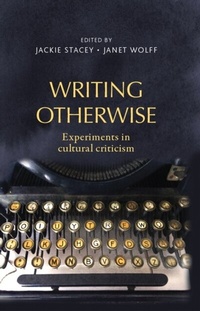
Writing Otherwise
Experiments in Cultural Criticism
1st Edition
Published on 16. May 2016
240 pages
978-1-5261-1256-9 (ISBN)
Description

Writing otherwise is a collection of essays by established feminist and cultural critics interested in experimenting with new styles of expression. Leading figures in their field, such as Marianne Hirsch, Lynne Pearce, Griselda Pollock, Carol Smart, Jackie Stacey and Janet Wolff, all risk new ways of writing about themselves and their subjects.
Aimed at both general and academic readers interested in how scholarly writing might be more innovative and creative, this collection introduces the personal, the poetic and the experimental into the frame of cultural criticism. This collection of essays is highly interdisciplinary and contributes to debates in sociology, history, anthropology, art history, cultural and media studies and gender studies. -- .
Aimed at both general and academic readers interested in how scholarly writing might be more innovative and creative, this collection introduces the personal, the poetic and the experimental into the frame of cultural criticism. This collection of essays is highly interdisciplinary and contributes to debates in sociology, history, anthropology, art history, cultural and media studies and gender studies. -- .
Reviews / Votes
This exciting and innovative collection presses up against the limits of what scholarship can be and its contributors are not afraid to pause where necessary to explore and describe those limits. The turn to the personal that has been so important for feminist and queer criticism is just one of the many richly varied voices and styles through which they insist on experimental writing not as a departure from scholarship but as itself a critical method. Moreover, their attention to writing offers unexpected vantage points on affect theory, including such elusive categories as sensation, mood, and atmosphere. Reading Writing otherwise feels at once enabling and deeply pleasurable.Ann Cvetkovich, Ellen Clayton Garwood Centennial Professor of English and Professor of Women's and Gender Studies at the University of Texas at Austin
In this fascinating collection diverse scholars introduce readers to the imaginative resources liberated by writing somewhat aslant of conventional disciplinary guidelines. The essays highlight intense personal engagements, present intriguing visual imagery or in other ways depict the poetic and elusive resonance of emotions. It is reassuring and delightful to read these lucid essays, confirming once more the potential for working creatively in academia, especially when choosing to trouble its traditional styles and frameworks.
Lynne Segal, author of Out of Time: The Pleasures & Perils of Ageing
The essays in Writing otherwise provide indispensable models for academics attempting to combine theoretical savvy with readable, inventive prose.
Susan Gubar, Distinguished Professor Emerita of English at Indiana University, writes the 'Living with Cancer' blog in The New York Times
Writing otherwise grabbed me by the collar and pulled me into a world where I wouldn't have minded staying. In this innovative collection, 'writing otherwise' is always sutured to 'knowing otherwise', whether historically (through use of memoir and fiction), textually (through playing with form and voice), or via the body (through touch and engagement with others). Drawing on the venerable feminist and queer traditions of interdisciplinarity and intersubjectivity, this collection shows us the difference that writing otherwise makes: it keeps the writer open to new ways of knowing; pulls her back to the past to see the future anew; forces a confrontation with dislocation and mortality; and yet marries loss and optimism in shifting cartographies of difference. Writing otherwise is an invitation to respond in kind in one's own work, an invitation I now feel better equipped to accept.
Clare Hemmings, Professor of Feminist Theory, at LSE's Gender Institute -- .
All prices
More details
Language
English
Place of publication
United Kingdom
Illustrations
24 black & white illustrations
ISBN-13
978-1-5261-1256-9 (9781526112569)
Copyright in bibliographic data and cover images is held by Nielsen Book Services Limited or by the publishers or by their respective licensors: all rights reserved.
Schweitzer Classification
Other editions
Additional editions
Book
08/2016
Manchester University Press
€38.90
Shipment within 15-20 days
Book
11/2013
Manchester University Press
€131.50
Article not available at the moment
Persons
Jackie Stacey is Professor of Media and Cultural Studies at the University of Manchester
Janet Wolff is Professor Emerita of Cultural Sociology at the University of Manchester -- .
Janet Wolff is Professor Emerita of Cultural Sociology at the University of Manchester -- .
Content
Writing otherwise - Jackie Stacey and Janet Wolff
Affects
Writing from the heart - Griselda Pollock
Contact - Mary Cappello
On being open to others: cosmopolitanism and the psychoanalysis of groups - Jackie Stacey
Touching lives: writing the sociological and the personal - Carol Smart
Displacements
Atlantic moves - Janet Wolff
Autopia: in search of what we're thinking when we're driving - Lynne Pearce
Cheap chickens and ethical eggs: the place of an English village in the world - Vron Ware
If the shoe fits: appropriating identity? - Brenda Cooper
Dust and mangoes: plain tales and hill stations - Margaret Beetham
Poetics
Bliss (opera's untenable pleasures) - Monica B. Pearl
Graphic to surface: textual effects and criticism - Judy Kendall
First person, plural: notes on voice and collaboration - Marianne Hirsch and Leo Spitzer -- .
Affects
Writing from the heart - Griselda Pollock
Contact - Mary Cappello
On being open to others: cosmopolitanism and the psychoanalysis of groups - Jackie Stacey
Touching lives: writing the sociological and the personal - Carol Smart
Displacements
Atlantic moves - Janet Wolff
Autopia: in search of what we're thinking when we're driving - Lynne Pearce
Cheap chickens and ethical eggs: the place of an English village in the world - Vron Ware
If the shoe fits: appropriating identity? - Brenda Cooper
Dust and mangoes: plain tales and hill stations - Margaret Beetham
Poetics
Bliss (opera's untenable pleasures) - Monica B. Pearl
Graphic to surface: textual effects and criticism - Judy Kendall
First person, plural: notes on voice and collaboration - Marianne Hirsch and Leo Spitzer -- .

