

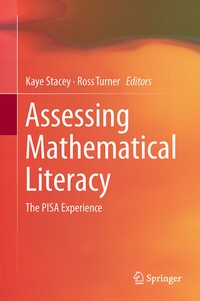
Assessing Mathematical Literacy
Description

This book describes the design, development, delivery and impact of the mathematics assessment for the OECD Programme for International Student Assessment (PISA). First, the origins of PISA's concept of mathematical literacy are discussed, highlighting the underlying themes of mathematics as preparation for life after school and mathematical modelling of the real world, and clarifying PISA's position within this part of the mathematics education territory. The PISA mathematics framework is introduced as a significant milestone in the development and dissemination of these ideas. The underlying mathematical competencies on which mathematical literacy so strongly depends are described, along with a scheme to use them in item creation and analysis. The development and implementation of the PISA survey and the consequences for the outcomes are thoroughly discussed. Different kinds of items for both paper-based and computer-based PISA surveys are exemplified by many publicly released items along with details of scoring. The novel survey of the opportunity students have had to learn the mathematics promoted through PISA is explained. The book concludes by surveying international impact. It presents viewpoints of mathematics educators on how PISA and its constituent ideas and methods have influenced teaching and learning practices, curriculum arrangements, assessment practices, and the educational debate more generally in fourteen countries.
More details
Other editions
Additional editions
Content
Preface.- The Assessment of Mathematical Literacy: Introduction to PISA and to this Book; Kaye Stacey and Ross Turner .- PART 1: The Foundations of PISA Mathematics.- PART 2: Implementing the PISA Survey: Collaboration, Quality and Complexity.- PART 3: PISA's Impact around the World: Inspiration and Adaptation.- 15. PISA's Influence on Thought and Action in Mathematics Education; Kaye Stacey (with contributors from ten countries) .
