

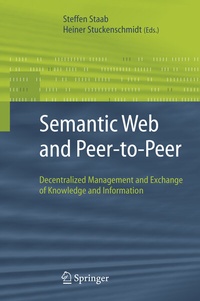
Semantic Web and Peer-to-Peer
Description

Just like the industrial society of the last century depended on natural resources, today's society depends on information and its exchange.
Staab and Stuckenschmidt structured the selected contributions into four parts: Part I, "Data Storage and Access", prepares the semantic foundation, i.e. data modelling and querying in a flexible and yet scalable manner. These foundations allow for dealing with the organization of information at the individual peers. Part II, "Querying the Network", considers the routing of queries, as well as continuous queries and personalized queries under the conditions of the permanently changing topological structure of a peer-to-peer network. Part III, "Semantic Integration", deals with the mapping of heterogeneous data representations. Finally Part IV, "Methodology and Systems", reports experiences from case studies and sample applications.
The overall result is a state-of-the-art description of the potential of Semantic Web and peer-to-peer technologies for information sharing and knowledge management when applied jointly.
More details
Other editions
Additional editions
Persons
PD Dr. Steffen Staab is a senior lecturer in applied computer science at the University of Karlsruhe. He has earned a M.S.E. from University of Pennsylvania, a Dr. rer. nat. from University of Freiburg and his habilitation from University of Karlsruhe. He has done research in the fields of computational linguistics, text mining, ontology engineering, knowledge management, and peer-to-peer. He has co-authored over 120 refereed publications and published 7 books, including a Handbook on Ontologies. In 1999, Steffen Staab has co-founded Ontoprise, the first Semantic Web company. He serves on the editorial board of IEEE Intelligent Systems, Journal of Web Semantics, Journal of Human-Computer Studies and Journal of Information Technology and Tourism. Steffen Staab has co-chaired a large number of workshops and several conferences. Recently, he serves as an area chair of ECAI-2004, Semantic Web track chair of WWW-2005, and co-chair of STAIRS-2004.
Dr. Heiner Stuckenschmidt Heiner Stuckenschmidt holds a post-doc position in the Knowledge Representation and Reasoning Group at the Vrije Universiteit Amsterdam where he received his PhD for work on Ontology-Based Information Sharing on the Semantic Web. He works includes Semantic Web related topics such as ontology languages, knowledge-based meta data management and robust and scalable terminological reasoning. Before moving to Amsterdam, he was employed as a researcher and lecturer at the University of Bremen. His research activities in Bremen included the application of ontologies for information sharing in web based information systems with a special focus on semantics-preserving information integration and spatially related information. He is organizer of a series of workshops on ontologies at international conferences (IJCAI'01, ECAI'02, IJCAI'03) and member of program committees of several semantic web related conferences (SWWS'01, ISWC'02, WWW'03) and has held / will hold tutorial atdifferent conferences (K-CAP 2001, IJCAI'03, ISWC'03). He is editor of a book on the application of ontologies in the cadastral domain the author of a book on Information Sharing on the Semantic web and has published more than 40 paper in international journals, conferences and workshops.
