

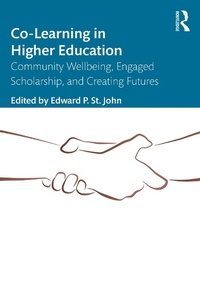
Co-Learning in Higher Education
Community Wellbeing, Engaged Scholarship, and Creating Futures
1st Edition
Published on 14. November 2022
314 pages
978-1-000-78429-9 (ISBN)
Description

Co-Learning in Higher Education addresses topics critical to the future of higher education: the wellbeing of communities, engagement of scholars supporting new generations of social activists, and the renewal and expansion of educational and career pathways. It develops a theory of co-learning that engages students and professors across generations in partnerships with community organizations, schools, and corporations that solve emerging social and environmental challenges. Collaboratively written cases discuss community projects, engaging pedagogies, and action research projects. These co-cases demonstrate the power of using critical pedagogies and social action within troubling contexts, rather than assuming public policy changes are the only solution. Contributors explore mentoring, discuss pedagogies that promote community wellbeing and equity, address the urgency of change in universities, and reflect on the implications of this chaotic period for empowering social agency among youth in rising generations. This is a timely volume for scholars and students in higher education and educational policy.
Reviews / Votes
"Edward St. John and his associates have provided both a rear-view mirror to look at important character in the drama of campus and community over more than a half century and a blue print to continue into the future. The autobiographical essays and commentaries are simultaneously apart and a part of a collective biography of how a network of colleagues and friends have been participant-observers in the kinds of thoughtful initiatives that work to turn the university as a "knowledge factory" into a home for informed, principled social and educational reform. Co-Learning in Higher Education goes beyond the obvious and into the essence of what our educational institutions and communities should strive to be and do."John Thelin, Professor of Higher Education and Public Policy, University of Kentucky
"Essential reading for any person who cares about improving social and economic inequalities in schools and colleges. The book illustrates how economic and social policy have influenced educational policy, deepening inequalities. It challenges readers to set aside assumptions and reimagine a future which lifts up communities and rising generations. "
Malisa Lee, Associate Vice President for Enrollment Management, Fresno State University
"Co-Learning in Higher Education is a book for our times. St. John and colleagues have penned a thoughtful primer on what citizens need to do as we confront a potpourri of problems in the 21st century. Their point is not simply to think about inequity, but develop ways that create a better future. Thoughtful. Powerful. Timely."
William G. Tierney, University Professor Emeritus, University of Southern California
"Edward P. St. John is one of a very small number of scholars who approaches problems of social policy from a foundation of well-reflected human values and beliefs. More than that: he has cultivated a shared conversation on it with diverse peers and thought-leaders and invites us with this book to listen in. Engrossing!"
Heinz Deiter Meyer, Professor of Education, University at Albany
More details
Edition
1. Auflage
Language
English
Place of publication
London
United Kingdom
Publishing group
Taylor & Francis Ltd
Target group
College/higher education
Product notice
Reflowable
Illustrations
13 Tables, black and white; 1 Halftones, black and white; 5 Illustrations, black and white
ISBN-13
978-1-000-78429-9 (9781000784299)
Copyright in bibliographic data and cover images is held by Nielsen Book Services Limited or by the publishers or by their respective licensors: all rights reserved.
Schweitzer Classification
Other editions
Additional editions
Edward P. St. John
Co-Learning in Higher Education
Community Wellbeing, Engaged Scholarship, and Creating Futures
Book
11/2022
1st Edition
Routledge
€60.50
Shipment within 10-20 days
Edward P. St. John
Co-Learning in Higher Education
Community Wellbeing, Engaged Scholarship, and Creating Futures
Book
11/2022
1st Edition
Routledge
€187.80
Shipment within 10-20 days
Person
Edward P. St. John is an Emeritus Professor of Education at the University of Michigan, USA.
Content
Preface
Chapter 1 Contexts for Co-Learning
Co-case contributors: Nick K. Gera, Patricia A. Somers, and Lijing Yang
Part I Community Wellbeing
Chapter 2 Foundations for Co-Learning
Co-case contributors: Cathleen Field Fenstermacher, Stacy A. Jacob, Alan Scott Lee, John Russell-Curry, Patricia A. Somers, and Ontario S. Wooden
Chapter 3 Educational Policy and Leadership
Co-case contributors: Leetta Allen-Haynes, Donaldo Batiste, Luis Miron, and Maureen B. St. John
Chapter 4 Promoting Community Wellbeing
Co-case contributors: Rick Dalton, Nate Daun-Barnett, Jerry Drane, Cliona Hannon, Tami L. Moore, and Jesus Solis
Part II Engaged Scholarship
Chapter 5 Seeking Social Justice
Co-case contributors: John Burkhardt, James Heft, Jeannine Kranzow, Megan Moore-Gardner, and Jenny Small
Chapter 6 Praxis
Co-case contributors: Bart Anderson, Judith Chapin-Kjelstrom, Amy S. Fisher, Pamela Felder-Small, and Marybeth Gasman
Chapter 7 Supporting Rising Generations
Co-case contributors: Feven Girmay, Penny A. Pasque, Gilia Smith, and Caroline Turner
Part III Creating Futures
Chapter 8 Reimagining Pathways
Co-case contributors: Shirley Ort, Pauline Reynolds, Patricia Somers, and Denis St. John
Chapter 9 Histories and Futures
Co-case contributors: Jeffrey Bardzell, Wang Chen, Roger Hagan, Jerry Pattengale, and Elias Samuels
Chapter 10 Generations Rising
Co-case contributors: Dorothea and James Brady, Feven Girmay, and Jon Reidel
Contributor Biographies
Index
Chapter 1 Contexts for Co-Learning
Co-case contributors: Nick K. Gera, Patricia A. Somers, and Lijing Yang
Part I Community Wellbeing
Chapter 2 Foundations for Co-Learning
Co-case contributors: Cathleen Field Fenstermacher, Stacy A. Jacob, Alan Scott Lee, John Russell-Curry, Patricia A. Somers, and Ontario S. Wooden
Chapter 3 Educational Policy and Leadership
Co-case contributors: Leetta Allen-Haynes, Donaldo Batiste, Luis Miron, and Maureen B. St. John
Chapter 4 Promoting Community Wellbeing
Co-case contributors: Rick Dalton, Nate Daun-Barnett, Jerry Drane, Cliona Hannon, Tami L. Moore, and Jesus Solis
Part II Engaged Scholarship
Chapter 5 Seeking Social Justice
Co-case contributors: John Burkhardt, James Heft, Jeannine Kranzow, Megan Moore-Gardner, and Jenny Small
Chapter 6 Praxis
Co-case contributors: Bart Anderson, Judith Chapin-Kjelstrom, Amy S. Fisher, Pamela Felder-Small, and Marybeth Gasman
Chapter 7 Supporting Rising Generations
Co-case contributors: Feven Girmay, Penny A. Pasque, Gilia Smith, and Caroline Turner
Part III Creating Futures
Chapter 8 Reimagining Pathways
Co-case contributors: Shirley Ort, Pauline Reynolds, Patricia Somers, and Denis St. John
Chapter 9 Histories and Futures
Co-case contributors: Jeffrey Bardzell, Wang Chen, Roger Hagan, Jerry Pattengale, and Elias Samuels
Chapter 10 Generations Rising
Co-case contributors: Dorothea and James Brady, Feven Girmay, and Jon Reidel
Contributor Biographies
Index
