

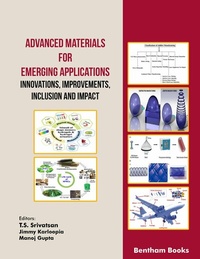
Advanced Materials for Emerging Applications Innovations, Improvements, Inclusion and Impact
Description

Advanced Materials for Emerging Applications is a monograph on emerging materials - materials that have observable differences in physical properties and manufacturing requirements when compared to existing materials and industrial processes. The volume aims to showcase novel materials that can be used in advanced technology and innovative products. The editors have compiled 17 chapters grouped into 3 sections: 1) Metals and Alloys, 2) Composite materials, and 3) Other materials. Chapters 1-5 discuss recent advances in friction stir welding, suitability of nickel-base shape memory alloys, thermal cycling studies of nickel-based shape memory alloys, nitrogen additions to stainless steel, and the evolution of zirconium alloy. Chapters 6-11 cover topics such as additive manufacturing of metal matrix composites, composite materials for biomedical applications, aluminum and magnesium metal matrix composites, aluminum nanocomposites for automobile applications, enhancing the strength of aluminum-boron carbide composites, and sisal fibers reinforced composites. Lastly, chapters 13-17 explore smart hydrogels, engineered iron-oxide nanomaterials for magnetic hyperthermia, emerging sustainable material technology for fire safety, recent advances in unconventional machining of smart alloys, and critical parameters influencing high-strain rate deformation of materials. This monograph provides information for a broad readership including material and manufacturing engineers, researchers, students (at undergraduate levels or above) and entrepreneurs interested in manufacturing new products. Readership Engineers, researchers, students (at undergraduate levels or above) in materials science, engineering and technology sectors; entrepreneurs interested in manufacturing new products.
All prices
More details
Other editions
Additional editions
Content
- Cover
- Title
- Copyright
- End User License Agreement
- Contents
- Preface
- Acknowledgements
- List of Contributors
- Recent Advances in Friction Stir Welding of Magnesium Alloys for Use in Performance-Specific Applications
- Divyanshu1, Kunal Chauhan1, Jimmy Karloopia1,*, N. M. Suri1 and T. S. Srivatsan2
- INTRODUCTION
- Stages in Friction Stir Welding
- Classification of Magnesium alloys
- PROCESS PARAMETERS FOR FRICTION STIR WELDING (FSW)
- Friction Stir Welding: Joint Design
- Friction Stir Welding (FSW) Tool
- Welding Parameters of Friction Stir Welding (FSW)
- MICROSTRUCTURAL EVOLUTION DURING FRICTION STIR WELDING (FSW) OF MAGNESIUM ALLOY/COMPOSITE
- MECHANICAL PROPERTIES OF FRICTION STIR WELDED (FSW) MAGNESIUM ALLOY / MAGNESIUM COMPOSITE
- DEFECTS IN FRICTION STIR WELDING
- APPLICATION OF FRICTION STIR WELDING TO MAGNESIUM ALLOYS
- MODIFIED FRICTION STIR WELDING PROCESSES
- Underwater Friction-Stir Welding (UFSW)
- Vibration-assisted Friction-Stir Welding (VFSW)
- Electrical Current-Aided Friction-Stir Welding (EFSW)
- Ultrasonic Vibration-Assisted Friction-Stir Welding (UVFSW)
- Laser-assisted Friction-Stir Welding (LFSW)
- FUTURE TRENDS IN FRICTION STIR WELDING
- CONCLUSION
- REFERENCES
- Suitability of Nickel-base Shape Memory Alloys for Selection and use in Sensing Applications
- Sachin Oak1,*, Kedarnath Rane2, Vinod Belwanshi3,4, Kiran Bhole1 and T. S. Srivatsan5
- INTRODUCTION
- BACKGROUND
- MATERIAL PROPERTIES AND PROCESSING TECHNIQUES
- SENSORS FABRICATION TECHNIQUES
- APPLICATION DOMAINS
- Automotive and E-mobility
- Space, Aircraft and Aerospace
- Bio-Medical and Bio-Engineering Applications
- Other Applications
- THE COBALT-CHROMIUM ALLOY [CCAS]
- SUMMARY
- REFERENCES
- Thermal and Thermomechanical Cycling Studies of Nickel-Based Shape Memory Alloys for Engineering and Medical Applications
- G. Swaminathan1,2 and Vedamanickam Sampath1,*
- INTRODUCTION
- Phase Transformation Temperatures
- Recovery Strain
- Recovery Stress
- Hysteresis
- FUNCTIONAL FATIGUE OF SHAPE MEMORY ALLOYS
- ORIGIN OF FUNCTIONAL FATIGUE IN SHAPE MEMORY ALLOYS
- THERMAL CYCLING OF SHAPE MEMORY ALLOYS
- THERMOMECHANICAL CYCLING OF SHAPE MEMORY ALLOYS
- PARTIAL CYCLING OF SHAPE MEMORY ALLOYS
- CONCLUDING REMARKS
- REFERENCES
- Nitrogen Additions to Type 316L Stainless Steel to Enhance its High Temperature Performance for Structural Applications in Fast Reactors
- M. Vasudevan1,*, V. Karthik1, A. Nagesha1 and G.V. Prasad Reddy1
- INTRODUCTION
- MATERIAL DETAILS
- INFLUENCE OF NITROGEN CONTENT ON THE TENSILE BEHAVIOUR OF 316LN STAINLESS STEEL
- INFLUENCE OF NITROGEN CONTENT ON THE CREEP BEHAVIOR OF 316LN STAINLESS STEEL
- INFLUENCE OF NITROGEN CONTENT ON THE LOW CYCLE FATIGUE AND CREEP-FATIGUE DAMGE OF 316LN STAINLESS STEEL
- Continuous Cycling
- Substructural Features and Fracture Modes
- Creep-fatigue Interaction
- INFLUENCE OF NITROGEN CONTENT ON THE FRACTURE TOUGHNESS OF 316LN STAINLESS STEEL
- INFLUENCE OF NITROGEN CONTENT ON THE RESISTANCE TO FATIGUE CRACK GROWTH PROPAGATION
- INFLUENCE OF NITROGEN CONTENT ON THE WORKABILTIY OF 316LN STAINLESS STEEL
- INFLUENCE OF NITROGEN CONTENT ON THE HOT CRACKING SUSCEPTIBILITY OF 316LN STAINLESS STEEL
- SUMMARY AND CONCLUSIONS
- ACKNOWLEDGEMENTS
- REFERENCES
- On the Evolution of a Zirconium Alloy for Use as Pressure Tubes in Indian Pressurized Heavy Water Reactors
- R. N. Singh1,*, A. K. Bind1, Saurav Sunil1, Apu Sarkar1, S. Neogy2 and T. N. Murty1
- INTRODUCTION: NUCLEAR REACTOR
- Pressurized Heavy Water Reactor
- Pressurized Heavy Water Reactor (PHWR) Coolant Channel Assembly
- Zirconium Alloys in-core Component
- Pressure Tube
- EVOLUTION OF ALLOY CHEMISTRY AND MANUFACTURING PRACTICE
- Alloy Chemistry
- Manufacturing Practice
- HYDRIDE FORMATION AND ITS REORIENTATION
- Terminal Solid Solubility of Hydrogen
- Hydride Precipitation
- Stress Reorientation of Hydrides
- TENSILE PROPERTIES
- 4.1. Stress-strain Curve: Double Melted Old Route (DMOR) and Quadruple Melted Old Route (QMOR)
- Temperature Dependence of Tensile Properties
- Anisotropy
- Loss of Coolant Accident (LOCA) and Superplasticity
- Variability
- Effect of Hydride on Strength and Ductility
- FRACTURE TOUGHNESS
- Double Melted Old Route (DMOR) and Quadruple Melted Old Route (QMOR)
- Effect of Circumferential Hydride
- Double Melted Old Route (DMOR)
- Quadruple Melted Old Route (QMOR)
- Influence of Radial Hydride
- Anisotropy - Miniature Impact Toughness
- DELAYED HYDRIDE CRACKING
- Delayed Hydride Cracking Velocity (VDHC) and Threshold Stress Intensity Factor (KIH)
- Temperature Dependence of Delayed Hydride Cracking - Heating and Cooling
- Effect of Strength and Hydride Orientation
- Modelling of Delayed Hydride Cracking Behaviour
- CREEP BEHAVIOR
- Creep Curve
- Creep Rate Curve
- Creep Rate versus Stress
- Activation Energy
- Creep Correlations
- SAFTEY ASSESMENT AND LIFE EXTENSION APPROACHES
- Leak Before Break (LBB)
- Operating Pressure Limits
- Life Extension Approaches
- CONCLUSION
- ACKNOWLEDGEMENTS
- REFERENCES
- State of the Art in Additive Manufacturing of Metal Matrix Composite for Use in Performance-Specific Application
- Akanksha Prajapati1, Dipayan Chakraborty1, Nisar Ahamad Khan1, Bhukya Praveen1 and Ajay Kumar1,*
- INTRODUCTION
- OVERVIEW OF ADDITIVE MANUFACTURING
- General Introduction to Additive Manufacturing
- Terminology
- Development and Fundamentals of Additive Manufacturing
- Common Steps in Additive Manufacturing
- Classification of Additive Manufacturing
- Fused Deposition Modeling (FDM)
- Stereo Lithography (SLA)
- Powder Based Fusion (PBF)
- Laminated Object Manufacturing (LOM)
- Advantages and Disadvantages of Additive Manufacturing
- Advantages
- Disadvantages
- Application of Additive Manufacturing
- Automobile Industries
- Aerospace/Aeronautics
- Medicine/Pharmaceutical industry
- Construction Industry
- Sports Industry
- METAL MATRIX COMPOSITE AND ITS PROGRESS
- CLASSIFICATION OF ADDITIVE MANUFACTURING FOR FABRICATION OF METAL-MATRIX COMPOSITES
- ADDITIVE MANUFACTURING ON PROCESSING OF METAL MATRIX COMPOSITES
- Titanium-Based Metal Matrix Composite
- Aluminum-Based Metal Matrix Composites
- Steel-Based Metal Matrix Composite
- Magnesium-Based Metal Matrix Composites
- CHALLENGES AND OPPORTUNITIES DURING THE FABRICATION OF METAL MATRIX COMPOSITE USING ADDITIVE MANUFACTURING
- SUMMARY AND FUTURE SCOPE
- REFERENCES
- Additive Manufacturing of Composite Materials for Use in Biomedical Applications
- Kunal Chauhan1, Divyanshu1, Jimmy Karloopia1,*, R. S. Walia1 and T. S. Srivatsan2
- INTRODUCTION
- ADDITIVE MANUFACTURING TECHNOLOGIES
- Vat Polymerization
- Binder Jetting
- Directed Energy Deposition
- Material Extrusion
- Powder Bed Fusion
- Material Jetting
- Sheet Lamination
- ADDITIVE MANUFACTURING OF TITANIUM ALLOYS AND COMPOSITES FOR BIOMEDICAL APPLICATIONS
- ADDITIVE MANUFACTURING OF COBALT-CHROMIUM ALLOYS FOR BIOMEDICAL APPLICATIONS
- ADDITIVE MANUFACTURING OF MAGNESIUM ALLOY AND ITS COMPOSITE FOR BIOMEDICAL APPLICATIONS
- TESTING OF ADDITIVELY MANUFACTURED PARTS FOR BIOMEDICAL APPLICATIONS
- Future Trends
- Additive Manufacturing (AM) Trends in Dentistry
- Additive Manufacturing Trends in Prosthetics and Implants
- Additive Manufacturing Trends in Medicine
- ADDITIVE MANUFACTURING (AM) PROGRESS FACTORS
- Additive Software
- Machine Connectivity
- Integration of Additive Manufacturing and Artificial Intelligence
- Distributed Manufacturing
- Manufacturing Execution Systems
- CONCLUSION
- REFERENCES
- Aluminum Metal Matrix and Magnesium Metal Matrix Composites: An Insight into Processing Influences on Corrosion Properties for use in Environment- Sensitive Applications
- Manoj Gupta1,* and Ajay Kumar T.2
- INTRODUCTION
- COMPOSITES: TERMINOLOGY AND TYPES
- Polymer Matrix Composites
- Metal Matrix Composites
- Ceramic Matrix Composites
- Carbon-Carbon Composites
- GALVANIC CORROSION AND POLARISATION DIAGRAMS
- Galvanic corrosion
- Polarization diagrams
- PROCESSING OF MAGNESIUM AND ALUMINUM METAL MATRIX COMPOSITES
- Processing of Magnesium Metal Matrix Composites
- Processing of Aluminum Metal Matrix Composites
- CORROSION OF MAGNESIUM BASED METAL MATRIX COMPOSITES
- CORROSION OF ALUMINUM BASED METAL MATRIX COMPOSITES
- CONCLUDING REMARKS AND OUTLOOK
- REFERENCES
- Aluminium Nanocomposites Developed by Additive Manufacturing for Use in Automobile Applications: Advances and Approaches
- Amarish Kumar Shukla1,*, Sumit Kumar Sharma2 and Prashant Sharma3
- OVERVIEW
- ADDITIVE MANUFACTURING METHOD
- METHOD TO DEVELOP ALUMINIUM COMPOSITE POWDER FOR POWDER BED FUSION PROCESS
- EFFECT OF PROCESS PARAMETERS ON THE MICROSTRUCTURAL AND MECHANICAL PROPERTIES OF THE METAL MATRIX COMPOSITES DEVELOPED BY LASER POWDER BED FUSION PROCESS
- Effect of Process Parameter on Microstructure
- Effect of Process Parameter on Mechanical Properties
- CHALLENGES AND APPLICATIONS
- CONCLUDING REMARKS
- REFERENCES
- Enhancing the Strength of Aluminum-Boron Carbide Composites to a High Degree by Magnesium Addition for Use in Automotive Applications
- Ramasis Goswami1,*, Syed Bermullah Qadri2 and Chandra Shekar Pande2
- INTRODUCTION
- EXPERIMENTAL
- RESULTS
- DISCUSSION
- SUMMARY AND CONCLUSIONS
- ACKNOWLEDGEMENT
- REFERENCES
- Processing and Fabrication of Sisal Fibers Reinforced Composites: A Conceptual Review
- S. Bhargava1, K. Rohit1, K. Dhakar1,* and T. S. Srivatsan2
- INTRODUCTION
- Matrix (Primary) Phase
- Reinforcing (Secondary) Phase
- NATURAL FIBER-REINFORCED COMPOSITE
- About Natural Fibers
- THE SISAL FIBERS
- PREPARATION OF SISAL-FIBER COMPOSITES
- Hand Layup Procedure
- Example
- Spray Layup Procedure
- The Injection Molding Procedure
- Compression Molding Procedure
- The Additive Manufacturing Procedure
- FACTORS INFLUENCING THE MECHANICAL CHARACTERISTICS OF THE SISAL FIBER-REINFORCED POLYMER COMPOSITES
- Variety of Fiber Utilized
- The Matrices Chosen for Use
- Adherence between the Reinforcing Fiber and the Matrix
- Dispersion of the Reinforcing Fiber
- Orientation of Fibers
- Use of Manufacturing Technique
- Presence of Voids in the Composite Materials
- Detection of Porosity in the Composite Material
- SURFACE MODIFICATION OF THE REINFORCING SISAL FIBERS
- Physical Procedures
- Chemical Procedures
- Applying Alkaline Method
- Applying Silane Method
- Applying Acetylation Method
- Applying Benzoylation Method
- Applying Peroxide Method
- MECHANICAL TESTS ON THE SISAL FIBER COMPOSITES
- The Tensile Test
- Example
- Flexural Testing
- Example
- Impact Testing
- Example
- CONCLUDING REMARKS AND VALUABLE INSIGHTS
- REFERENCES
- On the Selection and use of Biomaterials and Implants in Orthopedics: A Study and Evaluation into the Future
- K. Cheirmadurai1, K. Praveenkumar2,3, C. Uvanarayanan1,2, P. Suya Prem Anand2 and Geetha Manivasagam1,*
- INTRODUCTION
- METAL ALLOYS
- Titanium and Titanium Alloys
- Cobalt-Chromium Alloys
- Stainless Steel
- BIODEGRADABLE IMPLANTS
- Magnesium-based Implants
- Iron-based Degradable Implants
- Biodegradable Polymers in Orthopedic Implants
- ADDITIVE MANUFACTURING
- Additive Manufacturing Limitations
- SURFACE MODIFICATION
- Anodization
- Surface Texturing
- Ion-implantation
- Shot Peening
- Surface Coatings
- FUTURE DIRECTIONS
- MECHANICAL RESPONSE OF SPECIFIC BIOMATERIALS
- TYPE, SELECTION AND USE OF DIFFERENT BIOMATERIALS
- CONCLUDING REMARK
- ACKNOWLEDGMENTS
- REFERENCES
- Smart Hydrogels: Theory and Applications with Particular Focus on Biomedical Sciences
- Arun Dinesh Indira1,*, Chakravarthy Pammi2 and Arockia Kumar Raju3
- OVERVIEW
- GELS, THE WONDER MATERIAL
- HYDROGELS: A SOFT SMART MATERIAL
- PROPERTIES OF HYDROGELS
- Physical and Chemical Cross-linking
- TYPES OF HYDROGELS
- Based on Synthesis
- Based on Structure
- Superporous Hydrogels
- Based on Cross-linking
- Based on Interaction Charges
- Based on Availability
- Based on Response Stimuli
- Shape Memory Hydrogels
- Supramolecular Smart Hydrogels
- Self-healing
- MECHANISM OF STIMULI RESPONSE
- VARIOUS RESPONSE STIMULI
- Physical Stimuli
- Temperature
- Light
- Electricity
- Magnetism
- Chemical Stimuli
- pH
- Gas
- Redox
- Biochemical Stimuli
- Enzyme
- Glucose
- Antigens
- Miscellaneous Stimuli
- CHARACTERISATION TECHNIQUES
- 3D-PRINTING / ADDITIVE MANUFACTURING: A NEW PERSPECTIVE
- APPLICATIONS OF SMART HYDROGELS
- SUMMARY
- ACKNOWLEDGEMENT
- REFERENCES
- Engineered Iron-Oxide Based Nanomaterials for Magnetic Hyperthermia
- Mehak1, Rajkumar P. Thummer2, Lalit M. Pandey1,* and T. S. Srivatsan3
- INTRODUCTION
- RARE EARTH (RE) OR LANTHANIDE-DOPED IRON-OXIDE NANOPARTICLES (IONPS)
- TRANSITION METAL DOPED IRON-OXIDE NANOPARTICLES (IONPS)
- Other Metals Doped and Co-Doped Iron-oxide Nanoparticles (IONPs)
- CONCLUSION AND FUTURE PERSPECTIVE
- REFERENCES
- Emerging and Sustainable Material Technology: The Future of Fire Safety
- Akhil Charak1, Jimmy Karloopia2,*, Amit Verma3, Ravi Kumar4 and T.S. Srivatsan5
- INTRODUCTION
- POLYMER APPLICATIONS AND FLAME RETARDANTS
- MODERNIZATION, SOCIO-ECONOMIC CHANGES, AND CONSEQUENTIAL FIRE VULNERABILITIES
- Insulation and Energy Efficiency
- Plastics and Composites
- Energy and Data Cables
- Retrofitting of Older Buildings with Plastic Components
- Wildland Urban Interface (WUI)
- Film and Sheets
- FIRE AND ITS RETARDANT MECHANISMS
- MATERIALS OF THE FUTURE FOR PERFORMANCE-SPECIFIC APPLICATIONS
- LEACHING OUT OF THE FLAME RETARDANT AND IMPACT ON THE ENVIRONMENT
- BIO-BASED FLAME OR FIRE RETARDANT
- VARIOUS SUSTAINABLE FLAME RETARDANTS
- The Bio-Based Flame Retardants
- Saccharide-based products
- The Bio-based Aromatic Products
- Proteins
- Eggshell
- DNA
- Phytic Acid (PA)
- Vegetable Oils
- Adenosine Triphosphate (ATP)
- Non-Biological Flame Retardants
- Industrial Waste Geopolymers
- Industrial Waste Fly Ash (FA)
- Polyphenylene Sulfide (PPS) Fiber
- LIKELY FUTURE TRENDS
- SUMMARY AND OUTLOOK
- CONCLUSION
- REFERENCES
- Recent Advances in Unconventional Machining of Smart Alloys for use in Critical Manufacturing Sectors
- Santosh Sampath1,*, Sampath V.2 and Srivatsan S.1
- INTRODUCTION
- Mechanism Overview of Shape Memory Alloys
- One-way Shape Memory Effect (OWSME)
- Two-way Shape Memory Effect (TWSME)
- Pseudo Elasticity (PE)
- Applications of Shape Memory Alloys
- MACHINING OF SHAPE MEMORY ALLOYS
- Conventional Machining Process
- Need for Unconventional Machining Process (Non-conventional Machining Process)
- RECENT ADVANCES IN THE UNCONVENTIONAL MACHINING PROCESS
- Laser Machining
- Types of Unconventional Machining Process
- Electric Discharge Machining (EDM)
- Electrochemical Machining
- Water Jet Machining
- CONCLUSION
- REFERENCES
- Critical Parameters Influencing High-Strain Rate Deformation of Materials Using the Split-Hopkinson Pressure Bar Apparatus: A Review
- P. S. Dhanush1, Anil Chandra Adamane Ramesh1,*, T. K. Nikhil Vyas1, Anuradha Nayak Majila2, Chandru D. Fernando2 and S. Seetharamu3
- INTRODUCTION
- DISCUSSIONS ON EFFECT OF TEST PARAMETERS
- Position of Striker and Input/Incident Bar on Wave Propagation
- Optimal Strain Gauge Distance for Measuring Transmitted Signal
- Influence of Specimen Thickness
- SIGNAL DATA PROCESSING
- Effect of Pulse Shaper
- Filter Analysis
- Correction of Wave Signals
- CONCLUSION
- ACKNOWLEDGEMENTS
- REFERENCES
- Subject Index
- Back Cover
