

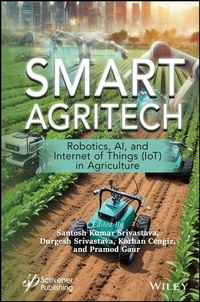
Smart Agritech
Description

The main goal of Smart Agritech: Robotics, AI, and Internet of Things (IoT) in Agriculture is to explore how emerging technologies such as robotics, artificial intelligence (AI), and IoT can be leveraged to improve efficiency, sustainability, and productivity in agriculture.
Agriculture has always been a vital sector of the global economy, providing food and raw materials for industries and households. However, with the growing population, changing climate conditions, and limited resources, the agriculture sector faces numerous challenges. To address these challenges, farmers and agricultural companies are turning to advanced technologies such as Robotics, Artificial Intelligence (AI), and the Internet of Things (IoT).
This exciting new volume provides a comprehensive overview of the latest technological advances in agriculture, focusing on these three cutting-edge technologies. The book will explore the potential benefits of these technologies in improving agricultural efficiency, productivity, and sustainability.
Whether for the veteran engineer, scientist in the lab, student, or faculty, this groundbreaking new volume is a valuable resource for researchers and other industry professionals interested in the intersection of technology and agriculture.
More details
Other editions
Additional editions
Persons
Santosh Kumar Srivastava, PhD, is an assistant professor in the Department of Computer Science and Engineering, School of Computing Science and Engineering, Galgotias University, Uttar Pradesh, India, since 2022. He completed his PhD in Computer Science and Engineering in 2021 from Shri JJT University, Jhunjhunu, Rajasthan, India. He has 20 years of IT administration, research, and academic experience and has published over 15 papers in reputed scientific journals and conferences. He also has five patents to his credit and is a member of IEEE, ACM, and other professional societies.
Durgesh Srivastava, PhD, is an associate professor at Chitkara University Institute of Engineering and Technology, Chitkara University, Rajpura, Punjab, India. He received his PhD degree in computer science and engineering from IKG Punjab Technical University, Jalandhar, Punjab, India in 2020. He has over 14 years of research and academic experience and has published over 30 papers in reputed scientific journals and conferences. He has published several patents and one book.
Korhan Cengiz, PhD, is an associate professor in the department of Computer Engineering, Istinye University, Istanbul, Turkey. He earned his PhD in electronics engineering from Kadir Has University, Turkey in 2016. He has published more than 40 articles in scientific journals, holds five international patents, has published more than ten book chapters, and one book. He has edited over 20 books and is the Associate Editor of IEEE Transactions on Intelligent Transportation Systems, IEEE Potentials Magazine, and holds editor positions with other reputed scientific publishers. He has presented more than 40 keynote talks at reputed conferences, and he has earned numerous awards for his research.
Pramod Gaur, PhD, is an assistant professor of computer science in the Department of Computer Science, BITS Pilani Dubai Campus, Dubai, UAE. He received his PhD from Ulster University, U.K., in 2018. Previously, he also worked as Assistant Professor at the LNMIIT, Jaipur, and a Postdoctoral RA in Neuro-Imaging Technology with the Intelligent Systems Research Centre, Ulster University. His research interests include brain-computer interface, the analysis of non-stationary signals, and machine learning.
Content
Preface xxiii
1 Introduction to Smart Farming: Definition, Importance and Trends 1
Manoj Kumar Mahto, Santosh Kumar Srivastava and Basant Sah
2 Overview of Robotics in Agriculture: Types and Applications 29
Praveen Kantha, Durgesh Srivastava, Santosh Kumar Srivastava, Sunil Kr. Maakar and Basant Sah
3 Digital Farming: The New Era of Agriculture-Opportunities and Challenges 57
Anju Khandelwal and Avanish Kumar
4 Challenges and Barriers to Smart Farming Adaptation: A Technical, Economic, and Social Perspective 75
Shivam Tiwari, Barkha Bhardwaj, Deepak Arora and Sabita Khatri
5 Sustainable Development in Agriculture: Soil Management 113
Shivani Dubey, Rishav Yadav, Vikas Singhal and Anoop Dixit
6 Concepts of Robotics, AI, and Internet of Things (IoT) in Agriculture 143
Devesh Kumar Bandil and Pankaj Rahi
7 Data Analytics in Agriculture: Predictive Models and Real-Time Decision-Making 169
Raman Kumar, Harpreet Kaur Channi and Harish Kumar Banga
8 Examining the Role of IoT and AI in Revolutionizing Agriculture: A Smart Farming Approach 201
Santosh Kumar Srivastava, Manoj Kumar Mahto, Sheo Kumar, Deepak Kumar Verma and Hare Ram Singh
9 Smart AgriTech: Sensors & Networks 227
Bikram Kar and Amit Kumar
10 Internet of Things in Agriculture: Sensor, Network and Communication Protocol 261
Rajeev Kumar, Surinder Singh and Prem Prakash
11 An Irrigation System: Design, Implementation, and Benefits 309
Shilpa Mahajan
12 Implementation of Smart Irrigation Systems 329
Jabar H. Yousif, Ghassan Al-Kindi, Ahmad. K. Kayed and Durgesh K. Srivastava
13 Smart Plant-Based Wastewater Treatment for Agricultural Irrigation Systems 351
Rituparna Saha and Amit Biswas
14 Drones in Agriculture: Mapping, Monitoring, and Decision-Making 373
Umangkumar B. Zalavadiya
15 Investigation of Banana Plant Disease Detection Using Transfer Learning 393
R. Karthickmanoj and S. Aasha Nandhini
16 Exploring Dataset for Apple Leaf Disease Detection: A Focus on Horticulture 419
Anupam Bonkra, Sunil Pathak and Amandeep Kaur
17 Optimizing Crop Yield Prediction Using Machine Learning Algorithms 443
Rejuwan Shamim and Trapty Agarwal
18 Analyzing Smart Farming Technologies: A Study on Indian Farmers' Adoption Trends 489
Nilesh Tejrao Kate, Upasana Acharya and Chandraprabha Vaidya
19 Leveraging Linear Regression Model to Address Food Insecurity in the United States: A Smart Agritech Approach 505
Anoushka Tomar, Shivani Dubey, Vikas Singhal and Ajay Kumar Sahu
About the Editors 545
Index 547
Preface
Agriculture has always been a vital sector of the global economy, providing food and raw materials for industries and households. However, with the growing population, changing climate conditions, and limited resources, the agriculture sector is facing numerous challenges. To address these challenges, farmers and agricultural companies are turning to advanced technologies such as robotics, artificial intelligence (AI), and the Internet of things (IoT).
This book entitled "Smart Agritech: Robotics, AI, and Internet of Things (IoT) in Agriculture" aims to provide a comprehensive overview of the latest technological advances in agriculture, focusing on the use of these three cutting-edge technologies. The book will explore the potential benefits of these technologies in improving agricultural efficiency, productivity, and sustainability.
Furthermore, the book will be written in a clear and concise manner that is accessible to a wide range of readers, from farmers and agribusiness professionals to researchers and students. It will be an ideal resource for those who wish to understand the potential of smart agriculture techniques and how they can be implemented to improve farm productivity, sustainability, and profitability. Finally, this book will provide a unique perspective by including case studies from developing countries, demonstrating how smart agriculture techniques can be adapted and applied in a variety of contexts. This sets it apart from many other books that focus primarily on developed countries and their agricultural systems.
Chapter 1
This chapter discusses how advanced technologies such as sensors, drones, and IoT are utilized in Smart farming to boost agricultural efficiency, productivity, and sustainability while addressing global food demand and environmental issues. It facilitates data collection and analysis to make informed decisions, optimizing crop growth and resource management by monitoring factors like soil moisture, temperature, and pests. Precision agriculture, employing data-driven farming techniques, and the use of autonomous robots and drones for tasks are highlighted. The IoT plays a vital role in monitoring variables, aiding waste reduction and productivity enhancement. Smart farming's benefits include increased yield, cost reduction, and improved sustainability, making it a crucial solution for future food demands amidst population growth.
Chapter 2
This chapter explores the diverse range of robotic technologies revolutionizing agricultural operations. From autonomous drones to robotic harvesters, it examines the various types and their applications across different stages of farming. By providing insights into the integration of robotics, this chapter aims to showcase the potential benefits for farmers, including increased efficiency, reduced labor costs, and sustainable practices. Ultimately, this overview serves as a gateway to understanding how robotics is reshaping the landscape of agriculture worldwide.
Chapter 3
This chapter explores how digital innovations are reshaping traditional farming practices, presenting both opportunities and challenges. By embracing digital tools such as IoT, AI, and data analytics, farmers can enhance productivity, efficiency, and sustainability. However, this digital revolution also poses challenges such as data security, access, and the digital divide in rural areas. Through insightful analysis and case studies, this chapter navigates the complexities of digital farming, offering a comprehensive understanding of its potential and hurdles.
Chapter 4
This chapter explores the hurdles faced by farmers as they navigate technical complexities, economic constraints, and social factors in adopting smart farming practices. Through an in-depth examination, we aim to shed light on the intricate challenges inhibiting the widespread adoption of these transformative technologies in agriculture. By analyzing the interplay between technology, economics, and society, this chapter offers valuable insights into overcoming barriers and fostering the successful integration of smart farming solutions. Our exploration underscores the importance of understanding and addressing the diverse challenges encountered on the path toward sustainable and efficient agricultural practices.
Chapter 5
This chapter explores innovative strategies and technologies aimed at preserving soil health while maximizing productivity. By addressing soil degradation and nutrient depletion, we aim to foster resilient farming practices in the face of environmental challenges. Through a comprehensive examination of soil management techniques, we seek to empower farmers with the knowledge and tools needed to cultivate healthy soils and secure food production for future generations. Join us on a journey to unlock the potential of sustainable soil management in shaping the future of agriculture.
Chapter 6
This chapter explores the transformative potential of robotics, AI, and IoT in agriculture. We delve into how these cutting-edge technologies are revolutionizing traditional farming practices. From autonomous robots to AI-driven decision-making, uncover the ways in which agriculture is evolving. The integration of IoT devices offers real-time monitoring and data analysis for optimized crop management. Join us on a journey to discover the conceivable advancements reshaping the landscape of modern agriculture.
Chapter 7
This chapter delves into the transformative potential of data analytics within agriculture, focusing on predictive models and real-time decision-making. It explores how harnessing data can revolutionize farming practices, enhancing efficiency and sustainability. By employing advanced analytics techniques, farmers can make informed decisions based on real-time insights, optimizing crop yield and resource allocation. This chapter discusses the integration of data-driven approaches into traditional farming methods, highlighting the benefits of predictive modeling for anticipating crop performance and mitigating risks. Through case studies and examples, it illustrates the practical applications of data analytics in modern agriculture, paving the way for a more resilient and productive food system.
Chapter 8
This chapter explores the transformative impact of IoT and AI on modern agriculture, focusing on smart farming approaches. By examining the integration of advanced technologies like sensors, drones, and AI, it explores how they enhance efficiency, productivity, and sustainability in farming practices. Through data-driven insights and informed decision-making, smart farming optimizes crop growth and resource utilization while addressing global food demand and environmental concerns. This exploration underscores the pivotal role of precision agriculture and autonomous systems in revolutionizing traditional farming methods. Ultimately, this chapter offers a comprehensive analysis of how IoT and AI are reshaping the agricultural landscape, paving the way for a more sustainable and productive future.
Chapter 9
This chapter provides a comprehensive examination of how IoT is transforming agriculture, revolutionizing farming practices through the interconnection of physical devices via the internet. It delves into the applications of IoT in agriculture, showcasing its advantages such as heightened efficiency, reduced waste, and increased crop yields, while also addressing challenges like infrastructure costs and rural connectivity limitations. Emphasizing the pivotal role of sensor-based IoT, the chapter illustrates how sensors collect crucial data on crops, soil, weather, and livestock, thereby optimizing agricultural techniques. It also highlights the significance of selecting appropriate network and communication protocols tailored to diverse farm locations. Through real-world case studies spanning countries like India, Thailand, China, Malaysia, the Philippines, and the United States, the chapter vividly demonstrates IoT's transformative influence on farming practices worldwide.
Chapter 10
This chapter delves into the transformative role of the Internet of things (IoT) in modern agriculture, focusing on sensors, networks, and communication protocols. It explores how IoT technologies revolutionize farming practices, offering insights into enhanced productivity, resource optimization, and sustainability. Through an examination of sensor deployment, network infrastructure, and communication protocols, we uncover the intricate web of interconnected systems driving agricultural innovation. This chapter provides a comprehensive overview of the IoT's integration into agriculture, offering practical insights for farmers, researchers, and industry professionals. By understanding the dynamics of IoT in agriculture, readers gain valuable perspectives on the future of farming and its pivotal role in addressing global food security challenges.
Chapter 11
This chapter offers comprehensive insights into the design and implementation of irrigation systems, highlighting their significance in agricultural settings. Readers will explore various irrigation techniques, their practical applications, and the benefits they bring to crop cultivation. From traditional methods to cutting-edge technologies, this chapter provides a holistic view of irrigation systems' evolution and their role in enhancing agricultural productivity. Whether you are a seasoned farmer or a curious enthusiast, this chapter aims to broaden your understanding of irrigation systems and their invaluable contributions to...
