

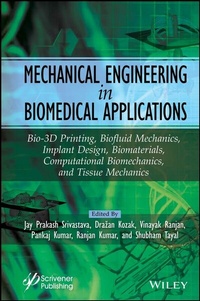
Mechanical Engineering in Biomedical Application
Description

The book explores the latest research and developments related to the interdisciplinary field of biomedical and mechanical engineering offering insights and perspectives on the research, key technologies, and mechanical engineering techniques used in biomedical applications.
The book is divided into several sections that cover different aspects of mechanical engineering in biomedical research. The first section focuses on the role of additive manufacturing technologies, rehabilitation in healthcare applications, and artificial recreation of human organs. The section also covers the advances, risks, and challenges of bio 3D printing. The second section presents insight into biomaterials, including their properties, applications, and fabrication techniques. The section also covers the use of powder metallurgy methodology and techniques of biopolymer and bio-ceramic coatings on prosthetic implants. The third section covers biofluid mechanics, including the mechanics of fluid flow within our body, the mechanical aspects of human synovial fluids, and the design of medical devices for fluid flow applications. The section also covers the use of computational modeling to study the blockage of carotid arteries. The final section elaborates on soft robotic manipulation for use in medical sciences.
Audience
The book provides practical insights and applications for mechanical engineers, biomedical engineers, medical professionals, and researchers working on the design and development of biomedical devices and implants.
More details
Other editions
Additional editions
Persons
Jay Prakash Srivastava is an assistant professor at GITAM University, Hyderabad, India. He received PhD in mechanical engineering from the Indian Institute of Technology (ISM) Dhanbad, India.
Drazan Kozak is Professor of mechanical engineering and applied mechanics at the Mechanical Engineering Faculty, University of Slavonski Brod, Croatia.
Vinayak Ranjan has a PhD in mechanical engineering from the Indian Institute of Technology (BHU), Varanasi. Dr. Ranjan is currently a visiting professor in the Department of Mechanical Engineering at Rowan University, New Jersey, USA.
Pankaj Kumar is the Director of the Center for Materials and Manufacturing Department of Mechanical Engineering, SR University, Warangal, India.
Ranjan Kumar is an assistant professor in the Department of Mechanical Engineering at Swami Vivekananda University, Kolkata, India.
Shubham Tayal is a Senior Layout Design Engineer at Synopsys India Pvt Ltd.
Content
Preface xiii
Acknowledgments xv
Part I: Additive Manufacturing 1
1 The Role of Additive Manufacturing Technologies for Rehabilitation in Healthcare and Medical Applications 3
Vidyapati Kumar, Ankita Mistri and Abhishek Mohata
2 Artificial Recreation of Human Organs by Additive Manufacturing 23
Neetesh Soni and Paola Leo
3 Advances, Risks, and Challenges of 3D Bioprinting 43
Chinmaya Padhy, Manish Amin, Suhridh Sundaram and Priyanka Paul
4 Laser-Induced Forward Transfer for Biosensor Application 77
Ankit Das, Samarpan Deb Majumder, Drazan Kozak and Chien-Fang Ding
Part II: Biomaterials 119
5 The Effect of the Nanostructured Surface Modification on the Morphology and Biocompatibility of Ultrafine-Grained Titanium Alloy for Medical Application 121
Dragana Mihajlovic, Marko Rakin, Anton Hohenwarter, Djordje Veljovic, Vesna Kojic and Veljko Djokic
6 Powder Metallurgy-Prepared Ti-Based Biomaterials with Enhanced Biocompatibility 151
Sugár, P., Antala, R., Sugárová, J. and Kovácik, J.
7 Total Hip Replacement Response to a Variation of the Radial Clearance Through In Silico Models 185
Alessandro Ruggiero and Alessandro Sicilia
8 Techniques of Biopolymer and Bioceramic Coatings on Prosthetic Implants 231
Sikta Panda, Chandan Kumar Biswas and Subhankar Paul
9 Mechanical Behavior of Bioglass Materials for Bone Implantation 261
Md Ershad and Ranjan Kumar
10 Biomedical Applications of Composite Materials 277
Mulugundam Siva Surya, Atla Sridhar and Maddula Satya Prasad
Part III: Biofluid Mechanics 291
11 Materials Advancement, Biomaterials, and Biosensors 293
Ashish Kumar Bhui, Priyanka Singh, Yunus Raza Baig, Sanvedna Shukla, Satish Sen, Amar Dey and Rajmani Patel
12 Blockage Study in Carotid Arteries 327
Bushra Khatoon and M. Siraj Alam
13 Mechanical Properties of Human Synovial Fluid: An Approach for Osteoarthritis Treatment 343
Sunil More, K. L. Vasudev, N.N. Krishnadas and Ankit Kotia
14 Artificial Human Heart Biofluid Simulation as a Boon to Humankind: A Review Study 355
Md Akhtar Khan
Part IV: Robotics 367
15 Robotics in Medical Science 369
Sourav Karmakar, Akanksha Mishra, Anand Kumar Mishra and Jay Prakash Srivastava
16 A Research Perspective on Ankle-Foot Prosthetics Designs for Transtibial Amputees 397
Vidyapati Kumar, Pushpendra Gupta and Dilip Kumar Pratihar
References 410
Index 413
