

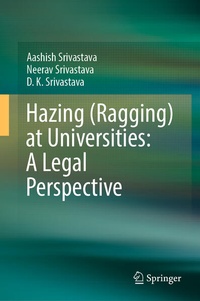
Hazing (Ragging) at Universities: A Legal Perspective
Description

This is the first socio-legal multi-jurisdictional study on hazing (ragging). This book considers four countries: the USA, India, Sri Lanka, and Australia. It states the legal position, identifies lacunas in law, and proposes possible legal solutions. Unfortunately, laws, regulations, and policies have failed to stamp out hazing from university campuses and residential colleges.
Hazing has spiralled out of control in a number of countries. It has descended into a cruel, barbaric, and inhuman practice. The number of students subjected to hazing and sexual abuse is alarming. According to a 2022 survey, more than half (53%) of American students who were part of a fraternity or sorority experienced hazing. Students are murdered, harmed, abused, and suffer long-term trauma. The prevention of hazing is one of the most important responsibilities of 21st century universities.
The theme of the book is that universities are in the best position to protect students from hazingand must play a vital role. As a sociological study, the book also considers why hazing occurs and what can be done to prevent it. Without engaging with the underlying causes, legal punitive measures continue to address the symptom rather than the cause. The book, therefore, explores how a more innovative approach to regulation can help tackle the cause.
The book will be of interest to policy makers, regulators at universities, education and legal academics, and personal injury lawyers.
More details
Other editions
Additional editions
Persons
Dr. Srivastava is a Senior Lecturer in the Department of Business Law and Taxation at Monash University. He was admitted to legal practice in Delhi, India. His articles and academic works have been published in the United States of America, the UK, Australia, Hong Kong, India, and the Czech Republic. He has published a book (Springer, 2014) and scholarly and research chapters and articles in journals such as the Torts Law Journal (Australia), Oxford University Commonwealth Law Review (UK), Journal of Business Law, Rutgers Computer and Technology Law Review, Common Law World Review, Journal of World Trade, Electronics Market, Information Technology and People, and African Journal of International and Comparative Law.
Professor Srivastava was a professor of law and the foundation Pro Vice Chancellor of OP Global University. He has over forty years of teaching and research experience in four jurisdictions: Australia, Papua New Guinea (PNG), Hong Kong, and India occupying senior positions. He has a large publishing portfolio that includes authoring, co-authoring, editing, or co-editing over 25 books; and publishing articles in respected journals, including Harvard International Law Journal, International and Comparative Law Quarterly, Oxford University Commonwealth Law Journal, Monash University Law Review, Australian Journal of Corporate Law, Canterbury Law Review, Oregon Law Review, Journal of Psychosocial Research, and Tort Law Journal. His specialisations include torts, contracts, and customary law, with a particular focus on underexplored legal areas.Neerav Srivastava is a teaching associate and PhD student at Monash, specializing in law, technology and society. Neerav has published articles in respected journals, written chapters for books, and has been cited in court decisions with approval. The journals in which his articles have been published include Torts Law Journal (Australia), Adelaide Law Review, Insolvency Law Journal, Hong Kong Law Journal, Competition and Consumer Law Journal, and Oxford University Commonwealth Law Review.
