

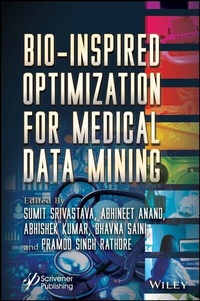
Bio-Inspired Optimization for Medical Data Mining
Description

This book is a comprehensive exploration of bio-inspired optimization techniques and their potential applications in healthcare.
Bio-Inspired Optimization for Medical Data Mining is a groundbreaking book that delves into the convergence of nature's ingenious algorithms and cutting-edge healthcare technology. Through a comprehensive exploration of state-of-the-art algorithms and practical case studies, readers gain unparalleled insights into optimizing medical data processing, enabling more precise diagnosis, optimizing treatment plans, and ultimately advancing the field of healthcare.
Organized into 15 chapters, readers learn about the theoretical foundation of pragmatic implementation strategies and actionable advice. In addition, it addresses current developments in molecular subtyping and how they can enhance clinical care. By bridging the gap between cutting-edge technology and critical healthcare challenges, this book is a pivotal contribution, providing a roadmap for leveraging nature-inspired algorithms.
In this book, the reader will discover
- Cutting-edge bio-inspired algorithms designed to optimize medical data processing, providing efficient and accurate solutions for complex healthcare challenges;
- How bio-inspired optimization can fine-tune diagnostic accuracy, leading to better patient outcomes and improved medical decision-making;
- How bio-inspired optimization propels healthcare into a new era, unlocking transformative solutions for medical data analysis;
- Practical insights and actionable advice on implementing bio-inspired optimization techniques and equipping effective real-world medical data scenarios;
- Compelling case studies illustrating how bio-inspired optimization has made a significant impact in the medical field, inspiring similar success stories.
Audience
This book is designed for a wide-ranging audience, including medical professionals, healthcare researchers, data scientists, and technology enthusiasts.
More details
Other editions
Additional editions
Persons
Sumit Srivastava, PhD, is the director of Information Technology at Manipal University, Jaipur, India. He obtained his doctorate in data mining from the University of Rajasthan, India. His areas of research involve algorithms, data science, knowledge, and engineering education. He has published more than 70 research papers in review journals.
Abhineet Anand, PhD, is a professor in computer science and engineering at Chandigarh University, Mohali, Punjab. He is also the director of the institution. His research includes artificial intelligence, machine learning, cloud computing, optical fiber, etc. He has published in various international journals and conferences, along with four book chapters.
Abhishek Kumar, PhD, is an associate professor in the Computer Science & Engineering Department at Chandigarh University, Punjab, India, and is affiliated with the University of Castilla-La Mancha (UCLM), Toledo, Spain. His research areas include artificial intelligence, renewable energy, image processing, and machine learning. In total, he has more than 100 publications in peer-reviewed journals. Kumar is a keynote speaker and a member of various national and international societies in the field of engineering and research. He was awarded the CV Ramen National Award in 2018 in the young researcher and faculty category.
Bhavna Saini, PhD, is an assistant professor at Central University, Rajasthan, India. His areas of research include face recognition and fingerprint recognition, data management systems, machine learning, and computer vision. He has numerous books and research papers at national and international levels.
Pramod Singh Rathore is an assistant professor in the Department of Computer and Communication Engineering, Manipal University Jaipur, India. He has teaching experience of more than 10 years and has 45 publications in peer-reviewed national and international journals.
Content
Preface xv
1 Bioinspired Algorithms: Opportunities and Challenges 1
Shweta Agarwal, Neetu Rani and Amit Vajpayee
1.1 Introduction 2
1.2 Bioinspired Principles and Algorithms 3
1.3 Opportunities of Bioinspired Algorithms 7
1.4 Challenges of Bioinspired Algorithms 9
1.5 Prominent Bioinspired Algorithms 12
1.6 Applications of Bioinspired Algorithms 18
1.7 Future Research Directions 21
1.8 Conclusion 23
2 Evaluation of Phytochemical Screening and In Vitro Antiurolithiatic Activity of Myristica fragrans by Titrimetry Method Using Machine Learning 31
G. Lalitha, S. Surya and M.P. Karthikeyan
2.1 Introduction 32
2.2 Methodology 33
2.3 Result and Discussion 35
2.4 Conclusion 38
3 Parkinson's Disease Detection Using Voice and Speech--Systematic Literature Review 41
Ronak Khatwad, Suyash Tiwari, Yash Tripathi, Ajay Nehra and Ashish Sharma
3.1 Introduction 42
3.2 Research Questions 43
3.3 Method 44
3.4 Algorithms 60
3.5 Features 63
3.6 Conclusion 67
4 Tumor Detection and Classification 75
Hermehar P.S. Bedi, Sukhpreet Kaur and Saumya Rajvanshi
4.1 Introduction 76
4.2 Methods Used for Detection of Tumors 77
4.3 Methods Used for Classification of Tumours 80
4.4 Machine Learning 84
4.5 Deep Learning (DL) 89
4.6 Performance Metrics 95
4.7 Method Wise Trend of Using Techniques for Detection of Brain Tumor 97
4.8 Conclusion 97
5 Advancements in Tumor Detection and Classification 103
Mayank Puri, Aman Garg and Lekha Rani
5.1 Introduction 104
5.2 Imaging Techniques Used in Tumor Detection and Classification 105
5.3 Molecular Biology Techniques 111
5.4 Machine Learning and Artificial Intelligence 115
5.5 Tumor Classification 121
5.6 Challenges and Future Directions 125
6 Classification of Brain Tumor Using Machine Learning Techniques: A Comparative Study 129
Gandla Shivakanth, Bhaskar Marapelli, A. Shivakumar Reddy, Dasari Manasa and Samtha Konda
6.1 Introduction 130
6.2 Related Work 131
6.3 Datasets 132
6.4 Experimental Setup 133
6.5 Results and Discussion 134
6.6 Conclusion 136
7 Exploring the Potential of Dingo Optimizer: A Promising New Metaheuristic Approach 141
Anju Yadav and Vivek Kumar Varma
7.1 Introduction 141
7.2 Architecture of Dingo Optimizer 142
7.3 Initialization Process 144
7.4 Iteration Phase 148
7.6 Other Optimization Techniques 150
7.7 Conclusion 151
8 Bioinspired Genetic Algorithm in Medical Applications 155
Krati Taksali, Arpit Kumar Sharma and Manish Rai
8.1 Introduction 156
8.2 The Genetic Algorithm 157
8.3 Radiology 158
8.4 Oncology 160
8.5 Endocrinology 161
8.6 Obstetrics and Gynecology 162
8.7 Pediatrics 162
8.8 Surgery 163
8.9 Infectious Diseases 164
8.10 Radiotherapy 164
8.11 Rehabilitation Medicine 165
8.12 Neurology 165
8.13 Health Care Management 166
8.14 Conclusion 166
9 Artificial Immune System Algorithms for Optimizing Nanoparticle Design in Targeted Drug Delivery 169
Ashish Kumar and Vivek Verma
9.1 Introduction 170
9.2 Artificial Immune Cells 171
9.3 The Artificial Immune System Architecture 172
10 Diabetic Retinopathy Detection by Retinal Blood Vessel Segmentation and Classification Using Ensemble Model 185
Gandla Shivakanth, K. Aruna Bhaskar, Bechoo Lal, A. Shivakumar Reddy and D. Manasa
10.1 Introduction 186
10.2 Literature Review 187
10.3 Proposed System 188
10.4 Conclusion and Future Scope 198
11 Diabetes Prognosis Model Using Various Machine Learning Techniques 201
Pawan Kumar Patidar, Manish Bhardwaj and Sumit Kumar
11.1 Introduction 202
11.2 Literature Review 209
11.3 Proposed Model 211
11.4 Experimental Results and Discussion 213
11.5 Conclusion 222
12 Diagnosis of Neurological Disease Using Bioinspired Algorithms 227
Inam Ul Haq
12.1 Introduction 228
12.2 Neurological Disease Diagnosis 244
12.3 Challenges and Future Directions 260
12.4 Conclusion 264
13 Optimizing Artificial Neural-Network Using Genetic Algorithm 269
Bhavy Pratap and Sulabh Bansal
13.1 Introduction 270
13.2 Methodology 278
13.3 Brief Study on Existing Implementations 283
13.4 Comparative Study on Different Implementations 285
14 Bioinspired Applications in the Medical Industry: A Case Study 289
Alankrita Aggarwal and Mohit Lalit
14.1 Introduction 290
14.2 Overview of Bioinspired Algorithms 291
14.3 Applications of Bioinspired Algorithms in Medical Field 296
14.4 Review of the Case Studies 297
14.5 Case Study 297
14.6 Some Examples of the Case Studies Related to Medical Field and Can Be Solved with Bioinspired Algorithms 300
14.7 Future Directions and Recommendations for Future Research 302
14.8 Conclusion and Summary of Findings 306
References 307
Index 309
Preface
This book is organized into fourteen chapters. Chapter 1 begins by introducing the concept of bio-inspired algorithms and their underlying principles. It then explores the opportunities offered by these algorithms, such as their capacity to locate the best answers in very big and intricate search fields, their robustness in dealing with uncertainty and noise, and their potential for parallel and distributed computing. The chapter will also highlight the application areas where bio-inspired algorithms have shown promising results, including in optimization problems, pattern recognition, and swarm robotics.
In Chapter 2, the semipermeable membrane of an egg was separated and used to assess the Mace spice's in vitro antiurolithiatic efficacy. By performing in vitro urolithiasis on the chosen plant, Mace spice, and using the common medication Neeri, the percentage of kidney stone dissolving was discovered. The Mace spice's ethanol leaf extracts have the greatest medication dissolving rates. Thus, through our research, it has been established that the Mace spice plant contains antiurolithiatic properties.
In Chapter 3, Parkinson's disease (PD) is normally diagnosed in a person after a thorough physical examination by a doctor that considers the patient's medical past, neurological examination, evaluation of motor symptoms, and other supporting tests with precise diagnostic criteria. However, there is no surefire way to identify PD. Furthermore, other medical problems, including arthritis and stroke, should be evaluated on subsequent visits because they can show similarly to Parkinson's disease. Only 80.6% of PD diagnoses are correct overall. Machine learning techniques can be applied in a variety of ways to develop different methods to recognize the presence of PD in an individual, as well as identify it in the initial stages of the disease, to aid doctors in the diagnosis of PD.
Chapter 4 explains the importance of detecting the tumors immediately. Various mechanical methods exist for the detection of tumors, such as Magnetic Resonance Imaging (MRI), Computerized Tomography (CT) Scan, and Positron Emission Tomography (PET) Scan. These scans send the waves into the patient's body to obtain images of the organ or body part affected. Images obtained from these scans are of Digital Imaging and Communications in Medicine (DICOM) format. Different techniques are available for the classification of the tumor, such as segmentation, feature extraction, machine learning techniques, and deep learning models. These techniques are discussed and compared in this chapter, which will help researchers to find the optimal solution for their research in the detection and classification of different tumors and other deadly diseases. Finally, this chapter chronicles all the relevant and important literature related with tumor detection and how it can be classified using new age computer- based technology, such as deep learning and machine learning.
Chapter 5 addresses current developments in molecular subtyping and how they could enhance the precision of tumor categorization. The clinical ramifications of tumor detection and categorization, including diagnosis, prognosis, and treatment planning, are covered in the chapter's concluding section. In order to inform treatment choices, enhance patient outcomes, and save healthcare costs, this section emphasizes the significance of precise tumor diagnosis and classification. Healthcare workers, researchers, and students with an interest in tumor detection and treatment will find the chapter to be an invaluable resource.
In Chapter 6, researchers assessed the performance of these algorithms using a variety of evaluation criteria, including accuracy, precision, recall, and F1 score. Our findings show that, with an accuracy of 90.5%, DNNs outperformed the competition, followed by SVM (85.3%), RF (81.9%), and KNN (78.5%). In order to determine which aspects were most crucial for each algorithm, feature selection was also performed. Various algorithms were discovered that favored various feature sets. This research sheds light on the usefulness of various machine learning algorithms for classifying brain tumors, which will help in the creation of more precise and effective diagnostic equipment for this serious medical disease.
In Chapter 7, a series of mathematical equations simulate dingo behavior in the wild to find the best solutions to a variety of optimization challenges. The dingo optimizer has demonstrated promising results in several applications, including engineering design, financial forecasting, and bioinformatics. The algorithm is rather simple to implement and has the potential to be a useful tool for researchers and practitioners in a wide range of domains.
Chapter 8 discusses how genetic algorithms can be applied to the field of medicine. In addition to pharmacotherapy, other fields such as radiology, surgery, cardiology radiotherapy, pediatrics, endocrinology, obstetrics and gynaecology, pulmonary medicine, orthopaedics, rehabilitation medicine, neurology, infectious diseases, and health care administration have all found promising applications for the genetic algorithm. This chapter explains the genetic algorithm and how it may be used in healthcare administration, disease detection, treatment planning, drug safety monitoring, prognosis, and more. It also aids doctors in envisioning the future applications of this metaheuristic technique in healthcare.
Chapter 9 focuses on compounds that may comprise naturally occurring proteins or carbohydrates in our bodies. The immune system doesn't target these coated nanoparticles because it doesn't recognize them as being foreign when it sees them. Making the nanoparticles small enough to get past the body's natural defenses is another option. Small particles are harder for our immune system to find and recognize. The nanoparticles can therefore avoid detection and enter their target cells if we make them small enough. A computational method called an artificial immune system (AIS) algorithm can be used to create nanoparticles that bypass the immune system and deliver medications to specific cells. The AIS algorithm is inspired by the natural immune system. It is possible to create nanoparticles that can bypass the immune system and deliver medications to specific cells by using an artificial immune system algorithm.
In Chapter 10, the reader will learn about a novel ensemble approach that was developed for accurate blood vessel segmentation and classification. The retinal images had been accumulated from Digital Retinal Images for Vessel Extraction (DRIVE) and Structured Analysis of the Retina (STARE) datasets. The ensemble approach can segment the retinal blood vessels using bio-inspired algorithms and Cuttlefish Algorithm (CFA) for segmentation of the fundus image. The features are then extracted from the segmented pictures using the Enhanced Local Binary Pattern (ELBP) and Inverse Difference Moment Normalized (IDMN) algorithms.
Chapter 11 demonstrates how to predict behaviors and events thanks to data-driven linkages and patterns. Predictive analytics provides a look into the future by using past events. It is important to note that the predictive model was built using previous predictive approaches, even if it is not based on the production of a mathematical model or algorithms for the development of the forecast. Instead, it uses algorithms that are built into the identified tool. It is suggested that, via the usage of the model, the organizations that provide both public and private health services adopt it in a commercial setting, using the model's predictive capabilities for the client's diagnosis and the optimization of consultation procedures.
Chapter 12 focuses on neurological disease diagnosis, providing an overview of common diseases and current diagnostic techniques. It reviews traditional diagnostic methods and their limitations, highlighting the need for alternative approaches. The application of bio-inspired algorithms in neurological disease diagnosis is discussed in detail. Genetic algorithms can optimize feature selection and classification algorithms, as demonstrated through case studies and research findings. Neural networks are explored for their potential in improving disease diagnosis accuracy through bio-inspired optimization techniques. Other bio-inspired algorithms, such as ant colony optimization and particle swarm optimization, are also examined for their applications in feature selection, clustering analysis, and diagnostic model optimization. Finally, the chapter addresses the challenges and limitations associated with the use of bio-inspired algorithms in neurological disease diagnosis. It emphasizes the need for further research and development in this emerging field. Overall, bio-inspired algorithms hold great promise in advancing the field of neurological disease diagnosis, offering new opportunities for accuracy and efficiency.
As shown in Chapter 13, GA synergizes well with NNs to optimize models and approximate parameters, thereby enhancing the effectiveness of NNs. GA can be applied in various ways to design the best ANN for a given problem domain, including optimizing weights, selecting topology, choosing features, training, and improving interpretation. In the sections herein, several studies are presented that utilize different ANN optimization techniques through GA, depending on the research objectives.
Chapter 14 presents a modern idea that employs artificial intelligence and machine learning with a blend of bio-inspired methods. The...
