

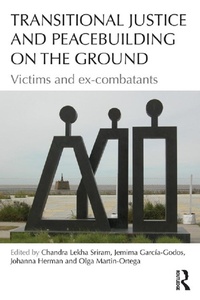
Transitional Justice and Peacebuilding on the Ground
Victims and Ex-Combatants
1st Edition
Published on 7. December 2012
320 pages
978-1-136-19115-2 (ISBN)
Description

This book seeks to refine our understanding of transitional justice and peacebuilding, and long-term security and reintegration challenges after violent conflicts.
As recent events following political change during the so-called 'Arab Spring' demonstrate, demands for accountability often follow or attend conflict and political transition. While traditionally much literature and many practitioners highlighted tensions between peacebuilding and justice, recent research and practice demonstrates a turn away from the supposed 'peace vs justice' dilemma.
This volume examines the complex relationship between peacebuilding and transitional justice through the lenses of the increased emphasis on victim-centred approaches to justice and the widespread practices of disarmament, demobilization, and reintegration (DDR) of excombatants. While recent volumes have sought to address either DDR or victim-centred approaches to justice, none has sought to make connections between the two, much less to place them in the larger context of the increasing linkages between transitional justice and peacebuilding.
This book will be of great interest to students of transitional justice, peacebuilding, human rights, war and conflict studies, security studies and IR.
As recent events following political change during the so-called 'Arab Spring' demonstrate, demands for accountability often follow or attend conflict and political transition. While traditionally much literature and many practitioners highlighted tensions between peacebuilding and justice, recent research and practice demonstrates a turn away from the supposed 'peace vs justice' dilemma.
This volume examines the complex relationship between peacebuilding and transitional justice through the lenses of the increased emphasis on victim-centred approaches to justice and the widespread practices of disarmament, demobilization, and reintegration (DDR) of excombatants. While recent volumes have sought to address either DDR or victim-centred approaches to justice, none has sought to make connections between the two, much less to place them in the larger context of the increasing linkages between transitional justice and peacebuilding.
This book will be of great interest to students of transitional justice, peacebuilding, human rights, war and conflict studies, security studies and IR.
Reviews / Votes
"Is the pursuit of justice a necessary route to lasting peace in post-conflict settings? Do peace-building efforts routinely undermine durable justice? The authors explode this false dichotomy in their exciting new volume. Drawing on recent experiences from Colombia and Sierra Leone to Lebanon and Uganda they consider the trade-offs routinely confronted by traumatised societies at war's end. They show how activities often cast as oppositional, in particular restorative justice versus disarmament, demobilization and reintegration, are more closely aligned than assumed." - Dr. Robert Muggah, Small Arms Survey, Geneva, Switzerland"Through nuanced case studies guided by a fresh analytical framework, the book manages to convey both the local complexity faced by countries undergoing transition, as well as the common challenges and opportunities. It asks practical questions and provides much food for reflection for both academics and practitioners." -- Hugo van der Merwe, Centre for the Study of Violence and Reconciliation (CSVR), Johannesburg, South Africa
More details
Series
Edition
1. Auflage
Language
English
Place of publication
London
United Kingdom
Publishing group
Taylor & Francis Ltd
Target group
College/higher education
Professional and scholarly
File size
4,61 MB
ISBN-13
978-1-136-19115-2 (9781136191152)
Copyright in bibliographic data and cover images is held by Nielsen Book Services Limited or by the publishers or by their respective licensors: all rights reserved.
Schweitzer Classification
Other editions
Additional editions
Chandra Sriram | Jemima Garcia-Godos | Johanna Herman
Transitional Justice and Peacebuilding on the Ground
Victims and Ex-Combatants
Book
11/2013
1st Edition
Routledge
€77.00
Shipment within 15-20 days
Chandra Sriram | Jemima Garcia-Godos | Johanna Herman
Transitional Justice and Peacebuilding on the Ground
Victims and Ex-Combatants
Book
11/2012
1st Edition
Routledge
€222.84
Shipment within 15-20 days
Persons
Chandra Lekha Sriram is Professor in Law at the School of African and Oriental Studies, University of London, UK.
Jemima Garcia-Godos is Associate Professor, Department of Sociology and Human Geography, University of Oslo, Norway.
Johanna Herman is a Research Fellow, Centre on Human Rights in Conflict, University of East London, UK.
Olga Martin-Ortega is a Senior Research Fellow, Centre on Human Rights in Conflict, University of East London, UK.
Jemima Garcia-Godos is Associate Professor, Department of Sociology and Human Geography, University of Oslo, Norway.
Johanna Herman is a Research Fellow, Centre on Human Rights in Conflict, University of East London, UK.
Olga Martin-Ortega is a Senior Research Fellow, Centre on Human Rights in Conflict, University of East London, UK.
Content
1. Introduction Jemima Garcia-Godos and Chandra Lekha Sriram Part 1: Critical Themes 2. Bridging the Gap: The United Nations Peacebuilding Commission and the Challenges of Integrating DDR and Transitional Justice, Dustin Sharp 3. Transitional Justice and Ongoing Conflicts, Par Engstrom 4. Just Peace? Integrating DDR and Transitional Justice, Lars Waldorf 5. Centralizing Legal Pluralism? Traditional Justice in Transitional Contexts, Rosemary Nagy Part 2: Country Case Studies 6. Peacebuilding and Transitional Justice in Cambodia: Attempts at DDR and the Rise of Victim-Centred Justice, Johanna Herman 7. Unfinished business: Peacebuilding, Accountability, and Rule of Law in Lebanon, Chandra Lekha Sriram 8. Building Peace and Delivering Justice in Bosnia and Herzegovina: The Limits of Externally Driven Processes, Olga Martin-Ortega 9. Victim-centred Justice and DDR in Sierra Leone, Chandra Lekha Sriram 10. Tempering Great Expectations: Peacebuilding and Transitional Justice in Liberia, Rosalind Raddatz 11. The Supposed Accountability/Peacebuilding Dilemma in Uganda, Joanna R. Quinn 12. Colombia: Accountability and DDR in the Pursuit of Peace?, Jemima Garcia-Godos 13. The National Accord, Impunity and the Fragile Peace in Kenya, Stephen Brown 14. Conclusions, Chandra Lekha Sriram and Jemima Garcia-Godos
