

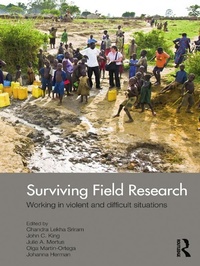
Surviving Field Research
Working in Violent and Difficult Situations
1st Edition
Published on 2. June 2009
280 pages
978-1-134-01018-9 (ISBN)
Description

In recent decades there has been increasing attention to mass atrocities such as genocide, war crimes, crimes against humanity, and other gross human rights violations. At the same time, there has been a vast increase in the number of academics and researchers seeking to analyze the causes of, and offer practical responses to, these atrocities. Yet there remains insufficient discussion of the practical and ethical challenges surrounding research into serious abuses and dealing with vulnerable populations.
The aim of this edited volume is to guide researchers in identifying and addressing challenges in conducting qualitative research in difficult circumstances, such as conducting research in autocratic or uncooperative regimes, with governmental or non-governmental officials, and perhaps most importantly, with reluctant respondents such as victims of genocide or (on the other side of the coin) war criminals. The volume proceeds in five substantive sections, each addressing a different challenge of conducting field research in conflict-affected or repressive situations:
Ethics
Access
Veracity
Security
Identity, objectivity, behaviour.
This important text will be vital reading for students, scholars and researchers in the areas of research methods, international relations, anthropology and human rights. It will also be of keen interest to policy practioners and NGOs, and especially relevant for those working in the regions of Africa, Latin America, and Asia.
The aim of this edited volume is to guide researchers in identifying and addressing challenges in conducting qualitative research in difficult circumstances, such as conducting research in autocratic or uncooperative regimes, with governmental or non-governmental officials, and perhaps most importantly, with reluctant respondents such as victims of genocide or (on the other side of the coin) war criminals. The volume proceeds in five substantive sections, each addressing a different challenge of conducting field research in conflict-affected or repressive situations:
Ethics
Access
Veracity
Security
Identity, objectivity, behaviour.
This important text will be vital reading for students, scholars and researchers in the areas of research methods, international relations, anthropology and human rights. It will also be of keen interest to policy practioners and NGOs, and especially relevant for those working in the regions of Africa, Latin America, and Asia.
Reviews / Votes
Research on civil war and peacebuilding has grown substantially in the past decade, but there is as yet little guidance for those willing to go to the field in the special conditions of conflict zones. This volume of case studies provides a wealth of ethnographic information about what to expect and extremely useful advice from those who have done it. Practitioners as well as students will find it immensely welcome. Susan L. Woodward, The Graduate Center, City University of New York, USAThis sensitive guide to the ethical and practical issues that accompany the conduct of field research in conflict and post-conflict settings is an absolute must for those who care about the safety and well being of those among whom they work. Gracefully written, this collection of the reflections of remarkably talented scholars should make a major impact on thinking about the responsibilities of the field researcher in situations where their questions and conclusions can pose threats to the subjects of their research and to themselves. William Reno, Associate Professor & Director of Graduate Studies, Department of Political Science, Northwestern University, USA 'Research on civil war and peacebuilding has grown substantially in the past decade, but there is as yet little guidance for those willing to go to the field in the special conditions of conflict zones. This volume of case studies provides a wealth of ethnographic information about what to expect and extremely useful advice from those who have done it. Practitioners as well as students will find it immensely welcome.' - Susan L. Woodward, The Graduate Center, City University of New York, USA
'This sensitive guide to the ethical and practical issues that accompany the conduct of field research in conflict and post-conflict settings is an absolute must for those who care about the safety and well being of those among whom they work. Gracefully written, this collection of the reflections of remarkably talented scholars should make a major impact on thinking about the responsibilities of the field researcher in situations where their questions and conclusions can pose threats to the subjects of their research and to themselves.' - William Reno, Associate Professor & Director of Graduate Studies, Department of Political Science, Northwestern University, USA
More details
Edition
1. Auflage
Language
English
Place of publication
London
United Kingdom
Publishing group
Taylor & Francis Ltd
Target group
College/higher education
Professional and scholarly
Product notice
Reflowable
File size
0,59 MB
ISBN-13
978-1-134-01018-9 (9781134010189)
Copyright in bibliographic data and cover images is held by Nielsen Book Services Limited or by the publishers or by their respective licensors: all rights reserved.
Schweitzer Classification
Other editions
Additional editions
Chandra Lekha Sriram | John C. King | Julie A. Mertus
Surviving Field Research
Working in Violent and Difficult Situations
Book
05/2009
1st Edition
Routledge
€292.70
Shipment within 15-20 days
Chandra Lekha Sriram | John C. King | Julie A. Mertus
Surviving Field Research
Working in Violent and Difficult Situations
Book
05/2009
1st Edition
Routledge
€76.40
Shipment within 15-20 days
Persons
Chandra Lekha Sriram is Professor of Human Rights and Director of the Centre on Human Rights in Conflict at the University of East London, UK.
John C. King is scholar-in-residence at the American University, USA.
Julie A. Mertus is Associate Professor and Co-Director of the MA program in Ethics, Peace and Global Affairs at the American University, USA.
Olga Martin-Ortega is Senior Research Fellow at the Centre on Human Rights in Conflict at the University of East London, UK.
Johanna Herman is Research Fellow at the Centre on Human Rights in Conflict at the University of East London, UK.
John C. King is scholar-in-residence at the American University, USA.
Julie A. Mertus is Associate Professor and Co-Director of the MA program in Ethics, Peace and Global Affairs at the American University, USA.
Olga Martin-Ortega is Senior Research Fellow at the Centre on Human Rights in Conflict at the University of East London, UK.
Johanna Herman is Research Fellow at the Centre on Human Rights in Conflict at the University of East London, UK.
Content
1. Introduction: Surviving Research Julie Mertus 2. Demystifying field research John C. King Part 1: Ethics 3. Exceeding Scholarly Responsibility: IRBs and Political Constraints Judy Hemming 4. Methods and Ethics with Research Teams and NGOs: Comparing Experiences Across the Border of Rwanda and Democratic Republic of Congo Elizabeth Levy Paluck 5. Maintenance of Standards of Protection during Writeup and Publication Chandra Lekha Sriram Part 2: Access 6. Got Trust? The Challenge of Gaining Access in Conflict Zones Julie Norman 7. From Cell Phones to Coffee: Issues of Access in Egypt Courtney Radsch 8. "That is not what we authorised you to do...": Access and Government Interference in Highly Politicised Research Environments Susan Thomson Part 3: Veracity 9. Researching Repellent Groups: Some Methodological Considerations on How to Represent Militants, Radicals, and Other Belligerents Carolyn Gallaher 10. Interpreting Truth and Lies in Stories of Conflict and Violence Lee Ann Fujii Part 4: Security 11. Maintenance of Personal Security: Ethical and Operational Issues Julie Mertus 12. Impact on Research of Security Seeking Behaviour Amy Ross Part 5: Identity, Objectivity, Behaviour 13. Fieldwork, Objectivity, and the Academic Enterprise Marie-Joelle Zahar 14. Dilemmas of Self-Representation and Conduct in the Field Stephen Brown 15. There and Back: Surviving Research in Violent and Difficult Situations Olga Martin-Ortega and Johanna Herman
