

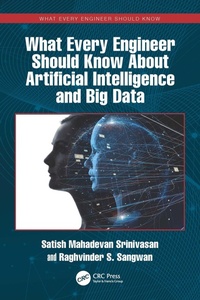
What Every Engineer Should Know About Artificial Intelligence and Big Data
1st Edition
Will be published approx. on 30. July 2026
316 pages
978-1-040-65964-9 (ISBN)
Description

Recognizing the vast potential in analyzing big data through machine learning (ML) and artificial intelligence (AI) technologies, companies are acknowledging these technologies as essential for maintaining relevance. A prevailing trend is emerging toward the adoption of distributed open-source computing for storing big data assets and performing advanced ML/AI analytics to predict future trends and risks for businesses. This book offers readers an overview of the essentials of big data and ML/AI, while acknowledging that the field is extensive and evolving. In addition to focusing on theory, this book shares real-life experiences building AI and big data analytics systems of value to practitioners.
* Features practical case studies on building big data and AI models for large-scale enterprise solutions.
* Discusses the use of design patterns for architecting AI that are safe, secure, and testable.
* Covers an array of concepts, including deep big data analytics, natural language processing, transformer architecture, and evolution of ChatGPT, swarm intelligence, and genetic programming.
Informed by the authors' many years of teaching ML and AI and working on predictive data analytics/AI projects, this book is suitable for use by graduates, professionals, and researchers within the field of data science and engineers and scientists interested in learning more about these essential technologies.
* Features practical case studies on building big data and AI models for large-scale enterprise solutions.
* Discusses the use of design patterns for architecting AI that are safe, secure, and testable.
* Covers an array of concepts, including deep big data analytics, natural language processing, transformer architecture, and evolution of ChatGPT, swarm intelligence, and genetic programming.
Informed by the authors' many years of teaching ML and AI and working on predictive data analytics/AI projects, this book is suitable for use by graduates, professionals, and researchers within the field of data science and engineers and scientists interested in learning more about these essential technologies.
More details
Series
Edition
1. Auflage
Language
English
Place of publication
London
United Kingdom
Publishing group
Taylor & Francis Ltd
Target group
College/higher education
Professional and scholarly
Product notice
Reflowable
Illustrations
32 Tables, black and white; 60 Halftones, black and white; 60 Illustrations, black and white
File size
7,95 MB
ISBN-13
978-1-040-65964-9 (9781040659649)
Copyright in bibliographic data and cover images is held by Nielsen Book Services Limited or by the publishers or by their respective licensors: all rights reserved.
Schweitzer Classification
Other editions
Additional editions

Satish Mahadevan Srinivasan | Raghvinder S. Sangwan
What Every Engineer Should Know About Artificial Intelligence and Big Data
Book
approx. 07/2026
1st Edition
CRC Press
€148.50
Not yet published
Satish Mahadevan Srinivasan | Raghvinder S. Sangwan
What Every Engineer Should Know About Artificial Intelligence and Big Data
Book
approx. 07/2026
1st Edition
CRC Press
€62.00
Not yet published
Persons
Satish Mahadevan Srinivasan is an Associate Professor of Information Science at Pennsylvania State University, Great Valley. He teaches courses related to database design, data mining, data collection and cleaning, data visualization, computer, network and web securities, network analytics and business process management.
Raghvinder S. Sangwan is a Professor of Software Engineering at Pennsylvania State University with expertise in analysis, design, and development of large-scale software-intensive systems, and the use of AI engineering to design and develop intelligent systems that are safe, secure, and trustworthy.
Raghvinder S. Sangwan is a Professor of Software Engineering at Pennsylvania State University with expertise in analysis, design, and development of large-scale software-intensive systems, and the use of AI engineering to design and develop intelligent systems that are safe, secure, and trustworthy.
Content
Part I Foundations and Platforms: Automation and Data Quality at Scale
Chapter 1 Fundamental Concepts in AI
Chapter 2 Big Data and Artificial Intelligence Systems
Chapter 3 Architecting Big Data Pipelines
Chapter 4 Big Data Frameworks and Data Cleaning Strategies
Chapter 5 Building Automated Pipelines for Data Cleaning
Part II Optimization and Search
Chapter 6 Swarm Intelligence
Chapter 7 Genetic Programming
Part III Learning Systems
Chapter 8 Foundations on Machine Learning and Artificial Learning
Chapter 9 Reinforcement Learning
Chapter 10 Deep Reinforcement Learning
Chapter 11 Natural Language Modeling
Chapter 12 Transformer Architecture and Evolution of LLMs
Part IV Systems in the Real World
Chapter 13 Architecting Distributed AI Systems Using Design Patterns
Chapter 14 Securing AI Systems
Chapter 15 AI System Safety in Practice
Chapter 16 Testing Strategies for AI Applications
Answer Keys for Chapter Questions
Chapter 1 Fundamental Concepts in AI
Chapter 2 Big Data and Artificial Intelligence Systems
Chapter 3 Architecting Big Data Pipelines
Chapter 4 Big Data Frameworks and Data Cleaning Strategies
Chapter 5 Building Automated Pipelines for Data Cleaning
Part II Optimization and Search
Chapter 6 Swarm Intelligence
Chapter 7 Genetic Programming
Part III Learning Systems
Chapter 8 Foundations on Machine Learning and Artificial Learning
Chapter 9 Reinforcement Learning
Chapter 10 Deep Reinforcement Learning
Chapter 11 Natural Language Modeling
Chapter 12 Transformer Architecture and Evolution of LLMs
Part IV Systems in the Real World
Chapter 13 Architecting Distributed AI Systems Using Design Patterns
Chapter 14 Securing AI Systems
Chapter 15 AI System Safety in Practice
Chapter 16 Testing Strategies for AI Applications
Answer Keys for Chapter Questions
