

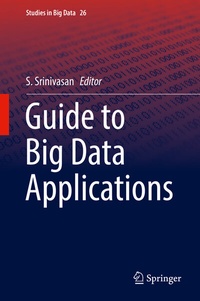
Guide to Big Data Applications
Description

This handbook brings together a variety of approaches to the uses of big data in multiple fields, primarily science, medicine, and business. This single resource features contributions from researchers around the world from a variety of fields, where they share their findings and experience. This book is intended to help spur further innovation in big data. The research is presented in a way that allows readers, regardless of their field of study, to learn from how applications have proven successful and how similar applications could be used in their own field. Contributions stem from researchers in fields such as physics, biology, energy, healthcare, and business. The contributors also discuss important topics such as fraud detection, privacy implications, legal perspectives, and ethical handling of big data.
Reviews / Votes
"The purpose is to provide an understanding of the basic aspects of big data, data privacy, and how to incorporate them in various fields. . There is a vast audience in multiple fields that would benefit from this book -- scientists, business professionals, medical professionals, researchers, and anyone interested in learning the basics of big data and its practical applications. . recommended for anyone interested in applying big data in any field, such as business, marketing, science, and so on." (Puja Sitwala, Doody's Book Reviews, August, 2017)More details
Other editions
Additional editions
Person
Dr. S. Srinivasan is the Associate Dean for Academic Affairs and Research as well as the Distinguished Professor of Information Systems at the Jesse H. Jones (JHJ) School of Business at Texas Southern University (TSU) in Houston, Texas, USA. He is the Director of Graduate Programs at the JHJ School of Business. Prior to coming to TSU, he was Chairman of the Division of International Business and Technology Studies at Texas A & M International University in Laredo. He spent 23 years at the University of Louisville (UofL) in Kentucky where he started the Information Security Program as a collaborative effort of multiple colleges. He was Director of the InfoSec program until 2010 when he left for Texas. The program was designated a National Center of Academic Excellence in Information Assurance Education by the US National Security Agency and the Department of Homeland Security. He successfully wrote several grant proposals in support of the InfoSec Program. His two books on Cloud Computing are "Security, Trust, and Regulatory Aspects of Cloud Computing in Business Environments" and "Cloud Computing Basics". His area of research is Information Security. He is the Editor-in-Chief for the Southwestern Business Administration Journal. He has taught Management of Information Systems and Computer Science courses. He spent his sabbatical leaves from UofL at Siemens in their R & D facility in Munich, Germany; UPS Air Group in Louisville, KY; and GE Appliance Park in Louisville, KY. Besides these industry experiences, he has done consulting work for US Army, IBM and a major hospital company in Louisville, KY. He is currently a Cybersecurity Task Force member of the Greater Houston Partnership.
