

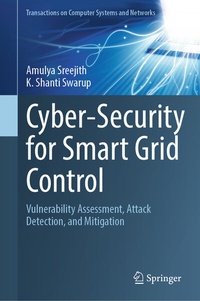
Cyber-Security for Smart Grid Control
Description

The book focuses on a very important area of Smart Grids - cyber security. It deals in particular with the tools and techniques for cyber security analysis of the Smart Grid control systems. This includes the standards and guidelines, detailed vulnerability assessment framework, attack detection strategies, and attack mitigation methods. The book is divided into three parts. The smart grid cyber-physical system is discussed in the first part. The second part introduces the attacks in the grid system and a vulnerability assessment framework followed by a tool that can be used to analyze the grid control systems using existing cyber security standards. In the third part, different forms of attack detection methods are discussed along with Python-based implementations for the same. The book also discusses attack mitigation methods with implementation. Detailed illustrations and tables are provided in each section. The book also includes case studies based on standard test systems thushelping students to implement the discussed methods. The case studies are based on MATLAB and Python implementations thus catering to a wide range of audiences. Outputs and screenshots of the tools and programs are included so students can compare their results and improve upon the discussed methods. The book will be useful to a wide variety of audiences such as students and researchers in Smart Grids, power system operators, and device manufacturers.
More details
Other editions
Additional editions
Persons
Dr. Amulya Sreejith is presently a Postdoc Fellow in the Department of Electrical and Computer Engineering, Kansas State University, Manhattan, KS. She has completed her PhD from Indian Institute of Technology Madras, India in the area of Cyber Security in Power System Control. She has done her MTech from VNIT Nagpur. Before joining as a postdoc fellow she worked as an R&D scientist at Gridsentry, a power cyber security startup. Her area of interest is in Electrical Power Systems, Automation and Protection, Cyber Systems Security, and Artificial Intelligence for power systems applications.
K. Shanti Swarup is a faculty with the Department of Electrical Engineering, Indian Institute of Technology (IIT) Madras, India. Before joining the department as a visiting faculty member, he held positions at the Mitsubishi Electric Corporation, Osaka, Japan, and Kitami Institute of Technology, Hokkaido, Japan, serving as a visiting research scientist and visiting professor, respectively, from 1992 to 1999. Since 2000, he has been a professor at IIT Madras. His research areas include power systems, smart grids, artificial intelligence, knowledge-based systems, computational intelligence, soft computing, Energy Management Systems (EMS), Supervisory Control and Data Acquisition (SCADA), power system automation, and network protection. He has done research projects with various industries like BHEL, Hitachi, Easun-MR, etc.
Content
Smart Grid Cyber Physical System: An overview.- Smart Grid Control.- Attack Modelling for Smart Grid Control.- Vulnerability Assessment for Multi-Area Load Frequency Control.- MITRE ATT&CK for Smart Grid Cyber-Security.- Signal Processing based Attack Detection.- Machine Learning Based Attack Detection.- Attack Mitigation and Recovery in Smart Grid Control.
