

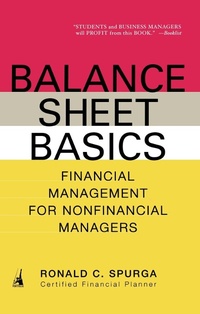
Balance Sheet Basics
Description

More details
Other editions
Additional editions

Person
Content
1. What is Financial Management? Getting the Financial Resources You Need Making a Profit-Your Basic Obligation Managing Assets The Tools of Financial Management Accounting records Financial reports Techniques for analyzing financial statements
2. Financial Statements The Balance Sheet Assets Current assets Fixed Assets "Other" Assets Liabilities Equity Valuation accounts Accounts recievable Losses in the value of inventions Fixed assets Some Examples The Profit-and-Loss Statement: A Retailer of Wholesaler Sales Cost of goods sold Selling Expenses General and administrative expenses Nonoperating income Profit-and-Loss Statement of a Small Manufacturer Raw materials Direct labor Manufacturing overhead Interpreting the Profit-and-Loss Statement Use With Caution!
3. Ratio Analysis of Financial Statements Businesses are not exactly comparable Ratios are computed for specific dates Financial statements show what has happened in the past The ratios are not ends in themselves Measure of Liguidity The current ratio Working capital The acid-test ratio Average collection period Inventory turnover Measures of Profitablity Asset earning power Return on the owner's equity Net profit on sales Investment turnover Return on investment (ROI) Common-size Financial Statements Using the Ratios
4. Control in Business Managemen Success or Failure Relates to How Management Manages Those Who Succeed
Business Ratios and How They Work Statements Reveal Important Relationships Three Kinds of Ratios Ten Key Ratios 1. Current assets to current liabilities 2. Current liabilities to tangible net worth 3. Net sales to tangible net worth 4. Net sales to working capital 5. Net profits to tangible net worth 6. Average collection period of receivables 7. Net sales to inventory 8. Fixed assets to tangible net worth 9. Total debt to tangible net worth 10. Net profit on net sales Analyzing the Profit-and-Loss (Income) Statement Net sales Cost of goods sold Gross profit on sales Selling expenses Operating profit General and administrative expenses Financial expenses Other operating expenses and income Extraordinary charges (if any) Net profit before taxes Taxes Net profit after taxes
6. Standard or Typical Ratios Need for Measurements Growth of Standard Ratio Studies Sampling the Field Obtaining the Figures Assembling the Results Operating Ratios vs. Financial Ratios
7. Ratio Analysis in Action: A Case History
8. Evaluating and Interpreting Ratios The Point of View Interpreting Operating Ratios Cost of Goods Sold and Gross Margin Operating Expenses Wages and salaries Owner's compensation Advertising cost Occupancy cost Bad debt costs Interpreting Balance-Sheet Ratios Current Assets to Current Liabilities Liabilities to Tangible Net Worth Turnover of Tangible Net Worth and Working Capital Net Profits on Tangible Net Worth Average Collection Period Inventory Turnover Fixed Assets to Tangible Net Worth Management Judgement Necessary
9. Looking Ahead The Cash Budget How to do it The cash balance-how much is enough? If you need funds-what kind? Projected Financial Statements The projected profit-and-loss statement The projected balance sheet The cash figure the receivables and inventory accounts Fixed assets Accrued liabilities and long-term debts The accounts payable figure The equity account Points to Remember Looking Still Further Ahead
10. The Different Types of Financing Equity Capital Working Capital Growth Capital SBA Loans SBICs and Other Venture Capital Sources When to Turn to Venture Capitalists
11. Unsecured Borrowings for Working Capital "The Annual Clean-Up" Putting Your Best Foot Forward
12. Secured Working Capital Financing Accounts Receivable Financing Factoring
13. Secured Growth Capital Financing Leasing Conditional Sales Purchases Sale Leasebacks Pulling the Various Elements Together
14. For Further Information Sources of Industry Ratio Data U.S. Government Publications Books
Appendix
Index
