

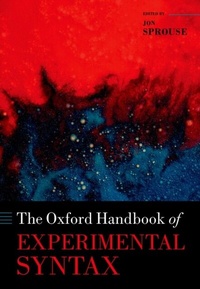
The Oxford Handbook of Experimental Syntax
1st Edition
Published on 15. April 2023
720 pages
978-0-19-251856-9 (ISBN)
Description

This volume showcases the contributions that formal experimental methods can make to syntactic research in the 21st century. Syntactic theory is both a domain of study in its own right, and one component of an integrated theory of the cognitive neuroscience of language. It provides a theory of the mediation between sound and meaning, a theory of the representations constructed during sentence processing, and a theory of the end-state for language acquisition. Given the highly interactive nature of the theory of syntax, this volume defines "experimental syntax" in the broadest possible terms, exploring both formal experimental methods that have been part of the domain of syntax since its inception (i.e., acceptability judgment methods) and formal experimental methods that have arisen through the interaction of syntactic theory with the domains of acquisition, psycholinguistics, and neurolinguistics. The Oxford Handbook of Experimental Syntax brings these methods together into a single experimental syntax volume for the first time, providing high-level reviews of major experimental work, offering guidance for researchers looking to incorporate these diverse methods into their own work, and inspiring new research that will push the boundaries of the theory of syntax. It will appeal to students and scholars from the advanced undergraduate level upwards in a range of fields including syntax, acquisition, psycholinguistics, neurolinguistics, and computational linguistics.
More details
Other editions
Additional editions
Jon Sprouse
The Oxford Handbook of Experimental Syntax
Book
03/2023
Oxford University Press
€190.50
Shipment within 15-20 days
Person
Jon Sprouse is a Professor of Psychology at New York University Abu Dhabi. His research focuses on the use of experimental syntax techniques, including acceptability judgments, EEG, and computational modeling, to explore fundamental questions in syntax. He has authored over forty journal articles and book chapters on experimental syntax, and his work has been recognized by the Best Paper in Language award, the Early Career award, and the C. L. Baker mid-career award from the Linguistic Society of America.
Content
- Part I. Judgment methods in syntactic theory
- 1: Jon Sprouse: Acceptability judgments
- 2: Elsi Kaiser and Jeffrey Runner: Acceptability judgments of binding and coreference: Methodological considerations
- 3: Kriszta Eszter Szendroi: (Quantifier) scope judgments
- 4: Maria Polinsky: Experimental syntax and linguistic fieldwork
- Annotated bibliography for Part I
- Part II. Acquisition methods in syntactic theory
- 5: Laurel Perkins and Jeffrey Lidz: Behavioral acquisition methods with infants
- 6: Kristen Syrett: Behavioral acquisition methods with preschool-age children
- 7: Lisa S. Pearl: Modeling syntactic acquisition
- 8: Jennifer Culbertson: Artificial language learning
- Annotated bibliography for Part II
- Part III. Psycholinguistic methods in syntactic theory
- 9: Masaya Yoshida: Self-paced reading
- 10: Dave Kush and Brian Dillon: Eye-tracking and experimental syntax
- 11: Stephani Foraker, Ian Cunnings, and Andrea E. Martin: Speed-accuracy tradeoff modeling and its interface with experimental syntax
- 12: Tim Hunter: Formal methods in experimental syntax
- 13: Mara Breen and Katy Carlson: Investigating syntactic structure and processing in the auditory modality
- 14: Matthew Wagers and Sandra Chung: Language processing experiments in the field
- Annotated bibliography for Part III
- Part IV. Neurolinguistic methods in syntactic theory
- 15: Jon Sprouse and Diogo Almeida: Electrophysiological methods
- 16: Jonathan R. Brennan: Hemodynamic methods
- 17: William Matchin and Corianne Rogalsky: Aphasia and syntax
- Annotated bibliography for Part IV
- 18: The contributors: The future of experimental syntax
