

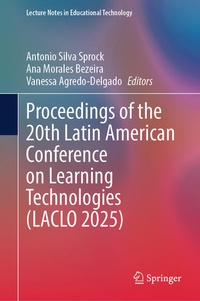
Proceedings of the 20th Latin American Conference on Learning Technologies (LACLO 2025)
Description

This book presents the proceedings of the XX Latin American Conference on Learning Technologies - LACLO 2025, showcasing research and developments in learning technologies in Latin America. It brings together and disseminates emerging innovations and studies that are transforming the educational field in the region. The methods and results presented will be of special interest to readers, as they include case studies, comparative analyses, and methodological proposals that have proven effective in diverse educational contexts. In addition, the book showcases detailed illustrations and tables to facilitate the understanding and application of the concepts presented. It serves as a valuable source of information on advances in educational technology, and enables readers to access an updated and relevant compendium of knowledge that can be implemented to improve teaching and learning practices.
More details
Other editions
Additional editions
Persons
Antonio Silva Sprock has been a full time professor and researcher at the School of Computer Science at Universidad Central de Venezuela since 2005, and for more than 25 years, a professor of Systems Engineering and Computer Science, Artificial Intelligence, Knowledge Engineering, Information and Communication Technology (ICT) in Education, ICT in Social Communication, ICT in Business Administration and Accounting, ICT in Management Sciences, Databases, Information Systems and Technology for All. He is Editor-in-Chief of the International Journal of Learning, Teaching and Educational Research (IJLTER) and the International Journal of Education and Emerging Practices (INJEEP), author of more than 50 papers presented at national and international congresses, 10 book chapters, 20 articles published in refereed journals, and tutor of more than 30 special works for degrees, masters, and doctorates. His research interests are in educational technologies, open science, artificial intelligence, and industry 4.0.
Ana Morales Bezeira has been a full time professor and researcher at the School of Computer Science at Universidad Central de Venezuela since 2004, and has done research stays at the Universidad de las Fuerzas Armadas del Ecuador. She has a Bachelor's Degree in Computer Science from University del Zulia (Venezuela), a Master's Degree in Telematics from Rafael Belloso Chacín University (Venezuela), and a PhD in Computer Science from Universidad Central de Venezuela. She has more than 22 years of experience in university teaching and research of higher education in different universities, and in directing subjects in different topics of technology and communications, education, and social development. She has published articles presented in national and international congresses, book chapters, articles in refereed journals, and tutored more than 20 special works of degrees, masters, and doctorates.
Vanessa Agredo-Delgado is a systems engineer graduated from the Faculty of Electronic Engineering and Telecommunications of the University of Cauca (Colombia) with a Master's degree in Computer Science and a PhD in Electronics Sciences from the same University, obtaining an honorable mention in the latter degree. She has also done research stays at the Universidad de Granada (Spain), Universidad de Castilla la Mancha in Ciudad Real and Albacete (Spain), Universidad Nacional de la Matanza (Argentina), and Universidad Nacional de La Plata Argentina. She has more than 10 years of experience in university teaching in different universities of higher education and in directing subjects in different topics. In addition, she has 10 years of experience in research on different areas of technology and communications, education, and social development, where she has published book chapters and journal papers, edited research books, and participated as a speaker, organizer, and reviewer in scientific events. Her research interests are in software engineering, specifically in the areas of usability, accessibility, software process lines, and learning and computer-assisted collaborative work.
Content
Conceptual design of the PANEG framework: A neurocognitive adaptation of MoCA to analyze the use of generative AI in university students.- Gamification in Education: Design, Development, and Evaluation of an Educational Video Game on Mexican History.- AI-assisted feedback in online teacher training course.- Arte na rua [Street Art]: A Digital Game to Support Art Education in Secondary Education.- Experience of teaching e-commerce during the COVID-19 pandemic: The case of the site for La Cabuya Cuenta in the context of the UNAPROPYMES project.- A Framework for Developing Digital Learning Objects for Culturally Diverse and Low-Connectivity Contexts: Insights from Amazonian Communities.- The Perceptions of Computer Programming Skills Learning for non-ICT Undergraduate Students.- Open Data as a Tool for Technological Extension: Enriching Computer Science Education Through Civic Engagement.- Understanding School Factors Related to Student Absenteeism in Brazilian Public High Schools: Insights for Educational Policy through a Clustering Approach.- Distance Education in Brazil: A Critical Analysis of the New National Policy and epistemological Contributions to Educational Policy Research.- Designing a Generative AI-Powered Intelligent Tutoring System for Introductory Programming: A Teacher-Centered Requirement Analysis.- Digital Technologies, Challenges, and Strategies in Distance Education: A Study with Students from a Brazilian Public University.- Using Logs to support Programming Education.- Data Literacy for High School Students: An Extension Experience with Computing Undergraduate.- Engagement, Motivation, and Use of Artificial Intelligence in Secondary Education.- Designing LLM-Based Educational Chatbots with Pedagogical Grounding.
