

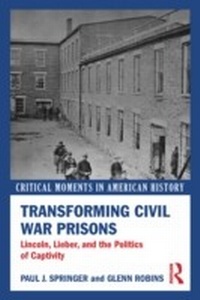
Transforming Civil War Prisons
Lincoln, Lieber, and the Politics of Captivity
1st Edition
Published on 4. September 2014
198 pages
978-1-135-05330-7 (ISBN)
Description

During the Civil War, 410,000 people were held as prisoners of war on both sides. With resources strained by the unprecedented number of prisoners, conditions in overcrowded prison camps were dismal, and the death toll across Confederate and Union prisons reached 56,000 by the end of the war. In an attempt to improve prison conditions, President Lincoln issued General Orders 100, which would become the basis for future attempts to define the rights of prisoners, including the Geneva conventions. Meanwhile, stories of horrific prison experiences fueled political agendas on both sides, and would define the memory of the war, as each region worked aggressively to defend its prison record and to honor its own POWs.
Robins and Springer examine the experience, culture, and politics of captivity, including war crimes, disease, and the use of former prison sites as locations of historical memory. Transforming Civil War Prisons introduces students to an underappreciated yet crucial aspect of waging war and shows how the legacy of Civil War prisons remains with us today.
Robins and Springer examine the experience, culture, and politics of captivity, including war crimes, disease, and the use of former prison sites as locations of historical memory. Transforming Civil War Prisons introduces students to an underappreciated yet crucial aspect of waging war and shows how the legacy of Civil War prisons remains with us today.
Reviews / Votes
Transforming Civil War Prisons explains the historical context for Union and Confederate prison policies, and why neither side was prepared for the unprecedented number of captives this bloody war wrought. Included are informative discussions of the "Lieber Code," excerpts from prison diaries, and a useful overview of prison historiography. This is a valuable book for students of the war and historians seeking to delve deeper into this often overlooked topic.-Lesley J. Gordon, author of The Broken Regiment: The 16th Connecticut's Civil War
This slim volume affords a sweeping view of the many facets of Civil War prisons. Readers are introduced to prison policy, captive experiences, war memory, and historiography, while also illuminating the varieties of captivity. The primary source documents will be especially helpful to students who will be afforded first-hand material while being introduced to this controversial subject.
-Michael P. Gray, author of Business of Captivity: Elmira and its Civil War Prison
More details
Series
Language
English
Place of publication
London
United Kingdom
Publishing group
Taylor & Francis Ltd
Target group
College/higher education
File size
2,47 MB
ISBN-13
978-1-135-05330-7 (9781135053307)
Copyright in bibliographic data and cover images is held by Nielsen Book Services Limited or by the publishers or by their respective licensors: all rights reserved.
Schweitzer Classification
Other editions
Additional editions
Paul J. Springer | Glenn Robins
Transforming Civil War Prisons
Lincoln, Lieber, and the Politics of Captivity
Book
08/2014
1st Edition
Routledge
€56.00
Shipment within 15-20 days
Paul J. Springer | Glenn Robins
Transforming Civil War Prisons
Lincoln, Lieber, and the Politics of Captivity
Book
08/2014
1st Edition
Routledge
€193.50
Shipment within 15-20 days
Persons
Paul J. Springer is Associate Professor of Comparative Military Studies at Air Command and Staff College. He is the author of America's Captives: The History of US Prisoner of War Policy.
Glenn Robins is Professor of History at Georgia Southwestern State University. He is the editor of They Have Left Us Here to Die: The Civil War POW Diary of Sgt. Lyle G. Adair, 111th US Colored Infantry.
Glenn Robins is Professor of History at Georgia Southwestern State University. He is the editor of They Have Left Us Here to Die: The Civil War POW Diary of Sgt. Lyle G. Adair, 111th US Colored Infantry.
Content
1. Prisoner of War Policy and Practice. 2. The Captivity Experience. 3. The Culture of Captivity. 4. The Politics of Captivity. 5. Honoring Civil War Captives. 6. Civil War Prisons in History and Memory. Documents.
