

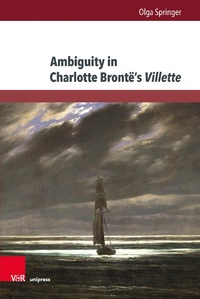
Ambiguity in Charlotte Brontë's Villette
1st Edition
Published on 17. February 2020
283 pages
978-3-8470-1119-4 (ISBN)
Description

Charlotte Brontë's final novel Villette (1853) is associated with ambiguity because of its open ending: Does M. Paul return to narrator-protagonist Lucy Snowe or is he killed in a storm raging on the Atlantic? Taking its famous ending as a starting point, this study explores Villette as a text in which ambiguity is all-pervasive in various ways. Among these is the narrator's ambivalent attitude toward herself and others, epitomised in her stylistic idiosyncrasies. The links between ambiguity and doubt are explored through an analysis of Lucy's signature phrase, 'I know not,' expressive of her existential doubts and questioning attitude toward the world. The analysis moreover focuses on the motif of the oracle as a traditionally ambiguous utterance, and explores its relevance in the context of the generic tradition of Villette as a fictional autobiography. Another focus is the interplay of figurative and literal levels of meaning in the allegorical episodes, creating ambiguity.
Dr Olga Springer is Assistant Professor of German in the School of Applied Language and Intercultural Studies at Dublin City University, Ireland. Her research interests are ambiguity in literary texts and Victorian literature.
Dr Olga Springer is Assistant Professor of German in the School of Applied Language and Intercultural Studies at Dublin City University, Ireland. Her research interests are ambiguity in literary texts and Victorian literature.
More details
Other editions
Additional editions
Olga Springer
Ambiguity in Charlotte Brontë's Villette
Book
02/2020
1st Edition
Brill Deutschland
€55.00
Shipment within 7-9 days
Person
Dr Olga Springer is Assistant Professor of German in the School of Applied Language and Intercultural Studies at Dublin City University, Ireland. Her research interests are ambiguity in literary texts and Victorian literature.
Content
- Intro
- Title Page
- Copyright
- Table of Contents
- Body
- Acknowledgements
- I. Introduction
- 1. Villette and Ambiguity: Starting Points
- 2. Reading (the Chapter) "Villette"
- 3. An Image of Ambiguity
- 4. The Metamorphoses of Villette
- 5. Critical Reflections on Ambiguity in Villette
- II. The Signature of Ambiguity: "I know not"
- 1. "I know not" - An Ambiguous Phrase in Villette
- 2. Knowing in Lucy and M. Pauls Relationship
- 3. The First Instances of "I know not"
- 4. Uncertainty, Self-Reliance and the City
- 5. The Uncertainty of Foreign Surroundings
- 6. Self-Knowledge and Recognition
- 7. "I know not" and Surveillance
- 8. Despair and Hope
- 9. Uncertainty and Ambiguity
- 10. Suspense: "a worse boon than despair"
- 11. Light-Heartedness in Uncertainty
- 12. The Uncertainty of Love
- 13. Scepticism
- 14. Fancying, Knowing and Believing
- III. Who Is Lucy Snowe?
- 1. Knowing Oneself and Knowing Others
- 2. "'Who are you, Miss Snowe?'"
- 3. The Dichotomy of Inside and Outside: The Mirror
- 4. Lucy in the Eyes of Others
- 5. "I will permit the reader to picture me" - Lucys Relationship with the Reader
- 6. Lucys Self-Characterizations
- 7. The Writing-Desk as a Metaphor of Lucys Mind
- 8. The Nun as Lucys Alter Ego
- 9. Independence: "I was no bright ladys shadow"
- 10. The Onlooker at Life and the Theatricality of the Self
- 10.1 Experiencing and narrating
- 10.2 "I might have taken this discovery as a thunderclap": The Mixing of Narrative Perspectives
- 10.3 Lucy as Spectator: The "Cleopatra" and Vashti
- 11. "I believed myself self-betrayed"
- 12. A Later Instance of "Who are you?": The Self in the Novel Fragment Emma
- 13. Self and Interpretation
- IV. "'Bad or good?'" - Endeavours at Oracular Prediction
- 1. The Ambiguity of Interpretation: Oracles
- 2. The Oracles in Villette
- 2.1 "'Mais - bien des choses'": The First Oracle
- 2.2 An Oracle About the Past
- 2.3 "[A] strange hum of oracles" - The Ambiguity of the Creative Impulse
- 2.4 "'[Y]ou shall be what you shall be!'"
- 2.5 Lucy and M. Paul: The Intimacy of Interpretation
- 2.6 The Deceptive Oracle
- 2.7 The Final Oracle
- 3. Lucy Snowes Providence and Fate: Villette in the Tradition of the Spiritual Autobiography
- 4. Conclusion
- V. "[C]?overed with a cloud": Allegory
- 1. Between Revelation and Concealment
- 1.1 Allegory and Ambiguity
- 2. Shipwreck
- 2.1 Lucy's Shipwreck
- 2.2 M. Pauls Shipwreck
- 2.3 The Ambiguity of Catastrophe
- 3. Lucy's Dialogue with Reason
- 3.1 Digression: The Battle Motif
- 3.2 Imagination
- 4. The Path as Metaphor
- 4.1 The Road not Taken - Lucy's Confession and the Possibility of Becoming a Nun
- 4.2 The "trace of white" and the "dim path" - Path Allegories in Jane Eyre and Villette
- 4.3 Home and Telos
- 5. Inner and Outer Worlds: The Allegorisation of Lucy's Surroundings
- 6. Conclusion: Allegory as Narrative Device and Artistic Self-Reflection
- VI. Conclusion: The Treasure of Letters and the Ambiguity of Hope
- 1. The Letters of Villette
- 1.1 Grahams Letters
- 2. The Burial of the Letters
- 3. Hope as a Literary Topos
- 4. Different Roles of Hope
- 5. The Hope of a Life After Death
- 6. The End
- VII. Works Cited
- 1. Primary Sources
- 2. Secondary Sources
