

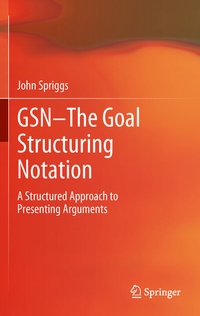
GSN - The Goal Structuring Notation
Description

Goal Structuring Notation (GSN) is becoming increasing popular; practitioners use it in the railway, air traffic management and nuclear industries, amongst others. Originally developed to present safety assurance arguments, GSN need not be restricted to safety assurances only; in principle, you can use it to present (and test) any argument. Anyone wishing to support, or refute, a claim can use GSN. Written by an experienced practitioner, The Goal Structuring Notation is both for those who wish to prepare and present compelling arguments using the notation, and for those who wish to review such arguments critically and effectively.
To emphasise the versatility of this approach The Goal Structuring Notation presents examples and questions based on diverse subject areas including Business Management, Drama, Engineering, Politics and Astrobiology. Simple examples introduce each symbol of the notation before introducing more complex structures which illustrate how the symbols work together in practical scenarios. To aid learning, questions and problems augment the text, so that the reader may reflect upon and try out the new concepts and principles presented.
As a comprehensive instruction in the basics of GSN and it's application, The Goal Structuring Notation also serves as a references or manual for the practitioner to dip into as problems are encountered or as a key resource for engineers working in those industries which require a clear description of the notation, covering the initial principles and showing why each piece of the notation is necessary.
Originally developed to present safety assurance arguments, GSN need not be so restricted. GSN - The GoalStructuring Notation presents examples from diverse subject areas, including business management, drama, engineering, politics and astrobiology.
More details
Other editions
Additional editions
Person
Content
Preface.- Table of Contents.- Table of Figures.- 1.Introduction.- 2.Goals.- 3.Contextual Information.- 4.How do Goal Make Arguments?.- 5.A More Practical Example.- 6.Argument Strategy.- 7.A Bit More Contextual Information.- 8.The Argument is Incomplete.- 9.The Argument is Ready for Review.- 10.A More Interesting Example.- 11.Generic Arguments.- 12.Missing Evidence.- 13.Counter-Evidence.- 14.Process Arguments.- 15.A Brief on Modular GSN.- 16.A Summary of Goal Structuring Notation.- Answers to Problems.
