

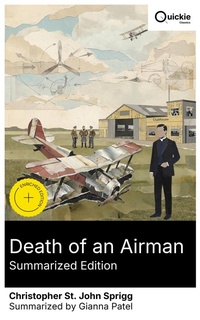
Death of an Airman (Summarized Edition)
Enriched edition. An aviation whodunit of upper-class intrigue, a pilot's-eye mystery with suspense, wit, and intricate plotting in early 20th-century England
Published on 10. January 2026
107 pages
8596547883159 (EAN)
Description

Death of an Airman unfolds at a provincial flying club, where an Australian bishop in training witnesses what seems a routine crash. Sprigg converts that spectacle into a fair puzzle: aerodynamic minutiae, the geometry of stalls and spins, and the hierarchies of club life all become evidence as Scotland Yard is drawn into smuggling and a staged death. The prose marries crisp technical exposition to dry social comedy and Golden-Age misdirection, situating the mystery amid interwar Britain's cult of civil aviation. Christopher St. John Sprigg (1907-1937), later famed as Marxist critic Christopher Caudwell, brought a fascination with flight and a journalist's precision to crime fiction. His later Illusion and Reality and Studies in a Dying Culture, and his death in the Spanish Civil War, reveal a mind attuned to modern systems; here that outlook yields procedure grounded in technology and a sociological portrait of the air-minded middle class. Recommended to admirers of Sayers and Freeman Wills Crofts as well as aviation enthusiasts, Death of an Airman offers clockwork detection enriched by the texture of early civil flying. Read it for elegant clueing, exact yet unpedantic flight lore, and humane intelligence-proof that the Golden Age could entertain while taking modernity seriously.
Quickie Classics summarizes timeless works with precision, preserving the author's voice and keeping the prose clear, fast, and readable-distilled, never diluted. Enriched Edition extras: Introduction · Synopsis · Historical Context · Brief Analysis · 4 Reflection Q&As · Editorial Footnotes.
More details
Persons
Christopher St. John Sprigg (1907-1937) was a British author, journalist, and poet, who also wrote under the pen name Christopher Caudwell. Despite his early death at the age of 29 during the Spanish Civil War, Sprigg left behind a unique literary footprint, particularly in the genre of detective fiction. He was born in Putney, London, and started his career as a journalist before turning to fiction writing. 'Death of an Airman' (1934) is one of his best-known works, acclaimed for its clever plotting and meticulous use of forensics, as well as its authentic representation of aviation, reflecting Sprigg's keen interest in the field. The book is celebrated for its well-crafted mystery and is considered a classic in the golden age of detective fiction. Other notable works include 'The Perfect Alibi' (1934) and 'Death of a Queen' (1935), both reinforcing his reputation as a master of the classic whodunit, with a style marked by conciseness and wit. Although his career in crime fiction was brief, Sprigg's novels have garnered appreciation for their ingenuity and remain a subject of interest for literary scholars and fans of detective literature alike.
