

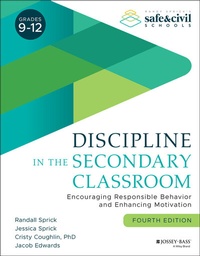
Discipline in the Secondary Classroom
Description

Discipline in the Secondary Classroom: A Positive Approach to Behavior Management, 4th Edition is an insightful treatment of the always-challenging topic of discipline in the high school classroom. The newly revised edition of the book incorporates a renewed focus on classroom management plans, handling the use and misuse of electronic devices in the classroom, and adapting instruction for a virtual classroom setting. Discipline in the Secondary Classroom discusses other issues crucial to the successful management of secondary classrooms and include:
* How behavior is learned
* Managing student work
* Managing the use of technology and electronic devices in the classroom
* Active engagement strategies for teacher-directed instruction (both the physical classroom and the virtual classroom)
* Corrective strategies for misbehavior and inattention
* Maintaining a Cycle of Continuous Improvement to be a better teacher each year
Perfect for grade 9 to 12 classroom teachers and educational administrators--including principals, assistant principals, staff development professionals, and consultants-- Discipline in the Secondary Classroom constitutes an indispensable resource for anyone aiming to achieve a civil, safe, and fair classroom environment.
More details
Other editions
Additional editions
Persons
Jessica Sprick is a consultant and presenter with Safe & Civil Schools with a focus on absenteeism prevention and intervention. She is an author for Ancora Publishing and ASCD.
Cristy Coughlin, is a school psychologist, researcher, and author with Ancora Publishing with interests in behavioral intervention, prevention, and assessment.
Jacob Edwards is a consultant and trainer for Safe & Civil Schools. He spent twelve years serving as a teacher and administrator in middle and high schools across a variety of socio economic contexts.
Content
Acknowledgments
Foreword
Preface
Introduction
Section One: Overview of the DSC Approach
Chapter 1: Develop a Clear Vision for Your Class and Your Classroom Management Approach
Section Two: Preparing Your Classroom Management Plan
Chapter 2: Structure for Success (Behavioral Decisions)
Chapter 3: Structure for Success (Instructional Decisions)
Chapter 4: Teach Students to Meet Expectations
Chapter 5: Observe: Use Data to Monitor and Adjust Your Management Plan
Chapter 6: Interact Positively (Build Positive Relationships with Students and Provide Positive Feedback)
Chapter 7: Interact Positively (Motivational Strategies and Systems)
Chapter 8: Correct Misbehavior Fluently
Section Three: Implementing, Sustaining, and Refining Your Classroom Management Plan
Chapter 9: Launch
Chapter 10: Maintain a Cycle of Continuous Improvement
Section Four: Implementing DSC in Virtual Learning Environments
Chapter 11: DSC in the Virtual Setting
References
Name Index
Subject Index
Introduction
This book was conceived and written to help teachers effectively manage student behavior and increase student motivation so they can focus their time and energy on instruction and student success. Discipline problems in school have always been and continue to be a leading frustration for teachers and a drain on instructional time.
Almost half of new teachers leave the profession within a few years (Ingersol et al., 2018). Two of the most common reasons given for leaving are discipline problems and a lack of administrative support for dealing with discipline. Inexperienced and unskilled teachers are often frustrated and sometimes even terrified by students who misbehave and challenge authority. Even skilled veteran teachers can find themselves pulling their hair out when they are faced with a particularly challenging group. Or teachers may find they are uncertain about how to meet the needs of students as demographics, economic situations, or other factors change within a district. Models for positive and proactive approaches to behavior management, such as the approach presented in this book, can give teachers in any of these situations the knowledge and skills to be confident and successful in working with students with behavioral and motivational challenges. Proactive behavior management models also provide a powerful framework for evaluating and strengthening classroom management plans across time.
There are many obvious and direct links between academic achievement and student behavior. One disruptive student can negatively affect the learning of all the other students in a class. If students are actively or passively resistant, a seemingly simple transition like moving to lab stations, which should take no more than two minutes, can take as long as 10 minutes, wasting large amounts of instructional time. Students who are unmotivated will be less engaged in their work and learn less than when they are excited about the content.
If examples of misbehavior or apathy like these occur every day in every class, you are losing huge amounts of instructional time. By implementing effective management techniques, you can simultaneously increase student engagement and improve academic achievement (Brophy, 1996; Brophy & Good, 1986; Christenson et al., 2008; Emmer & Evertson, 2009; Gettinger & Ball, 2008; Luiselli, et al., 2005; Scheuermann & Hall, 2008; Sprick et al., 2019).
Why Bother with a Positive Approach to Discipline?
The educational environment has changed greatly in the past 70 years. The accepted norm for disciplining students with behavior problems used to be punishment and, if the students continued to misbehave, suspension or expulsion. These measures did not necessarily change behavior, but they were easy solutions-the problem seemingly disappeared as the student disappeared from the classroom and, eventually, the school system. In 1900, high school graduation rates were only 6%, and in 1950, graduation rates were only 59% (Heckman & LaFontaine, 2010). While this may seem like an appalling dropout rate, in the past there were also plenty of jobs on farms or in factories for those without a high school education.
In the 2017-2018 school year, graduation rates were reported at 85% (Hussar et al., 2020). U.S. schools are doing better than ever before at helping students reach graduation. However, imagine looking at a kindergarten class with 20 bright-eyed young five-year-olds. If current dropout rates continue, at least three of those students will not make it to graduation. Many farm, factory, and other jobs that would allow someone without a high school diploma to live a comfortable adult life are increasingly being replaced by technology or will not adequately support the individual and their family. It is more important than ever for students to exit school with a high school diploma. As educators, we must do better to help all students thrive throughout their K-12 experience and reach graduation. Moreover, we must do more to equip students to be successful outside of school, whether they plan to immediately enter the job market or continue on to higher education.
Schools are under tremendous pressure to successfully educate all students, including those who, years ago, would have left school because of academic or behavioral problems. Effective ways to motivate and encourage positive behavior are vital to serving these students. For students who struggle in school because of experiences of trauma, poverty, systemic racism, generational difficulties with the school system, or a disability, purely punitive and reactive approaches are unlikely to make a lasting difference. These approaches do not address the needs of the students. We need to do business differently.
Therefore, a proactive and positive approach to behavior management is essential. With the strategies recommended in this book, you can guide students toward a successful school career and in turn to potential success in work and in life.
The DSC Approach
In this book, we refer to this proactive, positive approach as the DSC (Discipline in the Secondary Classroom) approach. Readers who are familiar with the Safe & Civil Schools collection of staff development materials, and in particular CHAMPS: A Proactive and Positive Approach to Classroom Management, our book for elementary and middle schools, will recognize the overall philosophy and procedures. CHAMPS is an acronym that teachers can use to teach expectations to students-but it has come to mean much more. DSC takes the CHAMPS approach and translates it for the high school level. CHAMPS and DSC represent the proactive, positive ideals that every teacher can learn and use to help their students achieve success.
The CHAMPS/DSC approach is designed to help you, the classroom teacher, develop (or fine-tune) an effective classroom management plan that is proactive, positive, and instructional. In the past 50 years, a large and varied body of research literature has identified consistent and reliable findings concerning how effective teachers manage student behavior and enhance student motivation. The techniques included in this approach have been derived from that literature.
Unlike programs that have set procedures, the DSC approach guides teachers in how to make effective decisions about managing behavior. For example, one of the tasks in Chapter 2, Structure for Success (Behavioral Decisions), is about the physical setting. Rather than implying that only one physical setting is correct, we specify factors that you should consider when designing the seating arrangement in your classroom. One of the most important factors is the teacher's ability to move quickly and directly from any part of the room to any other part. This is important because it allows you to supervise by physically circulating throughout the room and to reach and speak quietly with any student in the room-to praise, correct misbehavior, or answer a question.
A second factor we urge you to consider when designing your seating arrangement is the amount of desired student conversation. How much talking will be allowed and during which activities? Some physical arrangements are more conducive to conversation than others. After reviewing the factors to consider, we show different classroom arrangements and delineate the pros and cons of each. However, the teacher always makes the decisions: "How can I arrange my room to meet my needs and the needs of my students?"
In DSC, we provide the information you need to make an informed decision-we don't tell you what to do. If you talk about DSC with colleagues, we encourage you to talk about the DSC or CHAMPS approach, not the DSC program. We try to avoid calling it the DSC program because is it not a canned program, but rather a way of thinking about how to prevent misbehavior and encourage responsible behavior. It is a model for effective problem prevention and problem-solving. To use a cooking analogy, DSC teaches you how to become an effective cook. Rather than a recipe, which you must follow in a step-by-step fashion, DSC is like a cooking resource that teaches you how to effectively use different ingredients and cooking utensils and technology so you can create any culinary masterpiece you wish.
DSC, while not a program, does have one absolute rule: Students must be treated at all times with respect, honoring their inherent dignity and rights. Belittling and ridicule has no place in the teacher's repertoire of behavioral practices. You will learn more about some of the foundational principles and practices that guide the DSC approach in Chapter 1.
Is DSC "Research Based"?
Yes! First, DSC is entirely compatible with more than 50 years of research on how effective teachers manage their classrooms in ways that enhance academic achievement. Second, Safe & Civil Schools has many examples of district-based studies where CHAMPS and DSC have been implemented with remarkable results. Improvements include marked reductions in classroom disruptions, office referrals, and in-school and out-of-school suspensions, along with corresponding increases in teachers' perceptions of efficacy and student motivation and behavior.
For information on efficacy data, contact Safe & Civil Schools at safeandcivilschools.com. For more information on how DSC is compatible with classroom management research literature and for summaries of research studies on the DSC approach, see "Downloadable Resources" on page...
