

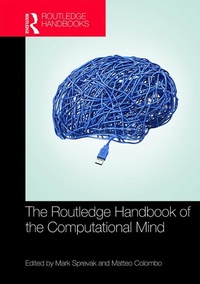
The Routledge Handbook of the Computational Mind
1st Edition
Published on 13. September 2018
526 pages
978-1-317-28672-1 (ISBN)
Description

Computational approaches dominate contemporary cognitive science, promising a unified, scientific explanation of how the mind works. However, computational approaches raise major philosophical and scientific questions. In what sense is the mind computational? How do computational approaches explain perception, learning, and decision making? What kinds of challenges should computational approaches overcome to advance our understanding of mind, brain, and behaviour?
The Routledge Handbook of the Computational Mind is an outstanding overview and exploration of these issues and the first philosophical collection of its kind. Comprising thirty-five chapters by an international team of contributors from different disciplines, the Handbook is organised into four parts:
History and future prospects of computational approaches
Types of computational approach
Foundations and challenges of computational approaches
Applications to specific parts of psychology.
Essential reading for students and researchers in philosophy of mind, philosophy of psychology, and philosophy of science, The Routledge Handbook of the Computational Mind will also be of interest to those studying computational models in related subjects such as psychology, neuroscience, and computer science.
The Routledge Handbook of the Computational Mind is an outstanding overview and exploration of these issues and the first philosophical collection of its kind. Comprising thirty-five chapters by an international team of contributors from different disciplines, the Handbook is organised into four parts:
History and future prospects of computational approaches
Types of computational approach
Foundations and challenges of computational approaches
Applications to specific parts of psychology.
Essential reading for students and researchers in philosophy of mind, philosophy of psychology, and philosophy of science, The Routledge Handbook of the Computational Mind will also be of interest to those studying computational models in related subjects such as psychology, neuroscience, and computer science.
Reviews / Votes
"One of the many strengths of this volume, skilfully edited by Mark Sprevak and Matteo Colombo, is that it reminds us of how long scientists - many of them psychiatrists (including R. D. Laing) - have wrestled with issues of computation in the mind and brain. This book is particularly timely given the wealth of opinion pieces and working-group position papers on computational psychiatry[.] ... My academic work is infused by computation and, rather than the 'busman's holiday' feel I get from many books on topics in which I feel invested, I felt inspired and eager to learn more after reading this book. ... The Handbook grounds computational psychiatry as a tool rather than a doctrine, a balanced and practical approach I suspect [Ada] Lovelace would have endorsed." - Philip R. Corlett, The British Journal of Psychiatry"Anyone interested in the fundamental issues confronted by computational approaches to mind will find this collection indispensable. Packed full of penetrating and insightful analyses from expert contributors, it not only perfectly captures the history and the current state of this important field, it helps set the agenda for its future." - Michael Wheeler, University of Stirling, UK
"This Handbook offers an unparalleled guide to navigating the world of computational cognitive science. It is a timely reminder of why cognitive science needs philosophy: our empirical claims are only as good as the conceptual frameworks that undergird them." - Sam Gershman, Harvard University, USA
"This excellent book will be the foundation of myriad university courses. Particularly impressive is the way that many of the chapters adopt an approach that is informed, but never overwhelmed, by philosophical reasoning. This makes the book an incisive and informative read." - Peter Dayan, University College London, UK
More details
Series
Edition
1. Auflage
Language
English
Place of publication
London
United Kingdom
Publishing group
Taylor & Francis Ltd
Target group
College/higher education
Illustrations
1 Tables, black and white
File size
61,77 MB
ISBN-13
978-1-317-28672-1 (9781317286721)
Copyright in bibliographic data and cover images is held by Nielsen Book Services Limited or by the publishers or by their respective licensors: all rights reserved.
Schweitzer Classification
Other editions
Additional editions
Mark Sprevak | Matteo Colombo
The Routledge Handbook of the Computational Mind
Book
12/2020
1st Edition
Routledge
€74.40
Shipment within 15-20 days
Mark Sprevak | Matteo Colombo
The Routledge Handbook of the Computational Mind
Book
08/2018
1st Edition
Routledge
€364.52
Shipment within 10-20 days
Persons
Mark Sprevak is a Senior Lecturer in Philosophy at the University of Edinburgh, UK. His book The Computational Mind is forthcoming from Routledge.
Matteo Colombo is an Assistant Professor at the Tilburg Center for Logic, Ethics, and Philosophy of Science, Tilburg University, The Netherlands; and a Humboldt Research Fellow at the Clinic for Psychiatry and Psychotherapy, Charite University Clinic Berlin, Germany.
Matteo Colombo is an Assistant Professor at the Tilburg Center for Logic, Ethics, and Philosophy of Science, Tilburg University, The Netherlands; and a Humboldt Research Fellow at the Clinic for Psychiatry and Psychotherapy, Charite University Clinic Berlin, Germany.
Content
Introduction Mark Sprevak and Matteo Colombo Part 1: History and Future Directions 1. Computational thought from Descartes to Lovelace Alistair M.C. Isaac 2. Turing and the first electronic brains: What the papers said Diane Proudfoot and Jack Copeland 3. British cybernetics Joe Dewhurst 4. Cybernetics Tara H. Abraham 5. Turing-equivalent computation at the "conception" of cognitive science Kenneth Aizawa 6. Connectionism and post-connectionist models Cameron Buckner and James Garson 7. Artificial Intelligence Murray Shanahan Part 2: Types of Computing 8. Classical computational models Richard Samuels 9. Explanation and connectionist models Catherine Stinson 10. Dynamic information processing Frank Faries and Anthony Chemero 11. Probabilistic models David Danks 12. Prediction error minimization in the brain Jakob Hohwy Part 3: Foundations and Challenges 13. Triviality arguments about computational implementation Mark Sprevak 14. Computational implementation J. Brendan Ritchie and Gualtiero Piccinini 15. Computation and levels in cognitive and neural sciences Lotem Elber-Dorozko and Oron Shagrir 16. Reductive explanation between psychology and neuroscience Daniel A. Weiskopf 17. Helmholtz's vision: Underdetermination, behavior and the brain Clark Glymour and Ruben Sanchez-Romero 18. The nature and function of content in computational models Frances Egan 19. Maps, models and computational simulations in the mind William Ramsey 20. The cognitive basis of computation: Putting computation in its place Daniel D. Hutto, Erik Myin, Anco Peeters and Farid Zahnoun 21. Computational explanations and neural coding Rosa Cao 22. Computation, consciousness, and "Computation and consciousness" Colin Klein 23. Concepts, symbols and computation: An integrative approach Jenelle Salisbury and Susan Schneider 24. Embodied cognition Marcin Milkowski 25. Tractability and the computational mind Jakub Szymanik and Rineke Verbrugge Part 4: Applications 26. Computational cognitive neuroscience Carlos Zednik 27. Simulation in computational neuroscience Liz Irvine 28. Learning and reasoning Matteo Colombo 29. Vision Mazviita Chirimuuta 30. Perception without computation? Nico Orlandi 31. Motor computation Michael Rescorla 32. Computational models of emotion Xiaosi Gu 33. Computational psychiatry Stefan Brugger and Matthew Broome 34. Computational approaches to social cognition John Michael and Miles MacLeod 35. Computational theories of group behavior Bryce Huebner and Joseph Jebari. Index
