

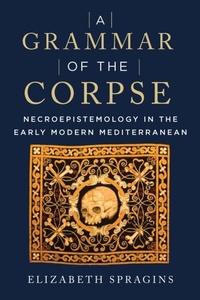
A Grammar of the Corpse
Necroepistemology in the Early Modern Mediterranean
Published on 6. June 2023
224 pages
978-1-5315-0159-4 (ISBN)
Description

No matter when or where one starts telling the story of the battle of al-Qasr al-Kabir (August 4, 1578), the precipitating event for the formation of the Iberian Union, one always stumbles across dead bodies-rotting in the sun on abandoned battlefields, publicly displayed in marketplaces, exhumed and transported for political uses. A Grammar of the Corpse: Necroepistemology in the Early Modern Mediterranean proposes an approach to understanding how dead bodies anchored the construction of knowledge within early modern Mediterranean historiography.
A Grammar of the Corpse argues that the presence of the corpse in historical narrative is not incidental. It fills a central gap in testimonial narrative: providing tangible evidence of the narrator's reliability while provoking an affective response in the audience. The use of corpses as a source of narrative authority mobilizes what cultural historians, philosophers, and social anthropologists have pointed to as the latent power of the dead for generating social and political meaning and knowledge. A Grammar of the Corpse analyzes the literary, semiotic, and epistemological function these bodies serve within text and through language. It finds that corpses are indexically present and yet disturbingly absent, a tension that informs their fraught relationship to their narrators' own bodies and makes them useful but subversive tools of communication and knowledge.
A Grammar of the Corpse complements recent work in medieval and early modern Iberian and Mediterranean studies to account for the confessional, ethnic, linguistic, and political diversity of the region. By reading Arabic texts alongside Portuguese and Spanish accounts of this key event, the book responds to the fundamental provocation of Mediterranean studies to work beyond the linguistic limitations of modern national boundaries.
A Grammar of the Corpse argues that the presence of the corpse in historical narrative is not incidental. It fills a central gap in testimonial narrative: providing tangible evidence of the narrator's reliability while provoking an affective response in the audience. The use of corpses as a source of narrative authority mobilizes what cultural historians, philosophers, and social anthropologists have pointed to as the latent power of the dead for generating social and political meaning and knowledge. A Grammar of the Corpse analyzes the literary, semiotic, and epistemological function these bodies serve within text and through language. It finds that corpses are indexically present and yet disturbingly absent, a tension that informs their fraught relationship to their narrators' own bodies and makes them useful but subversive tools of communication and knowledge.
A Grammar of the Corpse complements recent work in medieval and early modern Iberian and Mediterranean studies to account for the confessional, ethnic, linguistic, and political diversity of the region. By reading Arabic texts alongside Portuguese and Spanish accounts of this key event, the book responds to the fundamental provocation of Mediterranean studies to work beyond the linguistic limitations of modern national boundaries.
More details
Edition
New edition
Language
English
Place of publication
New York
United States
Target group
Professional and scholarly
Edition type
New edition
Illustrations
4 b/w illustrations
File size
8,91 MB
ISBN-13
978-1-5315-0159-4 (9781531501594)
Copyright in bibliographic data and cover images is held by Nielsen Book Services Limited or by the publishers or by their respective licensors: all rights reserved.
Schweitzer Classification
Other editions
Additional editions
Book
06/2023
Fordham University Press
€122.50
Shipment within 3-4 weeks
Person
Elizabeth Spragins is Assistant Professor of Spanish at the College of the Holy Cross.
Content
Preface vii
Introduction: Necroepistemology 1
1 Presence: Here Are the Dead 25
2 Absence: Disappearing the Royal Dead 45
3 Vitality: Wounded Narrators and the Living Dead 69
4 Assemblage: Recovering Diplomatic Power with Corpses 89
5 Erasure: Corpse Desecration for Narrative Control 110
Epilogue 135
Acknowledgments 141
Notes 145
Bibliography 195
Index 215
Introduction: Necroepistemology 1
1 Presence: Here Are the Dead 25
2 Absence: Disappearing the Royal Dead 45
3 Vitality: Wounded Narrators and the Living Dead 69
4 Assemblage: Recovering Diplomatic Power with Corpses 89
5 Erasure: Corpse Desecration for Narrative Control 110
Epilogue 135
Acknowledgments 141
Notes 145
Bibliography 195
Index 215
