

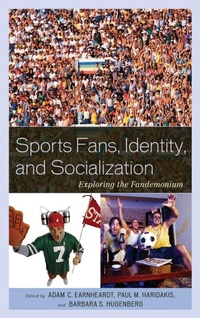
Sports Fans, Identity, and Socialization
Exploring the Fandemonium
Lexington Books (Publisher)
1st Edition
Published on 15. November 2011
1 pages
978-1-9787-7250-2 (ISBN)
Description

Once deemed an unworthy research endeavor, the study of sports fandom has garnered the attention of seasoned scholars from a variety of academic disciplines. Identity and socialization among sports fans are particular burgeoning areas of study among a growing cadre of specialists in the social sciences. Sports Fans, Identity, and Socialization, edited by Adam C. Earnheardt, Paul Haridakis, and Barbara Hugenberg, captures an eclectic collection of new studies from accomplished scholars in the fields such as communication, business, geography, kinesiology, media, and sports management and administration, using a wide range of methodologies including quantitative, qualitative, and critical analyses.
In the communication revolution of the twenty-first century, the study of mediated sports is critical. As fans use all media at their disposal to consume sports and carry their sports-viewing experience online, they are seizing the initiative and asserting themselves into the mediated sports-dissemination process. They are occupying traditional roles of consumers/receivers of sports, but also as sharers and sports content creators. Fans are becoming pseudo sports journalists. They are interpreting mediated sports content for other fans. They are making their voice heard by sports organizations and athletes. Mediated sports, in essence, provide a context for studying and understanding where and how the communication revolution of the twenty-first century is being waged.
With their collection of studies by scholars from North America and Europe, Earnheardt, Haridakis, and Hugenberg illuminate the symbiotic relationship among and between sports organizations, the media, and their audiences. Sports Fans, Identity, and Socialization spurs both the researcher and the interested fan to consider what the study of sports tells us about ourselves and the society in which we live.
In the communication revolution of the twenty-first century, the study of mediated sports is critical. As fans use all media at their disposal to consume sports and carry their sports-viewing experience online, they are seizing the initiative and asserting themselves into the mediated sports-dissemination process. They are occupying traditional roles of consumers/receivers of sports, but also as sharers and sports content creators. Fans are becoming pseudo sports journalists. They are interpreting mediated sports content for other fans. They are making their voice heard by sports organizations and athletes. Mediated sports, in essence, provide a context for studying and understanding where and how the communication revolution of the twenty-first century is being waged.
With their collection of studies by scholars from North America and Europe, Earnheardt, Haridakis, and Hugenberg illuminate the symbiotic relationship among and between sports organizations, the media, and their audiences. Sports Fans, Identity, and Socialization spurs both the researcher and the interested fan to consider what the study of sports tells us about ourselves and the society in which we live.
More details
Edition
1. Auflage
Language
English
Place of publication
United States
Publishing group
Bloomsbury Publishing Plc
Target group
Professional and scholarly
ISBN-13
978-1-9787-7250-2 (9781978772502)
Copyright in bibliographic data and cover images is held by Nielsen Book Services Limited or by the publishers or by their respective licensors: all rights reserved.
Schweitzer Classification
Other editions
Additional editions
Adam C. Earnheardt | Paul Haridakis | Barbara Hugenberg
Sports Fans, Identity, and Socialization
Exploring the Fandemonium
Book
05/2013
Lexington Books
€66.60
Shipment within 10-20 days
Persons
Adam C. Earnheardt is associate professor of communication studies and basic course director at Youngstown State University. Earnheardt was named a Distinguished Professor at Youngstown State in 2010. He is executive director of the Ohio Communication Association and incoming chair of the National Communication Association Mass Communication Division. Earnheardt has published three books including Judging Athlete Behaviors (VDM Verlag), Sports Mania (co-edited with Hugenberg & Harida-kis; McFarland) and The Modern Communicator (co-authored with O'Neill; Kendall Hunt/GRT). He has authored or co-authored more than a dozen peer-reviewed journal articles, encyclopedia entries, and book chapters. His scholar-ship has appeared in Psychology Today,Playboy, and several newspapers including the Pittsburgh Post-Gazette and the Canton Dailey Ledger where he served as an expert source on stories related to LeBron James and Ben Roethlisberger. Earnheardt is a lifelong Pittsburgh Steelers and Pittsburgh Penguins fan, and an admitted Pittsburgh Pirates loyalist.
Paul M. Haridakis is professor and interim director of the School of Communication Studies at Kent State University. His research interests include media use and effects, sports communication, new communication technologies, freedom of speech, political communication and media history. He is a co-author of Communication Research: Strategies and Sources (7th ed.). Wadsworth Cengage Learning. He is co-editor of War and the Media: Essays on News Reporting, Propaganda and Popular Culture (McFar-land & Co.); and co-editor of Sports Mania: Essays on Fandom and the Media in the 21st Century (McFarland & Co.).
Barb S. Hugenberg serves as a consultant to the basic communication course at Kent State University. She previously served at Kent State as assistant professor and basic course director. She is an active member of the National Communication Association's Basic Course Division and has served as co-coordinator of Basic Course Director's Conference (Cleveland, OH) and the Fourth Summit on Sport and Communication (Cleveland, OH). Hugenberg is the coeditor of the multi-volume Teaching Ideas for the Basic Communication Course (Kendall/Hunt) and War and the Media: Essays on News Reporting, Propaganda and Popular Culture (McFarland & Co.). Her articles have appeared in the Journal of Popular Culture and Communication Education.
Paul M. Haridakis is professor and interim director of the School of Communication Studies at Kent State University. His research interests include media use and effects, sports communication, new communication technologies, freedom of speech, political communication and media history. He is a co-author of Communication Research: Strategies and Sources (7th ed.). Wadsworth Cengage Learning. He is co-editor of War and the Media: Essays on News Reporting, Propaganda and Popular Culture (McFar-land & Co.); and co-editor of Sports Mania: Essays on Fandom and the Media in the 21st Century (McFarland & Co.).
Barb S. Hugenberg serves as a consultant to the basic communication course at Kent State University. She previously served at Kent State as assistant professor and basic course director. She is an active member of the National Communication Association's Basic Course Division and has served as co-coordinator of Basic Course Director's Conference (Cleveland, OH) and the Fourth Summit on Sport and Communication (Cleveland, OH). Hugenberg is the coeditor of the multi-volume Teaching Ideas for the Basic Communication Course (Kendall/Hunt) and War and the Media: Essays on News Reporting, Propaganda and Popular Culture (McFarland & Co.). Her articles have appeared in the Journal of Popular Culture and Communication Education.
Content
Foreword
James R. Walker
Introduction
Paul M. Haridakis & Adam C. Earnheardt
Part One: Fan Identity
1 Remaining Rooted in a Sea of Red: Agrarianism, Place
Attachment, and Nebraska Cornhusker Football Fans
Roger C. Aden & Scott Titsworth
2 The Dynamics of Identity in the Communities of Local
Professional Wrestling
David Beard & John Heppen
3 The 13th Man: Constructions of Fandom at the 2008
Ryder Cup
John Harris
4 Farewell to the Chief: Fan Identification and the
Sports Mascot as Postmodern Image
Phil Chidester
Part Two: Fan Socialization
5 The Social Dimension of Sports Fanship
Walter Gantz, David Fingerhut & Gayle Nadorff
6 The Importance of Team Identification in Perceptions
of Trust of Fellow and Rival Sport Fans
Daniel L. Wann, Frederick G. Grieve, Ryan K. Zapalac, Amanda J. Visek, Julie A. Partridge & Jason R. Lanter
7 No Limits: Sensation Seeking and Fandom in the Sport
Culture of the X Games
Sarah Porri & Andrew C. Billings
8 Sport Fans, Athletes, and Communication: Applying Theory to Understanding if Fans Impact Athletes'
Cognitive and Physical Performance
Jennifer Marmo
9 "Pronger You Ignorant Ape...I Hope You Fall Off Space Mountain!": A Study of the Institutional Work of
Sport Fans
William M. Foster, Craig G. Hyatt & Mark Julien
Part 3: Fans and Media
10 "Brett Favre is a God": Sports Fans' Perpetuation of
Mythology on Newspaper Websites
Kelly Berg & Allison Harthcock
11 Communicating Organizational History to Sports Fans
Matthew Gill
12 The Many Faces of "Fans": How the NBA Meets the
Demands of its Different Audience Segments
John A. Fortunato
13 From Good ol' Boys to National Spectacle: Motives and Identification among Young NASCAR Fans
John S. W. Spinda
14 Why Hispanic Fans Are the Lifeblood of Major League
Soccer
Ric Jensen
Part 4: Fans and Gender
15 From Football Widow to Fan: Web Narratives of
Women and Sports Spectatorship
Lawrence A. Wenner
16 Football Fans Do Wear Pink: Game Day Broadcasts, Female Football Fans and Their NFL 231
Kathy Brady
17 Great Expectations: An Analysis of the Fan Base for WNBA's 2008 Expect Great 247
Katherine L. Lavelle
Part 5: Fans and Fantasy Sports
18 Fantasy Sports and Sports Fandom: Implications for
Mass Media Research
Nicholas David Bowman, Jessi McCabe &
Tom Isaacson
19 Show Me the Numbers!: Media Dependency and Fantasy Game Participants
John P. McGuire, Greg G. Armfield & Jeff Boone
Index
About the Contributors
About the Editors
James R. Walker
Introduction
Paul M. Haridakis & Adam C. Earnheardt
Part One: Fan Identity
1 Remaining Rooted in a Sea of Red: Agrarianism, Place
Attachment, and Nebraska Cornhusker Football Fans
Roger C. Aden & Scott Titsworth
2 The Dynamics of Identity in the Communities of Local
Professional Wrestling
David Beard & John Heppen
3 The 13th Man: Constructions of Fandom at the 2008
Ryder Cup
John Harris
4 Farewell to the Chief: Fan Identification and the
Sports Mascot as Postmodern Image
Phil Chidester
Part Two: Fan Socialization
5 The Social Dimension of Sports Fanship
Walter Gantz, David Fingerhut & Gayle Nadorff
6 The Importance of Team Identification in Perceptions
of Trust of Fellow and Rival Sport Fans
Daniel L. Wann, Frederick G. Grieve, Ryan K. Zapalac, Amanda J. Visek, Julie A. Partridge & Jason R. Lanter
7 No Limits: Sensation Seeking and Fandom in the Sport
Culture of the X Games
Sarah Porri & Andrew C. Billings
8 Sport Fans, Athletes, and Communication: Applying Theory to Understanding if Fans Impact Athletes'
Cognitive and Physical Performance
Jennifer Marmo
9 "Pronger You Ignorant Ape...I Hope You Fall Off Space Mountain!": A Study of the Institutional Work of
Sport Fans
William M. Foster, Craig G. Hyatt & Mark Julien
Part 3: Fans and Media
10 "Brett Favre is a God": Sports Fans' Perpetuation of
Mythology on Newspaper Websites
Kelly Berg & Allison Harthcock
11 Communicating Organizational History to Sports Fans
Matthew Gill
12 The Many Faces of "Fans": How the NBA Meets the
Demands of its Different Audience Segments
John A. Fortunato
13 From Good ol' Boys to National Spectacle: Motives and Identification among Young NASCAR Fans
John S. W. Spinda
14 Why Hispanic Fans Are the Lifeblood of Major League
Soccer
Ric Jensen
Part 4: Fans and Gender
15 From Football Widow to Fan: Web Narratives of
Women and Sports Spectatorship
Lawrence A. Wenner
16 Football Fans Do Wear Pink: Game Day Broadcasts, Female Football Fans and Their NFL 231
Kathy Brady
17 Great Expectations: An Analysis of the Fan Base for WNBA's 2008 Expect Great 247
Katherine L. Lavelle
Part 5: Fans and Fantasy Sports
18 Fantasy Sports and Sports Fandom: Implications for
Mass Media Research
Nicholas David Bowman, Jessi McCabe &
Tom Isaacson
19 Show Me the Numbers!: Media Dependency and Fantasy Game Participants
John P. McGuire, Greg G. Armfield & Jeff Boone
Index
About the Contributors
About the Editors
