

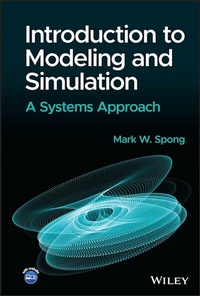
Introduction to Modeling and Simulation
Description

An essential introduction to engineering system modeling and simulation from a well-trusted source in engineering and education
This new introductory-level textbook provides thirteen self-contained chapters, each covering an important topic in engineering systems modeling and simulation. The importance of such a topic cannot be overstated; modeling and simulation will only increase in importance in the future as computational resources improve and become more powerful and accessible, and as systems become more complex. This resource is a wonderful mix of practical examples, theoretical concepts, and experimental sessions that ensure a well-rounded education on the topic.
The topics covered in Introduction to Modeling and Simulation are timeless fundamentals that provide the necessary background for further and more advanced study of one or more of the topics. The text includes topics such as linear and nonlinear dynamical systems, continuous-time and discrete-time systems, stability theory, numerical methods for solution of ODEs, PDE models, feedback systems, optimization, regression and more. Each chapter provides an introduction to the topic to familiarize students with the core ideas before delving deeper. The numerous tools and examples help ensure students engage in active learning, acquiring a range of tools for analyzing systems and gaining experience in numerical computation and simulation systems, from an author prized for both his writing and his teaching over the course of his over-40-year career.
Introduction to Modeling and Simulation readers will also find:
* Numerous examples, tools, and programming tips to help clarify points made throughout the textbook, with end-of-chapter problems to further emphasize the material
* As systems become more complex, a chapter devoted to complex networks including small-world and scale-free networks - a unique advancement for textbooks within modeling and simulation
* A complementary website that hosts a complete set of lecture slides, a solution manual for end-of-chapter problems, MATLAB files, and case-study exercises
Introduction to Modeling and Simulation is aimed at undergraduate and first-year graduate engineering students studying systems, in diverse avenues within the field: electrical, mechanical, mathematics, aerospace, bioengineering, physics, and civil and environmental engineering. It may also be of interest to those in mathematical modeling courses, as it provides in-depth material on MATLAB simulation and contains appendices with brief reviews of linear algebra, real analysis, and probability theory.
More details
Other editions
Additional editions
Person
Mark W. Spong, DSc, is Professor of Systems Engineering and Professor of Electrical and Computer Engineering at the University of Texas, USA, where he also holds the Excellence in Education Chair. Professor Spong received his doctorate in systems science and mathematics in 1981 from Washington University in St. Louis, USA. He is a Life Fellow of the IEEE and a Fellow of IFAC. Among the numerous notable awards he has received are the 2011 Pioneer in Robotics Award from the IEEE Robotics and Automation Society, the 2020 Rufus Oldenburger Medal from the ASME, the 2018 Bode Lecture Prize from the IEEE Control Systems Society, the 2016 Nyquist Lecture Prize from the ASME, and the IEEE Transactions on Control Systems Technology Outstanding Paper Award.
Content
Preface xiii
About the Companion Website xvii
1 Introduction 1
1.1 Introduction 1
1.1.1 Systems Engineering 1
1.1.2 The Input/Output Viewpoint 2
1.1.3 Some Examples 2
1.2 Model Classification 5
1.2.1 Static and Dynamic Systems 5
1.2.2 Linear and Nonlinear Systems 5
1.2.3 Distributed-Parameter Systems 6
1.2.4 Hybrid and Discrete-Event Systems 6
1.2.5 Deterministic and Stochastic Systems 7
1.2.6 Large-Scale Systems 7
1.3 Simulation Languages 9
1.4 Outline of the Text 10
Problems 11
2 Second-Order Systems 15
2.1 Introduction 15
2.2 State-Space Representation 19
2.3 Trajectories and Phase Portraits 22
2.4 The Direction Field 27
2.5 Equilibria 30
2.6 Linear Systems 33
2.7 Linearization of Nonlinear Systems 41
2.8 Periodic Trajectories and Limit Cycles 45
2.8.1 Relaxation Oscillators 45
2.8.2 Bendixson's Theorem 49
2.8.3 Poincaré-Bendixson Theorem 51
2.9 Coupled Second-Order Systems 53
Problems 55
3 System Fundamentals 61
3.1 Introduction 61
3.2 Existence and Uniqueness of Solution 61
3.3 The Matrix Exponential 64
3.4 The Jordan Canonical Form 67
3.5 Linearization 71
3.6 The Hartman-Grobman Theorem 72
3.7 Singular Perturbations 73
Problems 79
4 Compartmental Models 83
4.1 Introduction 83
4.2 Exponential Growth and Decay 84
4.3 The Logistic Equation 87
4.4 Models of Epidemics 88
4.5 Predator-Prey System 95
Problems 97
5 Stability 101
5.1 Introduction 101
5.2 Lyapunov Stability 102
5.3 Basin of Attraction 109
5.4 The Invariance Principle 110
5.5 Linear Systems and Linearization 113
Problems 116
6 Discrete-Time Systems 119
6.1 Introduction 119
6.2 Stability of Discrete-Time Systems 123
6.3 Stability of Discrete-Time Linear Systems 124
6.4 Moving-Average Filter 126
6.5 Cobweb Diagrams 128
6.5.1 Cobweb Diagrams in Economics 130
6.5.2 The Discrete Logistic Equation 131
Problems 134
7 Numerical Methods 137
7.1 Introduction 137
7.2 Numerical Differentiation 138
7.3 Numerical Integration 141
7.4 Numerical Solution of ODEs 147
7.4.1 Euler Predictor-Corrector Method 150
7.4.2 Runge-Kutta Methods 152
7.5 Stiff Systems 155
7.6 Event Detection 160
7.7 Simulink 163
7.8 Summary 168
Problems 169
8 Optimization 173
8.1 Introduction 173
8.2 Unconstrained Optimization 177
8.2.1 Iterative Search 179
8.2.2 Gradient Descent 180
8.2.3 Newton's Method 184
8.3 Case Study: Numerical Inverse Kinematics 187
8.4 Constrained Optimization 191
8.4.1 Equality Constraints 191
8.4.2 Inequality Constraints 196
8.5 Convex Optimization 200
Problems 204
9 System Identification 209
9.1 Introduction 209
9.2 Least Squares 209
9.3 Regression 212
9.4 Recursive Least Squares 217
9.5 Logistic Regression 220
9.6 Neural Networks 224
Problems 230
10 Stochastic Systems 233
10.1 Markov Chains 233
10.1.1 Regular and Ergodic Markov Chains 240
10.1.2 Absorbing Markov Chains 244
10.2 Monte Carlo Methods 249
10.2.1 Random Number Generation 250
10.2.2 Monte Carlo Integration 253
10.2.3 Monte Carlo Optimization 255
10.2.4 Monte Carlo Simulation 255
Problems 258
11 Feedback Systems 261
11.1 Introduction 261
11.2 Transfer Functions 263
11.3 Feedback Control 269
11.4 State-Space Models 273
11.4.1 Minimal Realizations 274
11.4.2 Pole Placement 280
11.4.3 State Estimation 283
11.4.4 The Separation Principle 285
11.5 Optimal Control 288
11.6 Control of Nonlinear Systems 289
Problems 292
12 Partial Differential Equation Models 297
12.1 Introduction 297
12.1.1 Existence and Uniqueness of Solutions 297
12.1.2 Classification of Linear Second-Order PDEs 298
12.2 The Wave Equation 299
12.2.1 The D'Alembert Solution 300
12.2.2 Initial-Value Problem 300
12.2.3 Separation of Variables 302
12.3 The Heat Equation 310
12.4 Laplace's Equation 313
12.5 Numerical Solution of PDEs 315
Problems 319
13 Complex Networks 321
13.1 Introduction 321
13.1.1 Examples of Complex Networks 322
13.2 Graph Theory: Basic Concepts 324
13.2.1 Graph Isomorphism 327
13.2.2 Connectivity 327
13.2.3 Trees 331
13.2.4 Bipartite Graphs 332
13.2.5 Planar Graphs 333
13.2.6 Graphs and Matrices 335
13.3 Matlab Graph Functions 341
13.4 Network Metrics 343
13.4.1 Degree Distribution 343
13.4.2 Centrality 347
13.4.3 Clustering 350
13.5 Random Graphs 354
13.5.1 Erdos-Rényi Networks 354
13.5.2 Small-World Networks 358
13.5.3 Scale-Free Networks 360
13.6 Synchronization in Networks 362
Problems 366
Appendix A Linear Algebra 371
A. 1 Vectors 371
A. 2 Matrices 373
A. 3 Eigenvalues and Eigenvectors 375
Appendix B Real Analysis 379
B. 1 Set Theory 379
B. 2 Vector Fields 380
B. 3 Jacobian 381
B. 4 Scalar Functions 381
B. 5 Taylor's Theorem 382
B. 6 Extreme-Value Theorem 383
Appendix C Probability 385
C.1 Discrete Probability 385
C.2 Conditional Probability 386
C.3 Random Variables 389
C.4 Continuous Probability 391
Appendix D Proofs of Selected Results 395
D. 1 Proof of Theorem 2.2 395
D. 2 Proof of Theorem 5.1 395
D. 3 Proof of Theorem 5.5 396
D. 4 Proof of Theorem 13.3 397
D. 5 Proof of Corollary 13.2 397
D. 6 Proof of Proposition 13.2 398
D. 7 Proof of Proposition 13.3 398
Appendix E Matlab Command Reference 399
References 403
Index 407
1
Introduction
1.1 Introduction
This text is concerned with modeling and simulation of systems, both natural and engineered. We treat both analytical and computational methods for a range of applications to electrical, mechanical, biological, financial, social, and other systems.
The notion of what constitutes a system is very broad and application dependent. Generally, by a system, one means a combination of interrelated components or parts that works in synergy to collectively perform a desired function. In business, for example, a system can mean a set of processes or procedures working together, such as a payroll system or inventory system. In physiology, the circulatory system is composed of the heart, blood, arteries, veins, and capillaries and delivers oxygen and nutrients to cells and removes waste products, such as carbon dioxide. In computer science, an operating system is the software that manages hardware and software resources and provides services to application programs. In biology, an ecosystem refers to a community of interacting species and their physical environment.
The distinction between component and system is application dependent. For example, in the semiconductor industry a microprocessor is a highly complex system, whereas in the automotive industry a microprocessor is a component in systems that control engine emissions, braking, cruise control, and other functions.
1.1.1 Systems Engineering
Systems engineering is an interdisciplinary field of engineering that focuses on how to design and manage systems over their life cycles [3, 15, 17]. A key problem in systems engineering is how to deal with the increasing complexity of modern systems. Modeling and simulation are important tools to help design and analyze modern complex systems. Good models allow meaningful simulation for testing, design validation, hardware-in-the-loop testing and iterative methods. Simulations are less expensive than prototype testing and can be more rapidly developed and modified.
In this text we take the viewpoint that modeling is the more important part of modeling and simulation. Simulations based on poor models are of relatively little use. Thus, we focus on the modeling aspects of systems and use simulations to illustrate their performance and gain insight into their structure.
1.1.2 The Input/Output Viewpoint
At an abstract level, we can view a system as an object or process that transforms inputs to outputs , which we write as ; see Figure 1.1. Within this input/output system paradigm various assumptions on the nature of the system must be made to derive concrete models that can be used for analysis, simulation, and prediction. How to do this is the principle subject of this text.
Figure 1.1 A general characterization of a system as an object or process that transforms inputs to outputs .
1.1.3 Some Examples
Examples of systems as objects that transform inputs to output are found in numerous fields of engineering and nature. Some representative examples include the following:
- (1) An electric circuit. In the circuit shown in Figure 1.2 we can take the voltage as input and the voltage as output. The system then transforms the input to the output according to Kirchhoff's laws.
Figure 1.2 An electric circuit with input voltage and output voltage . The output voltage is determined by Kirchhoff's Laws.
- (2) A mechanical system. The system in Figure 1.3 shows an interconnected mass, spring, and damper. If an input force acts on the mass, then the output position of the mass is governed by Newton's laws of motion.
Figure 1.3 A mass-spring-damper system with input force and output position . The motion of the mass as a function of time is governed by Newton's laws.
- (3) A DC motor. In a DC motor, as shown in Figure 1.4, we can take the applied voltage as input and the shaft angular velocity as output. The system then transforms electrical energy into mechanical energy to perform useful work.
Figure 1.4 A DC motor with input voltage and output speed . Both electrical and mechanical models govern the input/output behavior of this system.
- (4) An economic system. A system may have multiple inputs and/or multiple outputs. For example, in an economic system, variables such as money supply, interest rates, and regulations can be taken as inputs and variables such as inflation rate, growth rate, unemployment rate can be taken as outputs (Figure 1.5).
Figure 1.5 An economic system with multiple inputs and outputs. The choice of what variables to choose as inputs and what variables to choose as outputs is also an important part of the modeling process.
- (5) A manufacturing plant. A factory (Figure 1.6) can be thought of as a system that transforms raw materials (the inputs) to finished products (the outputs). The manufacturing process is composed of many individual processes that occur as discrete events, such as metal forming, welding, painting, final assembly, and other processes.
Figure 1.6 A manufacturing plant transforms input raw materials into output finished products. The system can be modeled as the interconnection of many subsystems, such as metal forming, welding, painting, assembly, and so on.
- (6) Machine learning. A machine learning system can be thought of as a computer program that takes data as input and produces estimates (classifications, decisions, suggestions) as outputs (Figure 1.7).
Figure 1.7 A machine learning (ML) system takes input data and produces output decisions. The generation of the input data and the algorithms used for the inference engine are key features of a learning system.
- (7) Feedback systems. Feedback is a fundamental property in both natural and engineered systems. By a feedback system we mean "a system where the input is influenced by the output."
Figure 1.8 A feedback system is one where the output affects future inputs.
We refer to the system in Figure 1.8 as a closed-loop system and the system in Figure 1.1 as an open-loop system. Feedback can be positive, which tends to have a destabilizing effect, as in a nuclear chain reaction, or negative, which tends to have a stabilizing effect, for example, when we sweat in hot weather to reduce our body temperature.
Feedback control is indispensable in modern engineering systems, such as automotive systems, aircraft, robotics, chemical and oil refineries, manufacturing, energy and power systems, and a host of other applications. In biological systems, feedback is present in regulating many processes, from body temperature to cell metabolism, gene expression, hormone production, as well as balance and locomotion. In weather and climate dynamics, feedback is an important mechanism affecting global temperatures, weather patterns, ocean currents, and so on.
1.2 Model Classification
A model is a mathematical representation and is both an abstraction and an approximation of physical reality. Developing models of systems takes several forms.
- Models from first principles. These are physics-based models, typically differential or difference equations derived from Newton's laws, Maxwell's equations, Kirchhoff's laws, and so on.
- Black box models. These are models based on measured data to identify an input/output structure. Such data-driven methods include neural networks, genetic algorithms, frequency-response methods, machine learning, or optimization methods.
- Gray box models. These are a combination of the above two using a-priori assumptions on the model together with measured data for parameter identification, systems identification, regression, or other methods.
System models may be classified in several ways, which can be useful to determine the best tools for their analysis. Some of the most useful classifications are listed below.
1.2.1 Static and Dynamic Systems
In a static system, there is an algebraic or functional relationship between input and output, as in a resistor where . Static models will be used, for example, when we discuss optimization, regression, and graph theory. In a dynamic system the output depends on the input together with the current state of the system, which typically evolves according to a differential or difference equation.
1.2.2 Linear and Nonlinear Systems
All systems possess nonlinearities. Despite this fact, linear systems are an important class of systems for two primary reasons. First, nonlinear systems are approximately linear near their equilibrium states. Second, linear systems are well understood and their behaviors are easily characterized. Nonlinear systems, on the other hand, are difficult to analyze and can often only be studied using numerical methods. At the same time, nonlinear systems have extremely rich behavior not possessed by linear systems.
The key to linearity is the principle of...
