

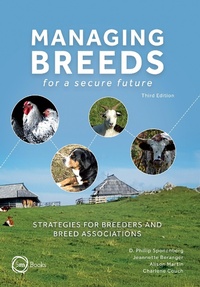
Managing Breeds for a Secure Future 3rd Edition
Strategies for Breeders and Breed Associations
Published on 31. December 2021
432 pages
978-1-78918-183-8 (ISBN)
Description

Long-term management of rare breeds is a complicated endeavour, and strategies for success have been detailed in the first and second editions of Managing Breeds for a Secure Future. For many the challenge of knowing exactly what to do when very short-term actions are needed to rescue a numerically small population of animals remains. Such situations point to a need for a specific set of recipes that can be followed in different situations in order to assure successful outcomes. This new edition addresses that need.Each rare breed rescue comes with its own array of specific problems, but several general concepts run through all of them. These concepts provide a good framework for breed rescue work. This book relies on these concepts in order to help breeders chart a course when confronted with a rare population (breed or bloodline) that faces immediate threat of loss.Some of the updates to new edition include:* Biological Issues* Population Analysis* Pedigree-based Analyses* Managing a Genetic Defect* General Rescue PrinciplesManaging Breeds for a Secure Future Third Edition is an expanded version of the second edition. It is re-organized to flow better, and has additional chapters on specific breeding protocols for maintaining breeds. It also delves more deeply into rescuing rare populations, through both theory and practice.
More details
Series
Language
English
Place of publication
Great Easton
United Kingdom
Target group
College/higher education
File size
33,68 MB
ISBN-13
978-1-78918-183-8 (9781789181838)
Copyright in bibliographic data and cover images is held by Nielsen Book Services Limited or by the publishers or by their respective licensors: all rights reserved.
Schweitzer Classification
Other editions
Additional editions
D. Phillip Sponenberg
Managing Breeds for a Secure Future 3rd Edition
Strategies for Breeders and Breed Associations
Book
12/2021
5M Books Ltd
€56.00
Shipment within 3-4 weeks
Content
- Cover Page
- Half Title Page
- Title Page
- Copyright Page
- Contents Page
- Preface Page
- 1 Introduction
- 1.1 How to Use This Book
- 1.2 What Is a Breed?
- 1.3 Genetic Character of Breeds
- 1.4 Why Breeds Are Important
- 1.5 Sustaining Breeds over Time
- 2 Breed Basics
- 2.1 How Breeds Form
- 2.2 Classes of Breeds
- 2.2.1 Landraces
- 2.2.2 Standardized Breeds
- 2.2.3 Modern "Type" and "Designer" Breeds
- 2.2.4 Industrial Strains
- 2.2.5 Feral Populations
- 2.2.6 Dog Breeds
- 2.2.7 Poultry Breeds
- 2.2.8 Summary
- 2.3 How Breeds Are Lost
- 3 Breeds as Gene Pools: Variability and Predictability
- 3.1 Standardized Breeds
- 3.2 Landraces
- 3.3 Subgroups within a Breed: Bloodlines, Strains, and Varieties
- 3.4 Gene Flow into and out of Breeds
- 3.4.1 Upgrading and What It Does
- 3.4.2 Upgrading and Bloodlines
- 4 Defining an Individual Breed
- 4.1 Which Animals to Include
- 4.2 One Breed or Two
- 4.3 Breed Histories
- 4.4 Geography and Source Herds
- 4.5 Recovery of Purebred Animals into Registries
- 4.5.1 Native on Appearance
- 5 Breed Standards
- 5.1 Breed Type
- 5.2 Different Sorts of Breed Standards
- 5.3 Breed Type Reproduces Breed Type
- 5.4 Developing a Breed Standard
- 5.5 Breed Standards and Genetic Diversity
- 5.6 Breed Standards and Breed Loss
- 5.7 Standard Traits That Can Be Detrimental
- 5.8 Qualitative and Quantitative Traits
- 5.9 Changes to the Breed Standard
- 6 Principles of Genetic Management
- 6.1 Linebreeding and Inbreeding
- 6.2 Outcrossing: Crossbreeding and Linecrossing
- 6.3 Defining Matings as "Related" or "Unrelated"
- 6.4 Linebreeding or Outcrossing: Which Is Best?
- 6.5 Rational Crossbreeding
- 7 Selection as a Genetic Management Tool
- 7.1 Degree of Selection
- 7.2 Selection and Breed-Specific Traits
- 7.3 Genetic Drift
- 7.4 Single Gene Traits
- 7.5 Polygenic Traits
- 8 Evaluating Individual Animals
- 8.1 Competitive Shows
- 8.2 Card Grading
- 8.3 Non-Competitive Exhibition
- 8.4 Performance Testing
- 8.4.1 Adaptation
- 8.4.2 Temperament and Behavior
- 8.4.3 Longevity
- 8.4.4 Comprehensive Strategies
- 9 Practical Aspects of Genetic Management
- 9.1 Selection of Animals for Reproduction
- 9.2 Pairing of Animals within Purebred Breeds
- 9.3 Strategic Selection of Specific Mates
- 9.4 Strategic Use of Coefficients of Inbreeding
- 9.5 Use of Estimated Breeding Values
- 9.6 Breeding Goals for Various Sorts of Breeders
- 9.7 Poultry Breeds and Breeders
- 10 Assisted Reproduction Techniques
- 10.1 Artificial Insemination
- 10.2 Embryo Transfer
- 10.3 In Vitro Fertilization
- 10.4 Cloning
- 10.5 Cryopreservation
- 10.5.1 Selection of Samples and Numbers to Conserve
- 10.5.2 Sampling Standardized Breeds
- 10.5.3 Sampling Landraces
- 10.5.4 Sampling Feral Populations
- 11 Animal Identification
- 12 Population Analysis
- 12.1 Census
- 12.1.1 Numbers of Animals
- 12.1.2 Monitoring Bloodlines, Strains, and Families
- 12.1.3 Monitoring Health Issues
- 12.2 DNA Analysis
- 12.2.1 DNA: Microsatellites
- 12.2.2 DNA: Single Nucleotide Polymorphisms (SNPs)
- 12.2.3 DNA: Mitochondria
- 12.2.4 DNA: Y Chromosomes
- 12.2.5 Other Uses of DNA Technology
- 12.3 Pedigree-Based Analyses
- 12.3.1 Pedigree-Based Inbreeding Coefficients
- 12.3.2 Pedigree-Based Kinship Levels
- 12.3.3 Foundation Bloodline Analysis
- 12.3.4 Popular (or Rare) Sires (or Dams)
- 12.4 Summary
- 13 Maintaining Breeds for Long-Term Success
- 13.1 Genetic Bottlenecks
- 13.2 Monitoring Effective Population Size
- 13.3 Generation Interval
- 13.4 Inbreeding and Loss of Diversity
- 13.5 Monitoring Inbreeding
- 13.6 Inbreeding within Individual Herds
- 13.7 Inbreeding within Breeds
- 13.8 Combining Linebreeding and Linecrossing
- 13.9 Inbreeding and Linebreeding to Expand Rare Genetics
- 13.10 Managing Contributions of Individual Animals
- 14 Specific Plans for Maintenance Breeding
- 14.1 "Regular" Conservation Breeding
- 14.2 Variations on "Regular" Conservation Breeding
- 14.2.1 Strategies for Tracking Animals to Manage Bloodlines
- 14.2.2 Small Populations with Single Males
- 14.2.3 Managing Populations Where Males Have Long Careers
- 14.3 Species Considerations for Conservation Breeding
- 14.3.1 Sheep and Goats
- 14.3.2 Swine
- 14.3.3 Rabbits
- 14.3.4 Poultry
- 14.3.5 Horses and Donkeys
- 14.3.6 Dogs
- 14.4 Rotational Breeding or Spiral Breeding
- 14.5 Poultry Plans (except Geese!)
- 14.5.1 The Felch Method
- 14.5.2 Sequential Rotation of Male Poultry
- 14.5.3 Only Two Lines Available: Poultry, Swine, and Rabbits
- 14.5.4 "Double Mating" of Poultry
- 14.6 Trio Breeding Plan for Rabbits and Others
- 15 Rescuing Small Populations: General Aspects
- 15.1 General Guiding Principles
- 15.2 Subdivision of Populations
- 15.3 Species-Specific Considerations
- 16 Specific Plans for Rescue Breeding
- 16.1 One Male, Several Females
- 16.1.1 Jericho Goats
- 16.2 One Male, Several Females, Some Inbreeding Depression
- 16.2.1 Palmer-Dunn Pineywoods Cattle
- 16.3 Multiple Males, Multiple Females, All Variably Inbred
- 16.3.1 Randall Lineback Cattle
- 16.4 One Male, Multiple Herds of Females
- 16.4.1 Criollo Macabeo Cattle
- 16.5 One Large Herd with Satellite Populations
- 16.5.1 Marsh Tacky Horses
- 16.6 Breeds with Multiple Rare Bloodlines
- 16.6.1 Choctaw/Cherokee/Huasteca Horses
- 16.6.2 Rare Strain Pineywoods Cattle
- 16.6.3 Java Chickens
- 16.7 Too Few Animals for Stand-Alone Conservation
- 16.7.1 Eggerton Myotonic Goats
- 16.8 Single Animal of Conservation Interest
- 16.8.1 Glendhu Leicester Longwool Sheep
- 16.9 Frozen Semen Available from Historic Stores
- 16.9.1 Shorthorn Cattle
- 16.10 Managing a Genetic Defect
- 16.10.1 Akhal-Teke Naked Foal Syndrome
- 17 Putting the Lessons Together: Dexter Cattle
- 18 External Factors Affecting Breeds
- 18.1 Market Demand
- 18.2 Crossbreeding
- 18.3 Regulations
- 18.4 Imports
- 18.4.1 Imports That Contribute Substantially to Conservation Efforts
- 18.4.2 Imports That Enhance American Bloodlines
- 18.4.3 Imports That Hamper Conservation in the Country of Origin
- 18.4.4 Imports That Endanger American Bloodlines and Breeds
- 18.4.5 Assessment of Importations
- 19 General Principles for Breed Associations
- 19.1 Purposes of Associations
- 19.2 Membership
- 19.3 Breed Associations for Endangered Breeds
- 19.4 Communication
- 19.5 Multiple Breed Associations
- 19.6 Codes of Ethics
- 19.7 Educational Programs
- 19.8 Research
- 19.9 Recruiting and Training New Breeders
- 19.10 Breed Promotion
- 19.11 Breed Sale Events
- 19.12 Assuring Continuity
- 20 Practical Details of Breed Associations
- 20.1 Forms of Association
- 20.1.1 Private Associations
- 20.1.2 Unincorporated Associations
- 20.1.3 Incorporated Associations
- 20.2 Bylaws
- 20.3 Board of Directors
- 20.3.1 Directors and Officers
- 20.4 Networks of Breed Associations
- 20.5 Promoting the Association
- 20.6 Association Responsibilities
- 20.6.1 Conservation Responsibilities
- 20.6.2 Reporting Pedigree Information
- 20.6.3 Reporting Breed Health Status
- 20.6.4 Reporting Measures of Genetic Diversity
- 20.6.5 Programs to Save Herds in Peril
- 20.6.6 Development of Long-Range Conservation Plans
- 20.6.7 Dispelling False Rumors Quickly
- 20.7 Conflict of Interest
- 20.8 Local and Regional Groups
- 21 Registry
- 21.1 Registration
- 21.2 Pedigrees
- 21.3 Pedigree Recording Systems
- 21.4 Litter Recording
- 21.5 Stud Reports
- 21.6 Selective Recording Systems
- 21.7 Registrations Are Important
- 21.8 Closed Herd Book Registries
- 21.9 Open Herd Book Registries
- 21.10 Registration of Crossbreds and Partbreds
- 21.11 Registration for Extensively Raised Landraces
- 21.12 Starting a Registry
- 22 Breeder Responsibilities
- 22.1 Master Breeders
- 22.2 Breeds, Breeders, Associations, and the Future
- Appendices
- Appendix 1 Phenotypic Matrix for Colonial Spanish Horses
- Appendix 2 A Protocol for Bloodline Analysis
- Appendix 3 A Protocol for Assessing Popular Sires or Dams
- Appendix 4 Sample Bylaws
- Index
