

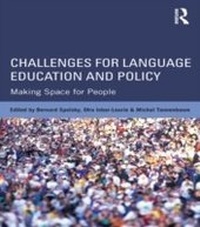
Challenges for Language Education and Policy
Making Space for People
1st Edition
Published on 15. September 2014
352 pages
978-1-134-65865-7 (ISBN)
Description

Addressing a wide range of issues in applied linguistics, sociolinguistics, and multilingualism, this volume focuses on language users, the 'people.' Making creative connections between existing scholarship in language policy and contemporary theory and research in other social sciences, authors from around the world offer new critical perspectives for analyzing language phenomena and language theories, suggesting new meeting points among language users and language policy makers, norms, and traditions in diverse cultural, geographical, and historical contexts.
Identifying and expanding on previously neglected aspects of language studies, the book is inspired by the work of Elana Shohamy, whose critical view and innovative work on a broad spectrum of key topics in applied linguistics has influenced many scholars in the field to think "out of the box" and to reconsider some basic commonly held understandings, specifically with regard to the impact of language and languaging on individual language users rather than on the masses.
Identifying and expanding on previously neglected aspects of language studies, the book is inspired by the work of Elana Shohamy, whose critical view and innovative work on a broad spectrum of key topics in applied linguistics has influenced many scholars in the field to think "out of the box" and to reconsider some basic commonly held understandings, specifically with regard to the impact of language and languaging on individual language users rather than on the masses.
Reviews / Votes
"Valuable for specialists and general readers alike, this extraordinary collection illuminates the personal and social origins and implications of real-life language policies with a level of authority, insight, and specificity not found elsewhere. It connects language policies to the aspirations, benefits, challenges, and tensions experienced by language managers and learners around the world."Mary McGroarty, Northern Arizona University, USA
More details
Language
English
Place of publication
London
United Kingdom
Publishing group
Taylor & Francis Ltd
Target group
College/higher education
Illustrations
19 s/w Tabellen
19 Tables, black and white
File size
5,70 MB
ISBN-13
978-1-134-65865-7 (9781134658657)
Copyright in bibliographic data and cover images is held by Nielsen Book Services Limited or by the publishers or by their respective licensors: all rights reserved.
Schweitzer Classification
Other editions
Additional editions
Bernard Spolsky | Ofra Inbar-Lourie | Michal Tannenbaum
Challenges for Language Education and Policy
Making Space for People
Book
07/2014
1st Edition
Routledge
€242.60
Shipment within 15-20 days
Bernard Spolsky | Ofra Inbar-Lourie | Michal Tannenbaum
Challenges for Language Education and Policy
Making Space for People
Book
07/2014
1st Edition
Routledge
€83.30
Shipment within 15-20 days
Persons
Bernard Spolsky is Professor Emeritus of English at Bar-Ilan University, Israel.
Ofra Inbar-Lourie is head of the Teachers' Education Unit of Tel Aviv University, School of Education, Israel.
Michal Tannenbaum is a Senior Lecturer and the head of the Language Education Program at Tel Aviv University, Israel.
Ofra Inbar-Lourie is head of the Teachers' Education Unit of Tel Aviv University, School of Education, Israel.
Michal Tannenbaum is a Senior Lecturer and the head of the Language Education Program at Tel Aviv University, Israel.
Content
Preface: Dear Elana, Bernard Spolsky
Introduction: A Portrait of the Researcher in a Never-Ending Journey, Ofra Inbar and Michal Tannenbaum
Chapter 1: Language Tests for Residency and Citizenship and the Conferring of Individuality, Tim McNamara, Kamran Khan, and Kellie Frost
Chapter 2: Setting Standards for Multilingual Curricula to Teach and Test Foreign Languages, Bessie Dendrinos and Voula Gotsoulia
Chapter 3: In the Name of the CEFR: Individuals and Standards, Monica Barni
Chapter 4: Acknowledging the Diversity of the Language Learner Population in Australia: Towards Context-Sensitive Language Standards, Catherine Anne Elder
Chapter 5: Students' Voices: The Challenge of Measuring Speaking for Academic Contexts, Lindsay Brooks and Merrill Swain
Chapter 6: Ethical Codes and Responsibility, Alan Davies
Chapter 7: Cultivating an Ecology of Multilingualism in Schools, Ofelia Garcia and Kate Menken
Chapter 8: English in Ethiopia: Making Space for the Individual in Language Policy, Elizabeth Lanza and Hirut Woldemariam
Chapter 9: Portraits of Language Activists in Indigenous Language Revitalization, Nancy H. Hornberger
Chapter 10: Refugees in Canada: On the Loss of Social Capital, Thomas Ricento
Chapter 11: Linguistic Landscapes Inside Multilingual Schools, Durk Gorter and Jasone Cenoz
Chapter 12: "We Are Not Really a Mixed City"- A De-Jure Bilingual Linguistic Landscape - The Case of Jewish-Arab Mixed Cities in Israel, Dafna Yitzhaki and Theodorus du Plessis
Chapter 13: Hebraization in the Palestinian Language Landscape in Israel, Muhammad Amara
Chapter 14: Hebrew in the North American Linguistic Landscape: Materializing the Sacred, Sharon Avni
Chapter 15: Welcome: Synthetic Personalization and Commodification of Sociability in the Linguistic Landscape of Global Tourism, Adam Jaworski
Chapter 16: A Researcher's Auto-Socioanalysis: Making Space for the Personal, Claire Kramsch
Chapter 17: Understanding the Holocaust: A Personal History, Critical Literacy Analysis of a Gestapo File, David I. Hanauer
Chapter 18: Language Experience Changes Language and Cognitive Ability: Implications for Social Policy, Ellen Bialystok
Chapter 19: Strategies for the Super-Multilingual in an Increasingly Global World, Andrew D. Cohen
Chapter 20: Gender, Sexuality and Multilingualism in the Language Classroom, Lyn Wright Fogle and Kendall A. King
Chapter 21: Examining Markers of Identity Construction in English Language Learning: Some Implications for Palestinian-Israeli and Jewish-Israeli Language Learners, Julia Schlam Salman, Elite Olshtain, and Zvi Bekerman
Chapter 22: Integrational Linguistics and L2 Proficiency, James P. Lantolf
About the Contributors
Introduction: A Portrait of the Researcher in a Never-Ending Journey, Ofra Inbar and Michal Tannenbaum
Chapter 1: Language Tests for Residency and Citizenship and the Conferring of Individuality, Tim McNamara, Kamran Khan, and Kellie Frost
Chapter 2: Setting Standards for Multilingual Curricula to Teach and Test Foreign Languages, Bessie Dendrinos and Voula Gotsoulia
Chapter 3: In the Name of the CEFR: Individuals and Standards, Monica Barni
Chapter 4: Acknowledging the Diversity of the Language Learner Population in Australia: Towards Context-Sensitive Language Standards, Catherine Anne Elder
Chapter 5: Students' Voices: The Challenge of Measuring Speaking for Academic Contexts, Lindsay Brooks and Merrill Swain
Chapter 6: Ethical Codes and Responsibility, Alan Davies
Chapter 7: Cultivating an Ecology of Multilingualism in Schools, Ofelia Garcia and Kate Menken
Chapter 8: English in Ethiopia: Making Space for the Individual in Language Policy, Elizabeth Lanza and Hirut Woldemariam
Chapter 9: Portraits of Language Activists in Indigenous Language Revitalization, Nancy H. Hornberger
Chapter 10: Refugees in Canada: On the Loss of Social Capital, Thomas Ricento
Chapter 11: Linguistic Landscapes Inside Multilingual Schools, Durk Gorter and Jasone Cenoz
Chapter 12: "We Are Not Really a Mixed City"- A De-Jure Bilingual Linguistic Landscape - The Case of Jewish-Arab Mixed Cities in Israel, Dafna Yitzhaki and Theodorus du Plessis
Chapter 13: Hebraization in the Palestinian Language Landscape in Israel, Muhammad Amara
Chapter 14: Hebrew in the North American Linguistic Landscape: Materializing the Sacred, Sharon Avni
Chapter 15: Welcome: Synthetic Personalization and Commodification of Sociability in the Linguistic Landscape of Global Tourism, Adam Jaworski
Chapter 16: A Researcher's Auto-Socioanalysis: Making Space for the Personal, Claire Kramsch
Chapter 17: Understanding the Holocaust: A Personal History, Critical Literacy Analysis of a Gestapo File, David I. Hanauer
Chapter 18: Language Experience Changes Language and Cognitive Ability: Implications for Social Policy, Ellen Bialystok
Chapter 19: Strategies for the Super-Multilingual in an Increasingly Global World, Andrew D. Cohen
Chapter 20: Gender, Sexuality and Multilingualism in the Language Classroom, Lyn Wright Fogle and Kendall A. King
Chapter 21: Examining Markers of Identity Construction in English Language Learning: Some Implications for Palestinian-Israeli and Jewish-Israeli Language Learners, Julia Schlam Salman, Elite Olshtain, and Zvi Bekerman
Chapter 22: Integrational Linguistics and L2 Proficiency, James P. Lantolf
About the Contributors
