

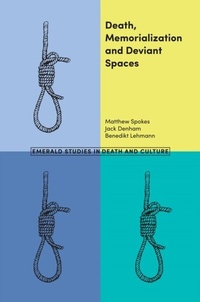
Death, Memorialization and Deviant Spaces
1st Edition
Published on 31. August 2018
168 pages
978-1-78756-571-5 (ISBN)
Description

This book offers an ethnographic exploration of three sites of infamous atrocity and their differing memorialization. 'Dark tourism' research has studied the consumerization of spaces associated with death and barbarity, whilst 'difficult heritage' has looked at politicized, national debates that surround the preservation of death. This book contributes to these debates by applying spatial theory on a scalar level, particularly through the work of Henri Lefebvre. It uses escalating case studies to situate memorialization, and the multifarious demands of politics, consumption and community, within a framework that rearticulates 'lived', 'perceived' and 'conceived' aspects of deviant spaces ranging from the small (a bench) to the very large (a city).
The first case study, the Tyburn gallows site in York, uses Lefebvre's notion of 'theatrical space' to contextualize the role of performativity in memorialization. The second, Number 25 Cromwell Street in Gloucester, builds on this by exploring the absence of memorialization through Lefebvre's concept of 'contradictory space' and the impact this has on consumption. The third expands to consider the city as a problematic memorial, here focusing on the political subjectivities of Dresden - rebuilt following the devastation of the Second World War - and its contemporary associations with neo-Nazi and anti-fascist protests.
Ultimately, by examining the issue of scale in heritage, the book seeks to develop a new way of unpacking and understanding the heteroglossic nature of deviant space and memorialization.
The first case study, the Tyburn gallows site in York, uses Lefebvre's notion of 'theatrical space' to contextualize the role of performativity in memorialization. The second, Number 25 Cromwell Street in Gloucester, builds on this by exploring the absence of memorialization through Lefebvre's concept of 'contradictory space' and the impact this has on consumption. The third expands to consider the city as a problematic memorial, here focusing on the political subjectivities of Dresden - rebuilt following the devastation of the Second World War - and its contemporary associations with neo-Nazi and anti-fascist protests.
Ultimately, by examining the issue of scale in heritage, the book seeks to develop a new way of unpacking and understanding the heteroglossic nature of deviant space and memorialization.
Reviews / Votes
Exploring different ideas on how to deal with the physical remnants of past atrocities, Spokes, Denham, and Lehmann identify overlaps and posit ways forward for understanding difficult heritage and dark tourism through the prism of spatial theory. They also suggest departures for further research into the intersection between death, spatiality, and infamy. Their case studies are The Tyburn Gallows in York, Number 25 Cromwell Street in Gloucester, and Neumarkt in Dresden. -- Annotation (c)2018 * (protoview.com) *More details
Series
Language
English
Place of publication
Bingley
United Kingdom
Target group
Professional and scholarly
File size
7,01 MB
ISBN-13
978-1-78756-571-5 (9781787565715)
Copyright in bibliographic data and cover images is held by Nielsen Book Services Limited or by the publishers or by their respective licensors: all rights reserved.
Schweitzer Classification
Persons
Matthew Spokes is Lecturer in Sociology at York St. John University, UK. His research principally focuses on the intersections between popular (and unpopular!) culture, death and spatial theory, especially in relation to interactive entertainment.Jack Denham is Lecturer in Sociology and Criminology at York St. John University, UK. He is a co-editor of the book series Emerald Studies in Death and Culture, and his research interests focus on 'murderabilia', crime in popular culture, the sociology of consumption, and death.
Benedikt Lehmann is Lecturer in Sociology and Criminology at York St. John University, UK. His research interests concentrate on social and criminological theory, financial markets and automation technology, alongside the politics of public space.
Benedikt Lehmann is Lecturer in Sociology and Criminology at York St. John University, UK. His research interests concentrate on social and criminological theory, financial markets and automation technology, alongside the politics of public space.
Content
1. Introduction 2. Heritage and Space: Some Theoretical Perspectives
3. Theatrics (The Tyburn gallows, York)
4. Consumption (Number 25 Cromwell Street, Gloucester)
5. Politicization (Neumarkt, Dresden)
6. Conclusions
3. Theatrics (The Tyburn gallows, York)
4. Consumption (Number 25 Cromwell Street, Gloucester)
5. Politicization (Neumarkt, Dresden)
6. Conclusions
