

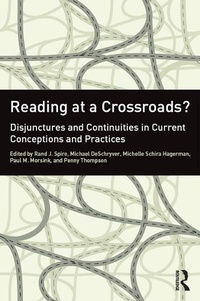
Reading at a Crossroads?
Disjunctures and Continuities in Current Conceptions and Practices
Published on 5. March 2015
198 pages
978-1-136-74110-4 (ISBN)
Description

The Internet is transforming the experience of reading and learning-through-reading. Is this transformation effecting a radical change in reading processes as readers synthesize understandings from fragments across multiple texts? Or, conversely, is the Internet merely a new place to use the same reading skills and processes developed through experience with traditional print-based media? Are the changes in reading processes a matter of degree, or are they fundamentally new? And if so, how must reading theory, research, and instruction adjust?
This volume brings together distinguished experts from the fields of reading research, teacher education, educational psychology, cognitive science, rhetoric and composition, digital humanities, and educational technology to address these questions. Every question is not answered in every chapter. How could they be? But every contributor has many thoughtful things to say about a subset of these important questions. Together, they add up to a comprehensive response to the issues the field faces as it approaches what may well be-or not -a crossroads. A website devoted to extending discussion around the book in creative (and disjunctive) ways [readingatacrossroads.net] moves it beyond the printed page.
This volume brings together distinguished experts from the fields of reading research, teacher education, educational psychology, cognitive science, rhetoric and composition, digital humanities, and educational technology to address these questions. Every question is not answered in every chapter. How could they be? But every contributor has many thoughtful things to say about a subset of these important questions. Together, they add up to a comprehensive response to the issues the field faces as it approaches what may well be-or not -a crossroads. A website devoted to extending discussion around the book in creative (and disjunctive) ways [readingatacrossroads.net] moves it beyond the printed page.
More details
Language
English
Place of publication
London
United Kingdom
Publishing group
Taylor & Francis Ltd
Target group
College/higher education
Illustrations
10 s/w Abbildungen
10 Illustrations, black and white
File size
3,59 MB
ISBN-13
978-1-136-74110-4 (9781136741104)
Copyright in bibliographic data and cover images is held by Nielsen Book Services Limited or by the publishers or by their respective licensors: all rights reserved.
Schweitzer Classification
Other editions
Additional editions
Rand J. Spiro | Michael DeSchryver | Michelle Schira Hagerman
Reading at a Crossroads?
Disjunctures and Continuities in Current Conceptions and Practices
Book
03/2015
1st Edition
Routledge
€231.40
Shipment within 15-20 days
Rand J. Spiro | Michael DeSchryver | Michelle Schira Hagerman
Reading at a Crossroads?
Disjunctures and Continuities in Current Conceptions and Practices
Book
03/2015
1st Edition
Routledge
€76.20
Shipment within 15-20 days
Persons
Rand J. Spiro is Professor of Educational Psychology and Educational Technology, Michigan State University, USA.
Michael DeSchryver is Assistant Professor in the Department of Teacher Education and Professional Development, Central Michigan University, USA.
Michelle Schira Hagerman is Director of Graduate Certificate Programs in Educational Technology and Online Teaching and Learning, Michigan State University, USA.
Paul M. Morsink is a doctoral candidate in Educational Psychology and Educational Technology, Michigan State University, USA.
Penny Thompson is Assistant Professor of Educational Technology, Oklahoma State University, USA.
Michael DeSchryver is Assistant Professor in the Department of Teacher Education and Professional Development, Central Michigan University, USA.
Michelle Schira Hagerman is Director of Graduate Certificate Programs in Educational Technology and Online Teaching and Learning, Michigan State University, USA.
Paul M. Morsink is a doctoral candidate in Educational Psychology and Educational Technology, Michigan State University, USA.
Penny Thompson is Assistant Professor of Educational Technology, Oklahoma State University, USA.
Content
Preface
Part One: Setting the Stage: The Big Picture
Chapter 1: A Brief History of Information Sources in the Late 20th and Early 21st Century (A Simulation), David Reinking and Jamie Colwell
Chapter 2: Literacy and the Technologies of Knowing, David R. Olson
Chapter 3: The Resistance to 21st-Century Reading, Mark Bauerlein
Chapter 4: Three Paradigms in Reading (Really Literacy) Research and Digital Media, James Paul Gee
Chapter 5: All Bets Are Off: How Certain Kinds of Reading to Learn on the Web Are Totally Different from What We Learned from Research on Traditional Text Comprehension and Learning from Text, Rand J. Spiro, Hannah Klautke, Angela K. Johnson
Part Two: The Nature of Reading (and Writing) Online
Chapter 6: Purposeful, Critical, and Flexible: Vital Dimensions of Online Reading and Learning, Julie Coiro
Chapter 7: From Computers and the Web to Mobile Devices and e-Texts: The Transition to Digital Reading Continues, Mark Warschauer
Chapter 8: Reading at a Million Crossroads: Massively Pluralized Practices and Conceptions of Reading, Douglas K. Hartman and Paul M. Morsink
Chapter 9: Reading and the Web: Broadening the Need for Complex Comprehension, Susan R. Goldman
Chapter 10: Building Coherence in Web-Based and Other Non-Traditional Reading Environments: Cognitive Opportunities and Challenges, Paul van den Broek and Panyiota Kendeou
Chapter 11: Disequilibrium.edu: Negotiating New Relationships Between Online Reading and Writing, Gail E. Hawisher and Scott Filkins
Part Three: Instruction: Reading Education in the Digital Age
Chapter 12: "Now Is the Winter of Our Discontent": Shakespeare, Kuhn, and Instability in the Field of Reading Education, Donna E. Alvermann & Jennifer L. Bogdanich
Chapter 13: Past, Present, and Future Conditions and Practices of Reading, Michael L. Kamil
Chapter 14: Neglected Areas of Instruction: Bad for Print, Worse for the Internet, Nell K. Duke, Shenglan Zhang, and Paul M. Morsink
Chapter 15: We're Closing the Digital Divide: Now Let's Work on Closing the Teleological Divide, Colin Harrison
Chapter 16: The Functionality of Literacy in a Digital World, Allan Collins and Richard Halverson
Index
Part One: Setting the Stage: The Big Picture
Chapter 1: A Brief History of Information Sources in the Late 20th and Early 21st Century (A Simulation), David Reinking and Jamie Colwell
Chapter 2: Literacy and the Technologies of Knowing, David R. Olson
Chapter 3: The Resistance to 21st-Century Reading, Mark Bauerlein
Chapter 4: Three Paradigms in Reading (Really Literacy) Research and Digital Media, James Paul Gee
Chapter 5: All Bets Are Off: How Certain Kinds of Reading to Learn on the Web Are Totally Different from What We Learned from Research on Traditional Text Comprehension and Learning from Text, Rand J. Spiro, Hannah Klautke, Angela K. Johnson
Part Two: The Nature of Reading (and Writing) Online
Chapter 6: Purposeful, Critical, and Flexible: Vital Dimensions of Online Reading and Learning, Julie Coiro
Chapter 7: From Computers and the Web to Mobile Devices and e-Texts: The Transition to Digital Reading Continues, Mark Warschauer
Chapter 8: Reading at a Million Crossroads: Massively Pluralized Practices and Conceptions of Reading, Douglas K. Hartman and Paul M. Morsink
Chapter 9: Reading and the Web: Broadening the Need for Complex Comprehension, Susan R. Goldman
Chapter 10: Building Coherence in Web-Based and Other Non-Traditional Reading Environments: Cognitive Opportunities and Challenges, Paul van den Broek and Panyiota Kendeou
Chapter 11: Disequilibrium.edu: Negotiating New Relationships Between Online Reading and Writing, Gail E. Hawisher and Scott Filkins
Part Three: Instruction: Reading Education in the Digital Age
Chapter 12: "Now Is the Winter of Our Discontent": Shakespeare, Kuhn, and Instability in the Field of Reading Education, Donna E. Alvermann & Jennifer L. Bogdanich
Chapter 13: Past, Present, and Future Conditions and Practices of Reading, Michael L. Kamil
Chapter 14: Neglected Areas of Instruction: Bad for Print, Worse for the Internet, Nell K. Duke, Shenglan Zhang, and Paul M. Morsink
Chapter 15: We're Closing the Digital Divide: Now Let's Work on Closing the Teleological Divide, Colin Harrison
Chapter 16: The Functionality of Literacy in a Digital World, Allan Collins and Richard Halverson
Index
