
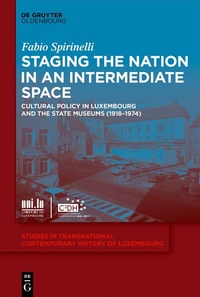
Staging the Nation in an Intermediate Space
Description
Alles über E-Books | Antworten auf Fragen rund um E-Books, Kopierschutz und Dateiformate finden Sie in unserem Info- & Hilfebereich.
In Luxembourg, the evolution of cultural policy remains underexplored despite its pivotal role in the nation-building process. This book investigates how national cultural policy evolved from the 1920s to the early 1970s, casting Luxembourg as a nationalized intermediate space between French and German influences. Featuring a case study of the history and art section of the State Museums - the precursor to today's Musée national d'archéologie, d'histoire et d'art - the book examines the interplay of structures, actors, and discourses and how a cultural institution was intertwined with cultural policy. The study exposes the tensions between adopting external models, on the one hand, and asserting a distinct national culture amid interventionist policies, on the other hand. By including the occupation period from 1940 to 1944, it illustrates how Nazi policies challenged Luxembourg's nation-building by seeking to integrate it into the Third Reich. Combining theoretical analysis with archival research, this work offers nuanced insights into nation-building processes and is highly relevant for historians, cultural policy scholars, and museum professionals.
More details
Other editions
Additional editions

Persons
Fabio Spirinelli , Chamber of Deputies, Luxembourg.
System requirements
File format: PDF
Copy protection: Watermark-DRM (Digital Rights Management)
System requirements:
- Computer (Windows; MacOS X; Linux): Use the free software Adobe Reader, Adobe Digital Editions, or any other PDF viewer of your choice (see eBook Help).
- Tablet/Smartphone (Android; iOS): Install the free app Adobe Digital Editions or another reading app for eBooks, e.g., PocketBook (see eBook Help).
- E-reader: Bookeen, Kobo, Pocketbook, Sony, Tolino and many more (only limited: Kindle).
The file format PDF always displays a book page identically on any hardware. This makes PDF suitable for complex layouts such as those used in textbooks and reference books (images, tables, columns, footnotes). Unfortunately, on the small screens of e-readers or smartphones, PDFs are rather annoying, requiring too much scrolling.
This eBook uses Watermark-DRM, a „soft” copy protection. This means that there are no technical restrictions to prevent illegal distribution. However, there is a personalised watermark embedded in the eBook that can be used to identify the purchaser of the eBook in the event of misuse and to provide evidence for legal purposes.
For more information, see our eBook Help page.