

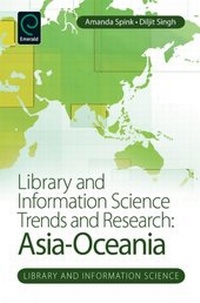
Library and Information Science Trends and Research
Asia-Oceania
1st Edition
Published on 16. January 2012
335 pages
978-1-78052-471-9 (ISBN)
Description

This book brings together a range of chapters about the trends in education and research in the field of library and information science (LIS) in the Asia-Oceania region of the world. Why a book about LIS in the Asia-Oceania region? One key reason for a book on the topic is the huge growth of the field in terms of students and schools particularly in Asia. Information is an important part of the human condition and critical to the development of the Asia-Oceania region.
All prices
More details
Series
Language
English
Place of publication
Bingley
United Kingdom
Target group
Professional and scholarly
File size
10,24 MB
ISBN-13
978-1-78052-471-9 (9781780524719)
Copyright in bibliographic data and cover images is held by Nielsen Book Services Limited or by the publishers or by their respective licensors: all rights reserved.
Schweitzer Classification
Other editions
Additional editions
Book
01/2012
Emerald Group Publishing Limited
€194.30
Shipment within 10-20 days
Content
Preface.
Chapter 1 Introduction.
Chapter 2 From Practice to Academia: 50 Years of LIS Education in Australia.
Chapter 3 Keeping Current: The Evolution of Postgraduate Library and Information Studies Education in New Zealand.
Chapter 4 From a Distance: Teacher Librarian Training by Distance Collaboration.
Chapter 5 Culture, Libraries and Information Services at the Intersection of Development in India: Propelling Growth in the 21st Century.
Chapter 6 Environmental Scanning - An Emerging Discipline for LIS Education.
Chapter 7 Developing Contextual Perceptions of Information Literacy and Information Literacy Education in the Asian Region.
Chapter 8 Information Culture in the Maldives.
Chapter 9 LIS Research Trends in Doctoral Studies and Project Work: A Case Study of DLISc, Rashtrasant Tukadoji Maharaj Nagpur University, Nagpur (1985-2010).
Chapter 10 Virtual Community Research in China: A Critical Review of the LIS Literature.
Chapter 11 Indonesian Library and Information Science Research as the Social Construction Process.
Chapter 12 Multilingual Resources and Services in Chinese Academic Libraries: A Survey.
About the Authors.
Subject Index.
Library and Information Science Trends and Research.
Library and Information Science.
Editorial Advisory Board.
Library and Information Science.
Copyright page.
List of Contributors.
Chapter 1 Introduction.
Chapter 2 From Practice to Academia: 50 Years of LIS Education in Australia.
Chapter 3 Keeping Current: The Evolution of Postgraduate Library and Information Studies Education in New Zealand.
Chapter 4 From a Distance: Teacher Librarian Training by Distance Collaboration.
Chapter 5 Culture, Libraries and Information Services at the Intersection of Development in India: Propelling Growth in the 21st Century.
Chapter 6 Environmental Scanning - An Emerging Discipline for LIS Education.
Chapter 7 Developing Contextual Perceptions of Information Literacy and Information Literacy Education in the Asian Region.
Chapter 8 Information Culture in the Maldives.
Chapter 9 LIS Research Trends in Doctoral Studies and Project Work: A Case Study of DLISc, Rashtrasant Tukadoji Maharaj Nagpur University, Nagpur (1985-2010).
Chapter 10 Virtual Community Research in China: A Critical Review of the LIS Literature.
Chapter 11 Indonesian Library and Information Science Research as the Social Construction Process.
Chapter 12 Multilingual Resources and Services in Chinese Academic Libraries: A Survey.
About the Authors.
Subject Index.
Library and Information Science Trends and Research.
Library and Information Science.
Editorial Advisory Board.
Library and Information Science.
Copyright page.
List of Contributors.

