

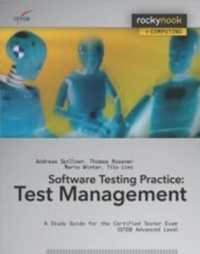
Software Testing Practice: Test Management
A Study Guide for the Certified Tester Exam ISTQB Advanced Level
1st Edition
Published on 24. August 2007
346 pages
978-1-4571-1823-4 (ISBN)
Description

Aimed at experts who are dedicated to software testing, The Software Testing Process: Test Management addresses the major issues related to advanced, state-of-the-art test management. This book covers the syllabus required to pass the Certified Tester Examination - Advanced Level as defined by the International Software Testing Qualifications Board (ISTQB).Software developers, project managers, quality managers, and team leaders will benefit from the comprehensive coverage of risk oriented management and the way testing is shown to be an integral, though independent part of software development.Included are best practices in the field of testing, as well as detailed descriptions of involved tasks, roles, and responsibilities. Well suited for self-study, the reader is ",taken by the hand", and guided through the key concepts and terminology of software testing in a variety of scenarios and case studies (as featured in the first book in this series, Software Testing Foundations).Not only will testers and test managers find this a must-read, but anyone requiring advanced professional knowledge and skills in this field, anyone wanting to become a true testing professional, will find this book a must for a successful, well-founded education in advanced test management. Topics include:Test process and test toolsTesting in the software life cycleTest policy and test manualTest plan and test planningTest controlIncident managementRisk management/risk-based testingStaff qualificationsTest metrics
More details
Other editions
Additional editions

Andreas Spillner | Tilo Linz | Thomas Roßner
The Software Testing Practice: Test Management
A Study Guide for the Certified Tester Exam ISTQB Advanced Level
Book
09/2007
1st Edition
Rocky Nook
€44.00
Article exhausted; check different version
Andreas Spillner | Tilo Linz | Thomas Rossner
Software Testing Practice: Test Management
A Study Guide for the Certified Tester Exam ISTQB Advanced Level
E-Book
08/2007
1st Edition
Rocky Nook
€34.99
Available for download
Content
- Cover
- Title
- Copyrights
- Foreword by Stephan Goericke
- Foreword by Tim Koomen
- Foreword by Hans Schaefer
- Foreword
- Table of Contents
- Chapter 1: Introduction
- 1.1 Software Testing Foundations - Condensed
- 1.2 Software Testing Practice: Test Management - Overview
- Chapter 2: Test Process and Test Tools
- 2.1 Test Process Fundamentals
- 2.1.1 Test Planning and Control
- 2.1.2 Test Analysis and Design
- 2.1.3 Test Implementation and Execution
- 2.1.4 Test Evaluation and Test Report
- 2.15 Completing the Test Activities
- 2.2 Test Tools
- 2.2.1 Tools for Management and Test Control
- 2.2.2 Tools for Test Data and Test Script Specification
- 2.2.3 Tools for Static Testing
- 2.2.4 Tools for Dynamic Testing
- 2.25 Constraints to be Considered
- 2.3 Summary
- Chapter 3: Testing in the Software life Cycle
- 3.1 Test and Development Process
- 3.2 Classification of Development Processes
- 3.3 The General V- Model
- 3.4 The W-Model
- 3.5 Rational Unified Process (RUP)
- 3.6 V-Model XT
- 3.7 Extreme Programming (XP)
- 3.8 Rapid Application Development (RAD)
- 3.9 Dynamic Systems Development Method (DSDM)
- 3.10 Summary
- Chapter 4: Test Policy and Test Handbook
- 4.1 Quality Policy and Test Policy
- 4.2 Bring the Test Policy to life
- 4.3 Test Policy and Test Handbook
- 4.4 Summary
- Chapter 5: The Test Plan
- 5.1 General Test Plan Structure
- 5.1.1 From Strategy to Implementation
- 5.1.2 Strategic Parts of the Test Plan
- 5.1.3 The Test Schedule
- 5.1.4 The Level Test Plan
- 5.1.5 IEEE 829 - Standard for Test Documentation
- 5.2 Test Plan Contents
- 5.2.1 Test Plan Identifier
- 5.2.2 Introduction
- 5.2.3 Test Items
- 5.2.4 Features to Be Tested
- 5.2.5 Features Not to Be Tested
- 5.2.6 Approach
- 5.2.7 Item Pass/Fail Criteria
- 5.2.8 Suspension Criteria and Resumption Requirements
- 5.2.9 Test Deliverables
- 5.2.10 Testing Tasks
- 5.2.11 Environmental Needs
- 5.2.12 Responsibilities
- 5.2.13 Staffing and Training Needs
- 5.2.14 Schedule
- 5.2.15 Risks and Contingencies
- 5.2.16 Approvals
- 5.3 Defining a Test Strategy
- 5.4 Test Effort Estimation
- 5.4.1 Flat Models
- 5.4.2 Detailed Models Based on Test Activities
- 5.4.3 Models Based on Functional Volume
- 5.5 Organization of Test Teams and Test levels
- 5.6 Test Planning as an Iterative Process Accompanying Development
- 5.6.1 Begin Test Activities Early and Refine Them Step-by-Step
- 5.6.2 "Plan-Do-Check-Act"-Cycles in Testing
- 5.7 Summary
- Chapter 6: Test Control
- 6.1 Initiating the Test Tasks
- 6.2 Monitoring the Test Progress
- 6.3 Reacting to Test Results
- 6.4 Reacting to Changed Circumstances
- 6.5 Evaluating Test Completion
- 6.6 Test Report
- 6.7 Summary
- Chapter 7: Assessing and Improving the Development and Test Processes
- 7.1 General Techniques and Approaches
- 7.1.1 Total Quality Management (TQM)
- 7.1.2 Kaizen
- 7.1.3 Six Sigma
- 7.2 Improving the Software Development Process
- 7.2.1 Capability Maturity Model Integration (CMMI)
- 7.2.2 ISO/IEC 15504 (SPICE)
- 7.2.3 Comparing CMMI with SPICE
- 7.3 Evaluation of Test Processes
- 7.3.1 Testing Maturity Model (TMM)T
- 7.3.2 Test Process Improvement® (TPI)
- 7.3.3 Comparing TMM with TPI
- 7.4 Audits and Assessments
- 7.4.1 Performing an Internal Audit or Assessment
- 7.4.2 Preparing an External Audit or Assessment
- 7.5 Summary
- Chapter 8: Deviation Management
- 8.1 Terminology
- 8.2 Documenting Incidents
- 8.3 Incident Handling
- 8.3.1 Roles and Balance of Interests in Deviation Management
- 8.3.2 Generic Deviation Management Process
- 8.3.3 Using Deviation Management Tools
- 8.4 Standardized Classification for Software Anomalies According to the IEEE 1044/1044.1 Standard
- 8.4.1 Overview of the Classifications Process
- 8.4.2 Data Model: Categories, Classifications, and Supporting Data Items
- 8.4.3 Classification Steps in Detail
- 8.4.4 Tailoring of Standards
- 8.5 Summary
- Chapter 9: Risk Management and Risk-Oriented Testing
- 9.1 Introduction
- 9.2 Context Identification
- 9.3 Risk Identification
- 9.3.1 Risk Categories
- 9.3.2 Techniques and Utilities
- 9.4 Risk Analysis and Risk Evaluation
- 9.4.1 Analysis Techniques
- 9.4.2 Risk Occurrence Indicators
- 9.4.3 Risk Inventory
- 9.5 Risk Control and Treatment
- 9.6 Risk Review and Risk Monitoring
- 9.7 Risk-Oriented Test Plan Creation and Test Prioritization
- 9.8 Further Possibilities
- 9.8.1 Failure Modes and Effect Analysis (FMEA)
- 9.8.2 Risk-Based Test Effort Optimization
- 9.9 Summary
- Chapter 10: Staff Qualification and Skills
- 10.1 Individual Skills
- 10.2 Functional Team Roles
- 10.3 Social Team Roles
- 10.4 The Communication Factor
- 10.5 The Motivation Factor
- 10.6 Summary
- Chapter 11: Test Metrics
- 11.1 Introduction
- 11.2 Some Measure Theory
- 11.3 Metrics Definition and Selection
- 11.4 Presenting Measurement Values
- 11.5 Several Test Metrics
- 11.5.1 Test-Case-Based Metrics
- 11.5.2 Test-Basis- and Test-Object-Based Metrics
- 11.5.3 Defect-Based Metrics
- 11.5.4 Cost- and Effort-Based Metrics
- 11.5.5 Evaluating Test Effectiveness
- 11.6 Residual Defect Estimations and Reliability
- 11.6.1 Residual Defect Probability
- 11.6.2 Reliability Growth Model
- 11.7 Summary
- Chapter 12: Selecting and Implementing Test Tools
- 12.1 Why Test Tools?
- 12.2 Evaluating and Selecting Test Tools
- 12.2.1 Principal Decision Whether to Use a Tool
- 12.2.2 Identifying the Requirements
- 12.2.3 Evaluation
- 12.2.4 Selecting the Tool to Be Procured
- 12.3 Introduction of Tools
- 12.3.1 Pilot Project
- 12.3.2 Distribution
- 12.4 Summary
- Chapter 13: Standards
- 13.1 Objectives and Positioning
- 13.2 Corporate Standards
- 13.3 Best Practices and Technical Specifications
- 13.4 Domain-Specific Standards
- 13.5 Generally Applicable Standards
- 13.5.1 Terminology and Contractual Standards
- 13.5.2 Process Standards
- 13.5.3 Product and Documentation Standards
- 13.5.4 Methods and Engineering Standards
- 13.5.5 Application of Standards
- 13.6 Summary
- Glossary
- A
- B
- C
- D
- E
- F
- H
- I
- M
- O
- P
- Q
- R
- S
- T
- U
- V
- Literature
- Standards
- WWW pages
- Index
- A
- B
- C
- D
- E
- F
- G
- H
- I
- J
- K
- L
- M
- N
- O
- P
- Q
- R
- S
- T
- U
- V
- W
- X
