

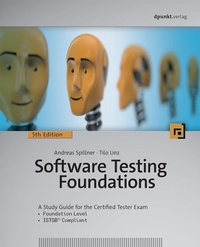
Software Testing Foundations, 5th Edition
Description

Professional testing of software is an essential task that requires a profound knowledge of testing techniques. The International Software Testing Qualifications Board (ISTQB) has developed a universally accepted, international qualification scheme aimed at software and system testing professionals, and has created the Syllabi and Tests for the "Certified Tester." Today, hundreds of thousands of people have taken the ISTQB certification exams.
The authors of Software Testing Foundations, 5th Edition, are among the creators of the Certified Tester Syllabus and are currently active in the ISTQB. This thoroughly revised and updated fifth edition covers the "Foundations Level" (entry level) and teaches the most important methods of software testing. It is designed for self-study and provides the information necessary to pass the Certified Tester-Foundations Level exam, as defined by the ISTQB. Also in this new edition, technical terms have been precisely stated according to the ISTQB glossary.
Topics covered:More details
Other editions
Additional editions
Content
- Cover
- Preface to the 5th Edition
- Foreword by Yaron Tsubery
- Overview
- 1 Introduction
- 2 Software Testing Basics
- 3 Testing Throughout the Software Development Lifecycle
- 4 Static Testing
- 5 Dynamic Testing
- 6 Test Management
- 7 Test Tools
- Appendices
- A Important Notes on the Syllabus and the Certified Tester Exam
- B Glossary
- C References
- Index
- A
- B
- C
- D
- E
- F
- G
- H
- I
- J
- K
- L
- M
- N
- O
- P
- Q
- R
- S
- T
- U
- V
- W
- Contents
- 1 Introduction
- 2 Software Testing Basics
- 2.1 Concepts and Motivations
- 2.1.1 Defect and Fault Terminology
- 2.1.2 Testing Terminology
- 2.1.3 Test Artifacts and the Relationships Between Them
- 2.1.4 Testing Effort
- 2.1.5 Applying Testing Skills Early Ensures Success
- 2.1.6 The Basic Principles of Testing
- 2.2 Software Quality
- 2.2.1 Software Quality according to ISO 25010
- 2.2.2 Quality Management and Quality Assurance
- 2.3 The Testing Process
- 2.3.1 Test Planning
- 2.3.2 Test Monitoring and Control
- 2.3.3 Test Analysis
- 2.3.4 Test Design
- 2.3.5 Test Implementation
- 2.3.6 Test Execution
- 2.3.7 Test Completion
- 2.3.8 Traceability
- 2.3.9 The Influence of Context on the Test Process
- 2.4 The Effects of Human Psychology on Testing
- 2.4.1 How Testers and Developers Think
- 2.5 Summary
- 3 Testing Throughout the Software Development Lifecycle
- 3.1 Sequential Development Models
- 3.1.1 The Waterfall Model
- 3.1.2 The V-Model
- 3.2 Iterative and Incremental Development Models
- 3.3 Software Development in Project and Product Contexts
- 3.4 Testing Levels
- 3.4.1 Component Testing
- 3.4.2 Integration Testing
- 3.4.3 System Testing
- 3.4.4 Acceptance Testing
- 3.5 Test Types
- 3.5.1 Functional Tests
- 3.5.2 Non-Functional Tests
- 3.5.3 Requirements-Based and Structure-Based Testing
- 3.6 Testing New Product Versions
- 3.6.1 Testing Following Software Maintenance
- 3.6.2 Testing Following Release Development
- 3.6.3 Regression Testing
- 3.7 Summary
- 4 Static Testing
- 4.1 What Can We Analyze and Test?
- 4.2 Static Test Techniques
- 4.3 The Review Process
- 4.3.1 Review Process Activities
- 4.3.2 Different Individual Review Techniques
- 4.3.3 Roles and Responsibilities within the Review Process
- 4.4 Types of Review
- 4.5 Critical Factors, Benefits, and Limits
- 4.6 The Differences Between Static and Dynamic Testing
- 4.7 Summary
- 5 Dynamic Testing
- 5.1 Black-Box Test Techniques
- 5.1.1 Equivalence Partitioning
- 5.1.2 Boundary Value Analysis
- 5.1.3 State Transition Testing
- 5.1.4 Decision Table Testing
- 5.1.5 Pair-Wise Testing
- 5.1.6 Use-Case Testing
- 5.1.7 Evaluation of Black-Box Testing
- 5.2 White-Box Test Techniques
- 5.2.1 Statement Testing and Coverage
- 5.2.2 Decision Testing and Coverage
- 5.2.3 Testing Conditions
- 5.2.4 Evaluation of White-Box Testing
- 5.3 Experience-Based Test Techniques
- 5.4 Selecting the Right Technique
- 5.5 Summary
- 6 Test Management
- 6.1 Test Organization
- 6.1.1 Independent Testing
- 6.1.2 Roles, Tasks, and Qualifications
- 6.2 Testing Strategies
- 6.2.1 Test Planning
- 6.2.2 Selecting a Testing Strategy
- 6.2.3 Concrete Strategies
- 6.2.4 Testing and Risk
- 6.2.5 Testing Effort and Costs
- 6.2.6 Estimating Testing Effort
- 6.2.7 The Cost of Testing vs. The Cost of Defects
- 6.3 Test Planning, Control, and Monitoring
- 6.3.1 Test Execution Planning
- 6.3.2 Test Control
- 6.3.3 Test Cycle Monitoring
- 6.3.4 Test Reports
- 6.4 Defect Management
- 6.4.1 Evaluating Test Reports
- 6.4.2 Creating a Defect Report
- 6.4.3 Classifying Failures and Defects
- 6.4.4 Defect Status Tracking
- 6.4.5 Evaluation and Reporting
- 6.5 Configuration Management
- 6.6 Relevant Standards and Norms
- 6.7 Summary
- 7 Test Tools
- 7.1 Types of Test Tools
- 7.1.1 Test Management Tools
- 7.1.2 Test Specification Tools
- 7.1.3 Static Test Tools
- 7.1.4 Tools for Automating Dynamic Tests
- 7.1.5 Load and Performance Testing Tools
- 7.1.6 Tool-Based Support for Other Kinds of Tests
- 7.2 Benefits and Risks of Test Automation
- 7.3 Using Test Tools Effectively
- 7.3.1 Basic Considerations and Principles
- 7.3.2 Tool Selection
- 7.3.3 Pilot Project
- 7.3.4 Success Factors During Rollout and Use
- 7.4 Summary
- Appendices
- A Important Notes on the Syllabus and the Certified Tester Exam
- B Glossary
- C References
- C.1 Literature
- C.2 Norms and Standards
- C.3 URLs
- Index
- A
- B
- C
- D
- E
- F
- G
- H
- I
- J
- K
- L
- M
- N
- O
- P
- Q
- R
- S
- T
- U
- V
- W
