
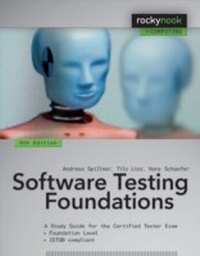
Software Testing Foundations, 4th Edition
Description
Alles über E-Books | Antworten auf Fragen rund um E-Books, Kopierschutz und Dateiformate finden Sie in unserem Info- & Hilfebereich.
Software Testing Foundations, 4th Edition provides the information necessary to pass the Certified Tester-Foundations Level exam, version 2011, as defined by the ISTQB; uses a format designed for self-study; and defines technical terms according to the updated ISTQB glossary.
Professional testing of software is an essential task that requires a profound knowledge of testing techniques. The International Software Testing Qualifications Board (ISTQB) has developed a universally accepted, international qualification scheme aimed at software and system testing professionals, and has created the Syllabi and Tests for the "Certified Tester." Today about 300,000 people have taken the ISTQB certification exams.
The authors of Software Testing Foundations, 4th Edition, are among the creators of the Certified Tester Syllabus and are currently active in the ISTQB. This thoroughly revised and updated fourth edition covers the "Foundations Level" (entry level) and teaches the most important methods of software testing. It is designed for self-study and provides the information necessary to pass the Certified Tester-Foundations Level exam, version 2011, as defined by the ISTQB. Also in this new edition, technical terms have been precisely stated according to the recently revised and updated ISTQB glossary.
Topics covered:
- Fundamentals of Testing
- Testing and the Software Lifecycle
- Static and Dynamic Testing Techniques
- Test Management
- Test Tools
All prices
More details
Other editions
Additional editions
Persons
Andreas Spillner is a professor of Computer Science in the Faculty of Electrical Engineering and Computer Science at the Hochschule Bremen (University of Applied Sciences), where he is responsible for software engineering, quality assurance, and programming. He was a founding member and is now an honorary member of the German Testing Board e.V., and he was founder and chair of the German Special Interest Group on Software Testing (SIGIST, "Test, Analyse und Verifikation von Software") from 1990 to 2003. Prof. Spillner was appointed Fellow of the German Informatics Society (GI-Fellow) in 2007.

System requirements
File format: ePUB
Copy protection: Adobe-DRM (Digital Rights Management)
System requirements:
- Computer (Windows; MacOS X; Linux): Install the free reader Adobe Digital Editions prior to download (see eBook Help).
- Tablet/smartphone (Android; iOS): Install the free app Adobe Digital Editions or the app PocketBook before downloading (see eBook Help).
- E-reader: Bookeen, Kobo, Pocketbook, Sony, Tolino and many more (not Kindle).
The file format ePub works well for novels and non-fiction books – i.e., „flowing” text without complex layout. On an e-reader or smartphone, line and page breaks automatically adjust to fit the small displays.
This eBook uses Adobe-DRM, a „hard” copy protection. If the necessary requirements are not met, unfortunately you will not be able to open the eBook. You will therefore need to prepare your reading hardware before downloading.
Please note: We strongly recommend that you authorise using your personal Adobe ID after installation of any reading software.
For more information, see our ebook Help page.
File format: ePUB
Copy protection: Watermark-DRM (Digital Rights Management)
System requirements:
- Computer (Windows; MacOS X; Linux): Use a reading software that can process the file format ePUB: e.g., Adobe Digital Editions or FBReader – both free (see eBook Help).
- Tablet/Smartphone (Android; iOS): Before downloading, install the free app Adobe Digital Editions (see eBook Help).
- E-reader: Bookeen, Kobo, Pocketbook, Sony, Tolino and many more (not Kindle).
The file format ePUB works well for novels and non-fiction books – i.e., „flowing” text without complex layout. On an e-reader or smartphone, line and page breaks automatically adjust to fit the small displays.
This eBook uses Watermark-DRM, a „soft” copy protection. This means that there are no technical restrictions to prevent illegal distribution. However, there is a personalised watermark embedded in the eBook that can be used to identify the purchaser of the eBook in the event of misuse and to provide evidence for legal purposes.
For more information, see our eBook Help page.