

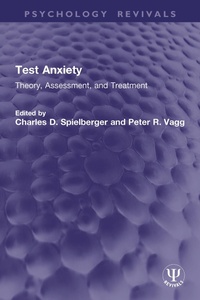
Test Anxiety
Theory, Assessment, and Treatment
Will be published approx. on 3. August 2026
270 pages
978-1-040-97445-2 (ISBN)
Description

In the 1990s test scores were increasingly being used in evaluating applicants for jobs and for admission into educational programs, examination stress and test anxiety had therefore become pervasive problems in modern society. In response, a broad range of treatment programs had been developed to reduce test anxiety, including: biofeedback, desensitization, cognitive behavior modification, rational-emotive therapy, and study skills training.
Originally published in 1995, Test Anxiety: Theory, Assessment and Treatment is divided into four sections presenting a comprehensive theory to promote understanding of the therapeutic impact of specific treatment interventions on test anxiety and academic performance. The chapters in Part I review and evaluate advances in theory and measurement of test anxiety. Antecedents, correlates, and consequences of test anxiety are examined in Part II. Reported next are five treatment studies conducted at the University of South Florida and University of Michigan. The text concludes with a theory-based treatment of test anxiety.
Still prevalent today, this volume can be read in its historical context.
Originally published in 1995, Test Anxiety: Theory, Assessment and Treatment is divided into four sections presenting a comprehensive theory to promote understanding of the therapeutic impact of specific treatment interventions on test anxiety and academic performance. The chapters in Part I review and evaluate advances in theory and measurement of test anxiety. Antecedents, correlates, and consequences of test anxiety are examined in Part II. Reported next are five treatment studies conducted at the University of South Florida and University of Michigan. The text concludes with a theory-based treatment of test anxiety.
Still prevalent today, this volume can be read in its historical context.
Reviews / Votes
Review for the original edition:"The unique contribution of [this book] is that it examines the processes that mediate the effects of interventions on anxiety and performance. ...[It] represents a major step forward in research in this field. This book has made a major contribution to my own thinking, and I am confident that it will be useful to many others - those dealing with the practical problems of helping test-anxious students as well as investigators during research in the area." - W. J. McKeachie, Ann Arbor, Michigan, from the Foreword
More details
Series
Language
English
Place of publication
London
United Kingdom
Publishing group
Taylor & Francis Ltd
Target group
College/higher education
Adult education
File size
22,19 MB
ISBN-13
978-1-040-97445-2 (9781040974452)
Copyright in bibliographic data and cover images is held by Nielsen Book Services Limited or by the publishers or by their respective licensors: all rights reserved.
Schweitzer Classification
Other editions
Additional editions

Book
approx. 08/2026
1st Edition
Routledge
€215.77
Not yet published
Persons
Charles D. Spielberger (1927-2013) was an American clinical community psychologist well-known for his development of the State-Trait Anxiety Inventory.
Peter R. Vagg
Peter R. Vagg
Content
Contributors. Foreword. Preface. Part I: Test Anxiety, Theory, and Measurement 1. Test Anxiety: A Transactional Process Model Charles D. Spielberger and Peter R. Vagg 2. Measurement of Test Anxiety: An Overview Scarvia B. Anderson and William I. Sauser, Jr. 3. An Evaluation of Test Anxiety Scales: Convergent, Divergent, and Predictive Validity Jeffrey R. Bedell and Herbert A. Marlowe 4. Theory and Measurement of Test Anxiety as a Situation-Specific Trait Volker Hodapp, Peter G. Glanzmann and Lothar Laux Part II: Antecedents, Correlates, and Consequences of Test Anxiety 5. Case Studies of Test-Anxious Students William D. Anton and E. Michael Lillibridge 6. Test Anxiety, Hemispheric Lateralization, and Information Processing James D. Papsdorf, Jess H. Ghannam and John Jamieson 7. Perspectives on Mathematics Anxiety and Test Anxiety William D. Anton and Mark C. Klisch 8. Anxiety and Test Performance Samuel Ball Part III: Research on the Treatment of Test Anxiety 9. Systematic Desensitization, Study Skills Counseling, and Anxiety-Coping Training in the Treatment of Test Anxiety Hector P. Gonzalez 10. Cognitive Therapy, Study Counseling, and Systematic Desensitization in the Treatment of Test Anxiety Benjamin Algaze 11. Comparison of Cognitive Therapy and Rational-Emotive Therapy in the Treatment of Test Anxiety Tucker M. Fletcher and Charles D. Spielberger 12. Systematic Desensitization, Cognitive Coping, and Biofeedback in the Reduction of Test Anxiety John C. Parker, IV, Peter Vagg, and James D. Papsdorf 13. Cognitive Therapy, Study Skills Training, and Biofeedback in the Treatment of Test Anxiety Peter R. Vagg and James D. Papsdorf Part IV: Theory-Based Treatment of Test Anxiety 14. Treatment of Test Anxiety: Application of the Transactional Process Model Peter R. Vagg and Charles D. Spielberger. References. Author Index. Subject Index.
