

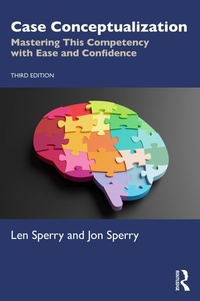
Case Conceptualization
Mastering This Competency with Ease and Confidence
3rd Edition
Published on 13. May 2026
280 pages
978-1-040-52757-3 (ISBN)
Description

Integrating recent research and developments in the field, this revised third edition introduces an easy-to-master strategy for developing and writing culturally sensitive case conceptualizations and treatment plans.
Concrete guidelines and updated case material are provided for developing conceptualizations for the five most common therapy models: biopsychosocial, cognitive-behavioral, time-limited psychodynamic Adlerian, and acceptance and commitment therapy. Chapters also include specific exercises and activities for mastering case conceptualization and related competencies. In this edition the evidence-based 8-P model (presentation, precipitant, predisposition, pattern, perpetuants, protective factors, plan, and predictive factors) is introduced to help streamline and shorten the process of writing case conceptualizations, suitable for use with nearly all clients. The method is clearly illustrated, and the authors provide strategies for learning it. While previous editions of Case Conceptualization have focused primarily on individual counseling and therapy with adults in clinical settings, this new edition extends the use of case conceptualization to children, couples, and families in most clinical, rehabilitation, and addiction counseling settings. It also addresses the use and value of this critical competency in both supervision and consultation, as well as the utilization of artificial intelligence (AI) in conceptualizing cases.
Practitioners, as well as graduate students in counseling, clinical psychology, and social work, will gain the essential skills and knowledge they need to master case conceptualization with ease and confidence.
Concrete guidelines and updated case material are provided for developing conceptualizations for the five most common therapy models: biopsychosocial, cognitive-behavioral, time-limited psychodynamic Adlerian, and acceptance and commitment therapy. Chapters also include specific exercises and activities for mastering case conceptualization and related competencies. In this edition the evidence-based 8-P model (presentation, precipitant, predisposition, pattern, perpetuants, protective factors, plan, and predictive factors) is introduced to help streamline and shorten the process of writing case conceptualizations, suitable for use with nearly all clients. The method is clearly illustrated, and the authors provide strategies for learning it. While previous editions of Case Conceptualization have focused primarily on individual counseling and therapy with adults in clinical settings, this new edition extends the use of case conceptualization to children, couples, and families in most clinical, rehabilitation, and addiction counseling settings. It also addresses the use and value of this critical competency in both supervision and consultation, as well as the utilization of artificial intelligence (AI) in conceptualizing cases.
Practitioners, as well as graduate students in counseling, clinical psychology, and social work, will gain the essential skills and knowledge they need to master case conceptualization with ease and confidence.
Reviews / Votes
"While multiple studies show that clinicians view case conceptualization skills as challenging to acquire...the essential message of this new edition of Case Conceptualization is that developing a sound and useful case conceptualization is readily achievable.... I urge anyone interested in learning case conceptualization or honing their skills in this area to study this book closely."Tracy D. Eells, PhD, University of Louisville; editor of the Handbook of Psychotherapy Case Formulation, 3rd edition
"This excellent resource offers a clear model for case conceptualization that not only addresses accreditation standards for counseling, psychology, and social work programs, but also helps mental health practitioners meet practical challenges of treatment planning. Weaving in different theory-based examples and issues related to AI, rehabilitation counseling, and addictions, this book brings case conceptualization alive."
John Sommers-Flanagan, PhD, University of Montana; co-author of Clinical Interviewing, 7th edition
"An indispensable resource for every clinician, this third edition by Sperry and Sperry masterfully guides readers through the essential process of developing and implementing therapeutic case conceptualizations. With clarity and depth, they illuminate how to tailor conceptualizations to diverse theoretical approaches and real-world clinical cases. This book is a must-have for therapists seeking to bring structure, focus, and intentionality to their work."
Michael D. Reiter, PhD, Capella University; editor of Case Conceptualization in Couple Therapy
More details
Edition
3rd edition
Language
English
Place of publication
London
United Kingdom
Publishing group
Taylor & Francis Ltd
Target group
Professional and scholarly
College/higher education
Illustrations
50 Tables, black and white; 3 Line drawings, black and white; 3 Illustrations, black and white
File size
4,17 MB
ISBN-13
978-1-040-52757-3 (9781040527573)
Copyright in bibliographic data and cover images is held by Nielsen Book Services Limited or by the publishers or by their respective licensors: all rights reserved.
Schweitzer Classification
Other editions
Additional editions

Book
05/2026
3rd Edition
Routledge
€222.84
Shipment within 10-20 days
Book
05/2026
3rd Edition
Routledge
€37.50
Shipment within 10-20 days
Persons
Len Sperry, MD, PhD, is a professor at Florida Atlantic University and the Medical College of Wisconsin, USA. He has pioneered research on case conceptualization for 45 years and his team has completed six studies on it.
Jon Sperry, PhD, is a professor at Lynn University, USA. He teaches, writes, and researches case conceptualization, and conducts workshops on it worldwide.
Jon Sperry, PhD, is a professor at Lynn University, USA. He teaches, writes, and researches case conceptualization, and conducts workshops on it worldwide.
Content
PART I: Dimensions of Case Conceptualization
1. Case Conceptualization: An Overview
2. Assessment and the Diagnostic Formulation
3. Explanations and Clinical and Cultural Formulations
4. Treatment Planning and Treatment Formulations
PART II: Case Conceptualization: Theoretical Approaches
5. Biopsychosocial Case Conceptualizations
6. Cognitive Behavioral Case Conceptualizations
7. Time-Limited Dynamic Case Conceptualizations
8. Adlerian Case Conceptualizations
9. Acceptance and Commitment Therapy Case Conceptualizations
PART III: Specific Applications of Case Conceptualizations
10. Case Conceptualizations in Treating Children, Couples, and Families
11. Case Conceptualization in Rehabilitation and Addictions Counseling
12. Case Conceptualization in Supervision and Consultation
1. Case Conceptualization: An Overview
2. Assessment and the Diagnostic Formulation
3. Explanations and Clinical and Cultural Formulations
4. Treatment Planning and Treatment Formulations
PART II: Case Conceptualization: Theoretical Approaches
5. Biopsychosocial Case Conceptualizations
6. Cognitive Behavioral Case Conceptualizations
7. Time-Limited Dynamic Case Conceptualizations
8. Adlerian Case Conceptualizations
9. Acceptance and Commitment Therapy Case Conceptualizations
PART III: Specific Applications of Case Conceptualizations
10. Case Conceptualizations in Treating Children, Couples, and Families
11. Case Conceptualization in Rehabilitation and Addictions Counseling
12. Case Conceptualization in Supervision and Consultation
