

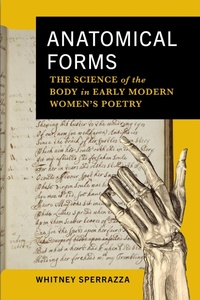
Anatomical Forms
Description

Demonstrates how early modern women writers such as Margaret Cavendish and Hester Pulter wielded poetics as a tool for scientific work
Anatomical Forms excavates the shared material practices of women's poetic work and anatomical study in early modern England. Asserting that poetry is a dimensional technology, Whitney Sperrazza demonstrates how women writers wielded poetics as a tool for scientific work in order to explore and challenge rapid developments in anatomy and physiology.
In the sixteenth and seventeenth centuries, anatomists were actively exploring the best ways to represent bodies in texts-to translate the work of the dissection room into the pages of books. When we recognize Renaissance anatomy as fundamentally a book-making project, Sperrazza insists, we find a complex and expansive history of anatomy in the pages of women's poetry. Women poets have long been absent from histories of literature and science, but by shifting our focus from content to form, Sperrazza reveals complex engagements with questions on corpse preservation, dissection, obstetrics and gynecology, and skin theory in the poetry of Margaret Cavendish, Aemilia Lanyer, Mary Wroth, Mary Sidney Herbert, and Hester Pulter.
Through close formal analysis and original research on early modern anatomy treatises, Anatomical Forms weaves together critical conversations in poetics, book history, the history of science, and women's writing. Sperrazza challenges her readers to imagine science differently-to understand that science might not always look like we expect it to look-and, in the process, brings into focus a feminist history of poetic form centered on material practice.
More details
Person
Content
- Cover
- Series Page
- Title Page
- Copyright
- Contents
- Note on Transcriptions and Citations
- Introduction
- Chapter 1. Paper Bodies: Anatomical Flapbooks and Margaret Cavendish's Dimensional Forms
- Chapter 2. Postmortem Poetics: Mary Sidney Herbert's Studies in Death, Dying, and Loss
- Chapter 3. Blank Matter: Copperplate Engraving, Paper Skins, and Mary Wroth's Anatomical Poetics
- Chapter 4. Writing the Womb: Aemilia Lanyer on the Secrets of Women
- Chapter 5. Situated Knowledges: Hester Pulter's Manuscript Laboratory and Our Archives of Scientific Forms
- New Histories of Literature and Science (A Coda)
- Notes
- Index
- Acknowledgments
