

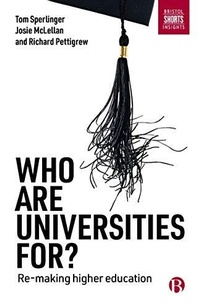
Who are Universities For?
Re-making Higher Education
1st Edition
Published on 11. September 2018
200 pages
978-1-5292-0040-9 (ISBN)
Description

The university system is no longer fit for purpose. UK higher education was designed for much smaller numbers of students and a very different labour market. Students display worrying levels of mental health issues, exacerbated by unprecedented levels of debt, and the dubious privilege of competing for poorly-paid graduate internships. Meanwhile who goes to university is still too often determined by place of birth, gender, class or ethnicity.
Who are universities for? argues for a large-scale shake up of how we organise higher education, how we combine it with work, and how it fits into our lives. It includes radical proposals for reform of the curriculum and how we admit students to higher education, with part-time study (currently in crisis in England) becoming the norm.
A short, polemical but also deeply practical book, Who are universities for? offers concrete solutions to the problems facing UK higher education and a way forward for universities to become more inclusive and more responsive to local and global challenges.
Who are universities for? argues for a large-scale shake up of how we organise higher education, how we combine it with work, and how it fits into our lives. It includes radical proposals for reform of the curriculum and how we admit students to higher education, with part-time study (currently in crisis in England) becoming the norm.
A short, polemical but also deeply practical book, Who are universities for? offers concrete solutions to the problems facing UK higher education and a way forward for universities to become more inclusive and more responsive to local and global challenges.
Reviews / Votes
"A groundbreaking plan for overhauling the universities system... [a] radical blueprint-making even the dreaming spires of Oxbridge [into] Open Universities", The Social Review "An important book that brims with ideas for transforming HE for a diverse, inclusive, post-disciplinary world. Refreshingly radical." Tim Blackman, VC, Middlesex University "A groundbreaking plan for overhauling the universities system... [a] radical blueprint-making even the dreaming spires of Oxbridge [into] Open Universities." Social Review "Urgent, radical and prescriptive, this polemic provides a radical manifesto for Higher Education in the era of the millennials. In the wake of student debt, a lack of social mobility and excess at the top, it breaks open the sterile complacency that has for too long gone unchallenged." David Lammy, MP "This powerful, accessible and passionate book highlights the way current HE excludes and disadvantages, and proposes an inclusive system design fit for part-time as well as full-time study. Fascinating and persuasive." Professor Sir Alan Tuckett, University of WolverhamptonMore details
Edition
First Edition
Language
English
Place of publication
Bristol
United Kingdom
Target group
Professional and scholarly
Illustrations
1 s/w Abbildung, 1 s/w Tabelle
1 Tables, black and white; 1 Illustrations, black and white
File size
0,45 MB
ISBN-13
978-1-5292-0040-9 (9781529200409)
Copyright in bibliographic data and cover images is held by Nielsen Book Services Limited or by the publishers or by their respective licensors: all rights reserved.
Schweitzer Classification
Other editions
Additional editions

Tom Sperlinger | Josie McLellan | Richard Pettigrew
Who are Universities For?
Re-making Higher Education
Book
09/2018
1st Edition
Bristol University Press
€23.20
Shipment within 3-4 weeks
Persons
Josie McLellan is Professor of History at the University of Bristol. She is a social and cultural historian, with particular research interests in public history and the co-production of research with people outside the university. She was a course director for the Foundation Year in Arts and Humanities, an alternative route into higher education from when the programme started in 2013 to 2017.
Richard Pettigrew is Professor of Philosophy at the University of Bristol, with particular interests in formal epistemology and the philosophy of mathematics. He set up the Foundation Year in Arts and Humanities. He has worked, outside the university, on projects addressing literacy in prisons and supporting adults with learning disabilities.
Tom Sperlinger is Professor of Literature and Engaged Pedagogy at the University of Bristol, where he is currently working with the Widening Participation team to introduce flexible opportunities for adult learners across the arts, sciences and social sciences. He set up the part-time BA in English Literature and Community Engagement and the Foundation Year in Arts and Humanities.
Richard Pettigrew is Professor of Philosophy at the University of Bristol, with particular interests in formal epistemology and the philosophy of mathematics. He set up the Foundation Year in Arts and Humanities. He has worked, outside the university, on projects addressing literacy in prisons and supporting adults with learning disabilities.
Tom Sperlinger is Professor of Literature and Engaged Pedagogy at the University of Bristol, where he is currently working with the Widening Participation team to introduce flexible opportunities for adult learners across the arts, sciences and social sciences. He set up the part-time BA in English Literature and Community Engagement and the Foundation Year in Arts and Humanities.
Content
Introduction: Who are universities for?
Towards a university for everyone: some proposals
Invisible crises: the state of universities in the UK
'It's not for me': outsiders in the system
Education and the shape of a life
False negatives: on admissions
The women in Plato's Academy
Where do the questions come from?
Conclusion: The university-without-walls
Towards a university for everyone: some proposals
Invisible crises: the state of universities in the UK
'It's not for me': outsiders in the system
Education and the shape of a life
False negatives: on admissions
The women in Plato's Academy
Where do the questions come from?
Conclusion: The university-without-walls
