

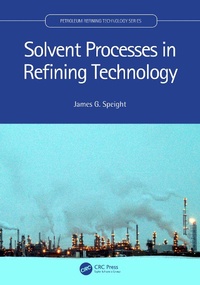
Solvent Processes in Refining Technology
1st Edition
Published on 12. December 2023
270 pages
978-1-003-81071-1 (ISBN)
Description

This book focuses on the various solvent processes that are used in crude oil refineries. It presents the differences between each type of process and discusses the types of feedstock that can be used for the processes. This accessible guide is written for managers, professionals, and technicians as well as graduate students transitioning into the refining industry.
Key Features:
Describes the various steps that are necessary for the solvent treatment of various feedstocks in crude oil refineries
Brings the reader up to date and adds more data
Provides an extensive glossary
Considers next-generation processes and developments
Key Features:
Describes the various steps that are necessary for the solvent treatment of various feedstocks in crude oil refineries
Brings the reader up to date and adds more data
Provides an extensive glossary
Considers next-generation processes and developments
More details
Series
Edition
1. Auflage
Language
English
Place of publication
London
United Kingdom
Publishing group
Taylor & Francis Ebooks
Target group
Professional and scholarly
Illustrations
37 Tables, black and white; 3 Line drawings, color; 36 Line drawings, black and white; 3 Illustrations, color; 36 Illustrations, black and white
ISBN-13
978-1-003-81071-1 (9781003810711)
Copyright in bibliographic data and cover images is held by Nielsen Book Services Limited or by the publishers or by their respective licensors: all rights reserved.
Schweitzer Classification
Other editions
Additional editions
James G. Speight
Solvent Processes in Refining Technology
Book
approx. 06/2026
1st Edition
CRC Press
€69.00
Not yet published
James G. Speight
Solvent Processes in Refining Technology
Book
12/2023
1st Edition
CRC Press
€270.80
Shipment within 10-20 days
Person
James G. Speight, Consultant, CD&W Inc., Laramie. WY
Dr. James G. Speight has a BSc and PhD in Chemistry; he also holds a DSc in Geological Sciences and a PhD in Petroleum Engineering. He has more than fifty years of experience in areas associated with (1) the properties, recovery, and refining of conventional petroleum, heavy oil, and tar sand bitumen, (2) the properties and refining of natural gas, and (3) the properties and refining of biomass, biofuels, biogas, and the generation of bioenergy. His work has also focused on environmental effects, environmental remediation, and safety issues associated with the production and use of fuels and biofuels. He is the author (and co-author) of more than 100 books related to petroleum science, petroleum engineering, biomass and biofuels, and environmental sciences.
Although he has always worked in private industry and has focused on contract-based work, Dr. Speight has served as a Visiting Professor in the College of Science, University of Mosul (Iraq), Visiting Professor in Chemical Engineering at the Technical University of Denmark, and the University of Trinidad and Tobago as well as adjunct appointments at various universities. He has also served as a thesis examiner for more than 25 theses.
As a result of his work, Dr. Speight has been honored as the recipient of the following awards: (1) Diploma of Honor, United States National Petroleum Engineering Society for Outstanding Contributions to the Petroleum Industry, 1995; (2) Gold Medal of the Russian Academy of Sciences for Outstanding Work in the Area of Petroleum Science. 1996; (3) Einstein Medal of the Russian Academy of Sciences In recognition of Outstanding Contributions and Service in the field of Geologic Sciences, 2001; (4) Gold Medal - Scientists without Frontiers, Russian Academy of Sciences In recognition of His Continuous Encouragement of Scientists to Work Together across International Borders, 2005; (5) Gold Medal - Giants of Science and Engineering, Russian Academy of Sciences. In recognition of Continued Excellence in Science and Engineering, 2006; (6) Methanex Distinguished Professor, University of Trinidad and Tobago In Recognition of Excellence in Research. 2007; and (7) The American Excellence Award for Excellence in Client Solutions from the United States Institute of Trade and Commerce, Washington, DC, 2018.
Dr. James G. Speight has a BSc and PhD in Chemistry; he also holds a DSc in Geological Sciences and a PhD in Petroleum Engineering. He has more than fifty years of experience in areas associated with (1) the properties, recovery, and refining of conventional petroleum, heavy oil, and tar sand bitumen, (2) the properties and refining of natural gas, and (3) the properties and refining of biomass, biofuels, biogas, and the generation of bioenergy. His work has also focused on environmental effects, environmental remediation, and safety issues associated with the production and use of fuels and biofuels. He is the author (and co-author) of more than 100 books related to petroleum science, petroleum engineering, biomass and biofuels, and environmental sciences.
Although he has always worked in private industry and has focused on contract-based work, Dr. Speight has served as a Visiting Professor in the College of Science, University of Mosul (Iraq), Visiting Professor in Chemical Engineering at the Technical University of Denmark, and the University of Trinidad and Tobago as well as adjunct appointments at various universities. He has also served as a thesis examiner for more than 25 theses.
As a result of his work, Dr. Speight has been honored as the recipient of the following awards: (1) Diploma of Honor, United States National Petroleum Engineering Society for Outstanding Contributions to the Petroleum Industry, 1995; (2) Gold Medal of the Russian Academy of Sciences for Outstanding Work in the Area of Petroleum Science. 1996; (3) Einstein Medal of the Russian Academy of Sciences In recognition of Outstanding Contributions and Service in the field of Geologic Sciences, 2001; (4) Gold Medal - Scientists without Frontiers, Russian Academy of Sciences In recognition of His Continuous Encouragement of Scientists to Work Together across International Borders, 2005; (5) Gold Medal - Giants of Science and Engineering, Russian Academy of Sciences. In recognition of Continued Excellence in Science and Engineering, 2006; (6) Methanex Distinguished Professor, University of Trinidad and Tobago In Recognition of Excellence in Research. 2007; and (7) The American Excellence Award for Excellence in Client Solutions from the United States Institute of Trade and Commerce, Washington, DC, 2018.
Content
Preface. Feedstock Evaluation. Introduction. Assay. Composition. Elemental Composition. Chemical Composition. Hydrocarbon Constituents. Non-Hydrocarbon Constituents. Molecular Weight. Use of the Data. References. The Deasphalting Process. Introduction. The Deasphalting Process. General Chemistry. General Operation. Commercial Deasphalting Processes. Process Design. Process Variables. Options for Heavy Feedstocks. Ancillary Operations. The Dewaxing Process. General Chemistry. General Operation. Commercial Dewaxing Processes. Process Design. Process Variables. Influence of Feedstock. Ancillary Operations. The Future. Deasphalting. Dewaxing. References. Conversion Factors and SI Units. Glossary. Index.
