

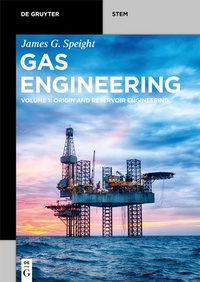
Gas Engineering
Description

Volume 1 deals with the origins of process gases and describes recovery, properties and composition. It covers as well the shale gas, the production from hydrocarbon rich deep shale formations, being one of the most quickly expanding trends in onshore domestic gas exploration.
Vol. 2: Composition and Processing of Gas Streams.
Vol. 3: Uses of Gas and Effects.
More details
Other editions
Additional editions
Person
Dr. James G. Speight (Larami, USA) has doctorate degrees in Chemistry, Geological Sciences, and Petroleum Engineering and is the author of more than 95 books in science, engineering, biosciences, and environmental sciences as well as books relating to ethics and ethical issues.
Dr. Speight's work has also focused on safety issues, environmental effects, remediation, reactors associated with the production and use of fuels and biofuels, process economics, as well as ethics in science and engineering and in ethic in the universities.
In 1996, Dr. Speight was elected to the Russian Academy of Sciences and awarded the Gold Medal of Honor that same year for outstanding contributions to the field of petroleum sciences. In 2001, he received the Scientists without Borders Medal of Honor of the Russian Academy of Sciences and was also awarded the Einstein Medal for outstanding contributions and service in the field of Geological Sciences. In 2005, the Academy awarded Dr. Speight the Gold Medal - Scientists without Frontiers , Russian Academy of Sciences, in recognition of Continuous Encouragement of Scientists to Work Together Across International Borders. In 2007 Dr. Speight received the Methanex Distinguished Professor award at the University of Trinidad and Tobago in recognition of excellence in research. In 2018 he was awarded the American Excellence Award for Excellence in Client Solutions , United States Institute of Trade and Commerce. Washington, DC.
JamesSp8@aol.com
https://www.drjamespeight.com
Content
- Intro
- Preface
- Contents
- Chapter 1 History and background
- Chapter 2 Reservoir fluids and reservoirs
- Chapter 3 Reservoir engineering
- Chapter 4 Production engineering
- Chapter 5 Field operations
- Chapter 6 Production
- Chapter 7 The environment
- Conversion factors and constants
- Glossary
- Appendix A Unconventional gas resources
- Appendix B Illustration of the terms used to describe the resources and reserves of natural gas
- Appendix C Properties of natural gas
- Appendix D Gas cleaning processes
- Appendix E Examples of ASTM test methods for natural gas and gas condensate
- Appendix F Examples of the gas processors association test methods for natural gas
- About the author
- Index
