

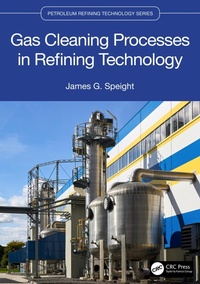
Gas Cleaning Processes in Refining Technology
1st Edition
Published on 26. November 2024
278 pages
978-1-040-25835-4 (ISBN)
Description

This book focuses on the various refinery processes that are used for gas cleaning operations. By understanding the use of gas cleaning processes, this book will satisfy the needs of engineers and scientists at all levels from academia to the refinery and help them understand the initial various processes. This accessible guide is written for managers, professionals, and technicians as well as graduate students transitioning into the refining industry.
Key Features:
Describes gas streams produced in a crude oil refinery and from non-refinery feedstocks.
Covers gas condensate, gas from biomass, waste and landfill waste, and details categorization by types of contaminants and by removal method.
Provides an extensive glossary.
Discusses the future of gas cleaning operations and the evolution of the industry.
This series of eight books is designed to present descriptions of (1) the development of technologies for a variety of feedstocks (including the viscous feedstocks which are often referred to as heavy feedstocks) utilizing advanced pre-treatment processing and hydrotreating, (2) an analysis of the catalyst deactivation mechanism for developing optimum technologies for processing feedstocks with low reactivity, (3) the development of advanced technologies applicable to the viscous feedstocks, (4) the development of advanced hydrocracking processes for heavy feedstock upgrading, (5) the development of innovative upgrading processes for the viscous feedstocks, and (6) the role of biomass in the future refinery. Furthermore, each book is a stand-alone volume that will bring the reader further up to date and adds more data as well as processing options that may be the processes of the evolving twenty-first century. As the eighth book in the series, this book will focus on the various refinery processes that are used for gas cleaning operations.
The target audience includes engineers, scientists, and students who want an update on crude oil processing and the direction of the industry in the next 50 years. Such personnel include (1) professionals in the refining industry, (2) technicians in the refining industry, (3) industry management personnel who need to understand the various processes and the role of these process in producing the desired feedstocks for further processing and the use of solvents to produce saleable products, and (4) the academic staff and graduate students who are moving into the refining industry. Any non-technical readers, with help from the extensive glossary, will also benefit from the series.
Key Features:
Describes gas streams produced in a crude oil refinery and from non-refinery feedstocks.
Covers gas condensate, gas from biomass, waste and landfill waste, and details categorization by types of contaminants and by removal method.
Provides an extensive glossary.
Discusses the future of gas cleaning operations and the evolution of the industry.
This series of eight books is designed to present descriptions of (1) the development of technologies for a variety of feedstocks (including the viscous feedstocks which are often referred to as heavy feedstocks) utilizing advanced pre-treatment processing and hydrotreating, (2) an analysis of the catalyst deactivation mechanism for developing optimum technologies for processing feedstocks with low reactivity, (3) the development of advanced technologies applicable to the viscous feedstocks, (4) the development of advanced hydrocracking processes for heavy feedstock upgrading, (5) the development of innovative upgrading processes for the viscous feedstocks, and (6) the role of biomass in the future refinery. Furthermore, each book is a stand-alone volume that will bring the reader further up to date and adds more data as well as processing options that may be the processes of the evolving twenty-first century. As the eighth book in the series, this book will focus on the various refinery processes that are used for gas cleaning operations.
The target audience includes engineers, scientists, and students who want an update on crude oil processing and the direction of the industry in the next 50 years. Such personnel include (1) professionals in the refining industry, (2) technicians in the refining industry, (3) industry management personnel who need to understand the various processes and the role of these process in producing the desired feedstocks for further processing and the use of solvents to produce saleable products, and (4) the academic staff and graduate students who are moving into the refining industry. Any non-technical readers, with help from the extensive glossary, will also benefit from the series.
More details
Series
Edition
1. Auflage
Language
English
Place of publication
London
United Kingdom
Publishing group
Taylor & Francis Ltd
Target group
Professional and scholarly
Illustrations
37 Tables, black and white; 39 Line drawings, black and white; 39 Illustrations, black and white
File size
6,93 MB
ISBN-13
978-1-040-25835-4 (9781040258354)
Copyright in bibliographic data and cover images is held by Nielsen Book Services Limited or by the publishers or by their respective licensors: all rights reserved.
Schweitzer Classification
Other editions
Additional editions
James G. Speight
Gas Cleaning Processes in Refining Technology
Book
approx. 07/2026
1st Edition
CRC Press
€66.00
Not yet published
James G. Speight
Gas Cleaning Processes in Refining Technology
Book
11/2024
1st Edition
CRC Press
€250.60
Shipment within 10-20 days
Person
Dr. James G.Speight has a BSc and PhD in Chemistry; he also holds a DSc in Geological Sciences and a PhD in Petroleum Engineering. He has more than fifty years of experience in areas associated with (1) the properties, recovery, and refining of conventional petroleum, heavy oil, and tar sand bitumen, (2) the properties and refining of natural gas, and (3) the properties and refining of biomass, biofuels, biogas, and the generation of bioenergy. His work has also focused on environmental effects, environmental remediation, and safety issues associated with the production and use of fuels and biofuels. He is the author (and co-author) of more than 100 books related to petroleum science, petroleum engineering, gas processing, gas engineering, as well as biomass and biofuels, and environmental sciences.
Content
Chapter 1 Gas Streams Produced in a Crude Oil Refinery
Chapter 2 Non-Refinery Gas Streams
Chapter 3 Gas Condensate
Chapter 4 Gas from Biomass
Chapter 5 Gas from Waste and Landfill Waste
Chapter 6 Gas Cleaning-Categorization by Types of Contaminants
Chapter 7 Gas Cleaning Processes-Categorization by Removal Method
Chapter 8 The Future of Gas Cleaning Operations
Glossary
Conversion Factors
Index
Chapter 2 Non-Refinery Gas Streams
Chapter 3 Gas Condensate
Chapter 4 Gas from Biomass
Chapter 5 Gas from Waste and Landfill Waste
Chapter 6 Gas Cleaning-Categorization by Types of Contaminants
Chapter 7 Gas Cleaning Processes-Categorization by Removal Method
Chapter 8 The Future of Gas Cleaning Operations
Glossary
Conversion Factors
Index
